Acquisition Policy
The Art Gallery of Hamilton has in place guidelines and policies surrounding the acquisition of artwork into the permanent collection.
NOTICE: Please know that we have placed offers of donation to the collection on hold as we undertake a comprehensive collection review. We are happy to discuss your offer with a view to future acquisition.
In regard to works that are donated to the collection by private citizens, companies or corporations, the timeline of events is as follows:
Offer
The donor approaches curatorial staff of the AGH with their proposed work. This is normally carried out in the form of a written offer of donation, complete with particulars for the piece, as well as a visual document.
Please note that donation offers submitted after October 31 of the calendar year will not be considered or processed until the following calendar year.
Curatorial Consideration
The Curators, in consultation with one another, as well as the President and CEO, internally consider the merit of the work and its relevance to the institutional mandate, Collection Policy and to the existing permanent collection. Should the work be deemed an appropriate fit for the collection, the Curators decide to present it to the Acquisition Committee (Historical and Contemporary). If the work is not deemed a proper fit contextually, the Curator then contacts the donor and the work is respectfully declined.
Acquisition Meeting
As noted above, the Curator presents the proposed donation to the Acquisition Committee, with the work on-site if feasible. The Committee votes as to the acceptance of the work into the permanent collection.
Cost
All costs associated with completing the donation, including appraisal fees, photography and transportation are to be borne by the donor in exchange for a tax receipt. This must be communicated to each prospective donor at the onset by the Curator, and will be administrated by the Collections Manager/Research, and the Manager, Finance and Administration.
(The AGH respectfully requests reimbursements for costs incurred before applying for Canadian Cultural Property Export Review Board [CCPERB] certification on behalf of the donor.)
Gifting
Upon receiving notification that their donation has been accepted into the collection, the donor has two options with which to proceed for the gifting process:
- Charitable Tax Receipt
- Canadian Cultural Property Export Review Board certification (T871)
The course of action for a charitable tax receipt is as follows. As this receipt is issued in-house, it is the more expedient of the two options.
If the donor has owned the work for more than three years prior to the offer the process is as follows. The AGH obtains a fair market evaluation for the object from an accredited appraiser (if the value of the object is greater than $50,000, two appraisals must be sought). The Gallery provides the appraiser with the information needed to complete an evaluation, including a photograph, condition report, provenance and exhibition history of the work.
The donor then learns of the value assigned by the appraiser from the Curator or Collections Manager/Research. Should the value arrived at be acceptable to all parties involved, the Collections Manager/Research then issues deeds of gift to the donor in duplicate to sign, thereby transferring legal ownership of the work to the AGH. A tax receipt for the value of the appraisal, signed by the President and CEO, is then issued to the donor and the transaction is complete.
If the donor has owned the work for three years or less, the process has been amended as of December 5th, 2003, and is no longer the same as above. A gift that fits this criteria will be valued at either its cost (the donor must provide appropriate invoices) OR it’s fair market value – whichever value is lower. The new provisions are in place to eliminate the possibility of a donor receiving a tax credit for an amount that exceeds his or her out-of-pocket cost.
(Should the donor decide that the assigned value is unacceptable, he/she reserves the right to request another appraisal to be carried out, but must also bear the cost of this new appraisal. Should the Curator feel strongly that the initial appraisal is indeed an accurate reflection of the current market, he/she will advise the donor to that effect. Should the donor remain dissatisfied, with either the new appraisal or the Curator’s support of the initial appraisal, and wishes that the work be returned, this will be done at the donor’s expense. The donor will also reimburse the AGH for all costs related to the appraisal process.)
The Canadian Cultural Property Export Review Board certification (T871), is the second option available to donors. As this certification exempts the donor from paying any applicable capital gains tax, the process is slightly lengthier as the Review Board requires detailed information for not only the work, but also the means by which it was acquired by the donor. The Review Board meets four times a year, putting each application through a rigorous examination.
The steps taken are essentially the same as outlined above to the acceptance of the appraisal(s). At this stage, the AGH begins preparation of the application for the next possible meeting of the Review Board. The donor decides whether they would like the work reviewed as a proposed donation or an irrevocable donation.
The application for a proposed donation includes the following:
- A written justification arguing for the work’s importance and its being of outstanding significance
- Full provenance and exhibition history
- Certificate of authenticity
- Justified appraisal(s)
- Comprehensive condition report
- Digital Photo-documentation
On this application, the work is considered at the next meeting of the Review Board for which the AGH can meet the deadline. Should the work be accepted at the value submitted, the Collections Manager/Research then issues deeds of gift to the donor in duplicate to sign, thereby transferring legal ownership of the work to the AGH. The AGH in turn submits a copy of the signed deed of gift to the Board, who then issues a T871 certification form featuring the current date, to the donor. The AGH then forwards a tax receipt to the donor as well to complete the transaction.
Should the Board contest or reassign the value at which the work was submitted, they reserve the right to solicit another appraisal, which they will consider against those submitted by the AGH. This will take place at the following meeting of the Review Board. The AGH, on behalf of the donor, is permitted to request one redetermination on the part of the Board, and is encouraged to tender additional information in support of the initially submitted value. Should the request for redetermination be unsuccessful the donor will consult with the Curator as to the status of their donation. Should the donor choose to withdraw the offer of donation from the Gallery they will be invoiced for the cost of the appraisal(s) solicited, as well as any shipping costs incurred by the return of the work. Should the redetermination prove successful, the Collections Manager/Research then issues deeds of gift to the donor in duplicate to sign, thereby transferring legal ownership of the work to the AGH. The AGH in turn submits a copy of the signed deed of gift to the Board, who then issues a T871 certification form featuring the current date, to the donor. The AGH then forwards a tax receipt to the donor as well to complete the transaction.
The application for an irrevocable donation includes the following:
- A written justification arguing for the work’s importance and its being of outstanding significance and national importance
- Full provenance and exhibition history
- Certificate of authenticity
- Justified appraisal(s)
- Comprehensive condition report
- Digital Photo-documentation
- A signed copy of the deed of gift bearing the date of donation
For this application as well, the work is considered at the next meeting of the Review Board for which the AGH can meet the deadline. Should the work be accepted at the value submitted, the Review Board then issues a T871 certification form featuring the date noted on the deed of gift, to the donor. The AGH then forwards a tax receipt to the donor as well to complete the transaction.
Should the Board reassign the value at which the work was submitted, they will issue the T871 certification to the donor in the amount that they have deemed appropriate featuring the date noted on the deed of gift. They will note that the donor can request a redetermination of the part of the Board in regard to the fair market value of the cultural property. Again, the Board will only grant one redetermination per object.
Should the redetermination prove successful, the Board then issues a T871 certification form featuring the date noted on the deed of gift, to the donor. The AGH then forwards a tax receipt to the donor as well to complete the transaction.
Should the request for redetermination be unsuccessful the donor will consult with the Curator as to the status of their donation. As the Board is aware that the donor has made an irrevocable offer to the institution, the donor cannot request the return of the work if dissatisfied, and must accept the Board’s reassignment of fair market value. The Board then issues a T871 certification form featuring the date noted on the deed of gift, to the donor. The AGH then forwards a tax receipt to the donor as well to complete the transaction.
The major difference between a proposed donation and an irrevocable donation is important to note here, especially for year-end donations. Certification and issuance of a tax receipt for a proposed gift cannot be guaranteed as taking place in the same year as the work was accepted into the collection. While every effort is made on the part of the AGH to meet the closest CCPERB deadline, the Board usually holds the last meeting of the year in mid to late November and the deadline for this meeting is the beginning of October. Therefore, works accepted by the AGH Acquisition Committee into the collection after the beginning of October will not be considered by the Review Board until the following year. Any proposed gifts, as such, will be considered and consequently certified in the new fiscal year. For example, a proposed donation accepted by the Acquisition Committee in December of 2016, and considered by the Review Board at a meeting in March of 2017, will be certified and processed as a donation for the tax year 2017.
On the other hand, an irrevocable donation will always be considered and certified by the date noted on the signed and submitted deed of gift. Therefore, a Review Board meeting taking place in a new year will not alter the fiscal year at which the donation is considered; these donations will be considered as the year in which they were accepted into the collection.
Notes:
- For detailed information and advice on capital gains or other tax related issues, please consult a tax accountant directly.
- The donation procedure can be a lengthy process and can take up to a year from the proposal to the issuance of a tax receipt. Therefore, it is advisable to consider any donations as early in the year as possible.
- The donor is kept up to date at every stage of the gifting process by the Collections Manager/Research.
Updated March 2016
From the Contemporary Art Collection
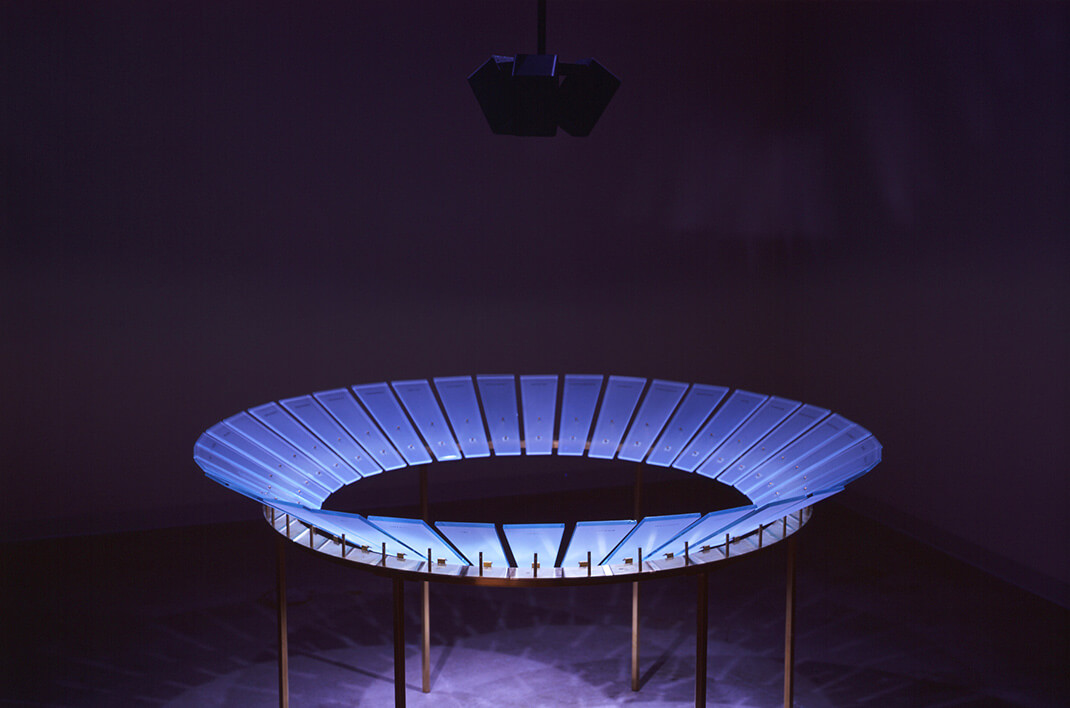
Roulette 1993-2005
Barbara Steinman (Canadian b. 1950)
sound sculpture; brass, etched glass, audio, Gift of the artist, 2010
© Courtesy Barbara Steinman