Exhibition Archive (>2016)
Exhibitions
Exhibition Archive (>2016)
A chronological listing of the exhibitions held at the Art Gallery of Hamilton since 1923.
2010s
2016
February 20 – May 8
1920s Modernism in Montreal: The Beaver Hall Group
They were bold and experimental and at the forefront of modern painting in Canada in the 1920s. And they were not the Group of Seven.
The painters associated with Montreal’s Beaver Hall Group (so named for the location where they shared studio and exhibition space) were among Canada’s most avant-garde artists of their day and yet until now their contribution as an association has yet to be fully researched and presented.
The Montreal Museum of Fine Arts has righted the situation and organized the first major exhibition to shed new light on this pivotal association of artists. In essence, the Beaver Hall Group was to Montreal what the Group of Seven was to Toronto. But rather than offering an image of Canada’s identity through the depiction of untamed landscapes, they showed their attachment to the portrait and to humanized cityscapes and landscapes.
The exhibition levels the art historical playing field. In locating the activities of this Montreal group in a national context, we are given a broader view of the artistic landscape in Quebec, Ontario and indeed Canada. This is particularly important as the Beaver Hall Group has always, in part, been characterized by its female membership. As the first association of its kind in Canada to bring together professional women artists, it provided both a community and public forum for their activities and the development of their practices, another sign of the Group’s progressive, modern nature.
Don’t miss the opportunity to see newly discovered paintings as well as masterworks by such modern greats as Edwin Holgate, Anne Savage, Sarah Robertson, Prudence Heward, and A.Y. Jackson. Many are a revelation.
The exhibition is curated by Jacques Des Rochers, Curator of Quebec and Canadian Art (before 1945) at the MMFA, and Brian Foss, Director, School for Studies in Art and Culture, Carleton University, Ottawa.
February 6 – May 15
Fearful Symmetry: The Art of John Scott
Organized by Faulconer Gallery at Grinnell College, Iowa. Curated by Daniel Strong.
Fearful Symmetry: The Art of John Scott will include 28 works on paper in a vast installation in the AGH’s largest rooms reserved for contemporary art exhibitions.
Born and raised in Windsor, a child of the North American working class and of the 1960s, activism has never subsided in John Scott’s work. His imagination has been fed by science fiction, the Space Age and Motor City manufacturing might and blight. Sympathy for the worker as a human tool in the global industrial complex pervades what some have called his apocalyptic vision.
Viewers may be familiar with Scott’s consistent and eerily prescient style in his works on paper, plotting intersections of humanity and technology, religious fervor and military might, utopian visions and dystopian outcomes. His articulation of these themes through sculpture may be less familiar, and this poignant material aspect of his practice will serve to generate new readings of his four-decade-long practice.
We are thrilled to be featuring his work Trans AM Apocalypse No. 3, (1998-2000), an actual car, which the artist painted matte, incising on the surface words from the Book of Revelation that refer to the apocalypse. This work is on loan from the Art Gallery of Ontario, who are partnering with us to perform some necessary conservation to the surface of the car during the exhibition. Check back for the dates in February 2016 during which you can visit the exhibition and meet an AGO conservator to learn more about this rare and compelling project.
This is the second part in a two-part exhibition; the first was hosted by McMaster Museum in Fall 2015.
January 23 – April 24
2016 Members Exhibition of the Central Ontario Art Association: Rhapsody in Colour
The Art Gallery of Hamilton is proud to present the works of the members of the Central Ontario Art Association, for the first time at the AGH. Over fifty years old, and with a current membership of over 150 artists, the COAA is an independent, non-profit organization that aims to nurture fellowship in the visual arts. This juried exhibition highlights the members™ diverse artistic practices, embracing all media and all levels of artistic development.
2015
January 31 – March 21
Things Made Here: The Glen Faulman Collection
Curated by Melissa Bennett, Curator of Contemporary Art at the AGH and Tara Bursey, Independent Curator
Glen Faulman (AKA The Hamilton Kid) is a 10th generation Hamiltonian and a 3rd generation steelworker. He is also part owner of This Ain’t Hollywood on James Street North—needless to say he has great pride in this city, and in particular, the things made here. Glen’s goal is to collect “an artifact from every manufacturing plant that ever operated in Hamilton,” which would be a number approaching a thousand.
On view at the AGH Design Annex are selections from his extensive collection of objects made in Hamilton. From a late 19th century sewing machine produced at a factory formerly located at James Street North and Vine Street, to a stunning Hamilton cash register made on James Street North at Colbourne, to nail samples and graphic ads for soda pop and beer, these everyday artifacts will be familiar to long-time Hamiltonians. They are a stunning introduction for those less familiar. Three types of objects are on display: graphic designs used commercially, the things themselves that were produced, and the things to make things with, such as nails and other components.
February 28 – May 24
Robert Burley: The Disappearance of Darkness
Curated Dr. Gaëlle Morel, Exhibitions Curator, Ryerson Image Centre
Since 2005, Canadian photographer Robert Burley has documented the demise of film-manufacturing facilities and industrial darkrooms around the world. This exhibition and accompanying publication speak to a historical moment of no return, or what the artist calls “the dizzying moment in photography’s history in which technological changes redefined the medium forever.”
Robert Burley: The Disappearance of Darkness addresses the abrupt breakdown of a century-old industry, which embodies the medium’s material culture. Burley’s large-format colour prints visually record the major economic impact caused by the shift from analogue photography to digital technology. His investigation began when he was granted access to the Kodak Canada plant in Toronto. Following 18 months photographing the desertion, decommissioning and demolition of the facility, he turned to document the international disappearance of manufacturers Agfa-Gevaert, Ilford and Polaroid.
Burley’s project presents the industrial architecture of these facilities with an emphasis on the unique character of the buildings, specifically designed to fabricate products in darkness. As an artist working in photography for the past 30 years, Burley has been both an observer and a participant in this radical transition. As such, his work strikes a subtle balance between the commemoration of the demise of now obsolete materials – film-based photography – and the celebration of cutting-edge visual technology.
February 21 – May 24
One-Eyed-Rabbit: Jonathan Plante
Young Gallery
Organized by VOX, centre de l’image contemporaine
One-Eyed-Rabbit is different. He has only one eye and would like to jump into his rabbit hole without chipping his teeth… He meets a worm that has no eyes but can navigate through holes in the ground! Together they will discover the power of imagination and the inner workings of sight: a little with the eyes, a lot with the brain, always with the heart.
In a playful atmosphere and through the story of a friendly rabbit, Montreal artist Jonathan Plante invites young people ages 4 to 10 (and kids of all ages!) to (re)discover the mysteries of visual perception in a variety of ways. The exhibition includes an animated video, original paintings, a giant didactic book, and mirror anamorphoses that will stimulate the imagination of little ones and grownups alike. These unexpected and interactive aesthetic experiences notably address abstraction, art history and optical illusions. Through the various works, viewers are invited to discover the mechanisms of vision and the role it plays in the arts, while developing the imagination.
One-Eyed-Rabbit is designed and produced by VOX, centre de l’image contemporaine. Jonathan Plante (b. 1976) lives and works in Montreal.
February 28 – May 31
Illuminations: Italian Baroque Masterworks in Canadian Collections
Co-curated by Dr. Benedict Leca, former Director, Curatorial Affairs, Art Gallery of Hamilton and Dr. Devin Therien, AGH Guest Curator
Italian Baroque Art is most often associated with dynamic movement, overwhelmingly-rich colors and compositions, and the creation of new pictorial subjects. The style known as Baroque (c. 1590-1715) was centered in Rome, Naples, and Bologna and subsequently spread to other international cities, including Madrid, Paris, London, and Amsterdam.
Illuminations is the first comprehensive exhibition examining the breadth of Italian Baroque painting in Canadian public collections. Building on the Tanenbaum gift of European art to the Art Gallery of Hamilton, the exhibition explores how light and shadow were central to the creation of dynamic and theatrical pictures. The selected paintings are examined by investigating the artists’ chiaroscuro – the pictorial effects created by light and shade. In contrasting Mattia Preti’s and Jusepe Ribera’s deeply shaded pictures with Luca Giordano’s and Nicolas Poussin’s luminous works, the exhibition reveals how light was strategically used to signify demeanour, emotion or religious symbolism.
Through a comparison of religious, mythological, and popular imagery, Illuminations simultaneously explores how Baroque audiences were confronted with paintings that broke with tradition by manipulating the conventional use of light. In addition to painting monumental religious imagery, artists also depicted large and theatrically-lit gambling scenes and street concerts. Such paintings emphasize the conflicting aspects of seventeenth-century life, including those between the secular and religious, public and private, and decorous and profane.
Featuring many of Canada’s foremost Baroque pictures, the exhibition examines a culture – similar to our own – that was captivated by theatrical display.
May 8 – August 29
The Painted Page: Book Illustrations by Jacqui Oakley
Curated by Melissa Bennett, Curator of Contemporary Art at the AGH
Hamilton-based Jacqui Oakley’s painted images have been circulating the globe in such widely recognized publications as The New York Times, Rolling Stone, Penguin Books, National Geographic, Amazon, and most recently as illustrations in re-releases of the complete novels of Jane Austen, Sherlock Holmes and the works of L.M. Montgomery, including Anne of Green Gables.
Featured at the AGH Design Annex will be selections of Oakley’s original paintings, never-before shown to the public, exhibited alongside the books themselves. Highlighting their contemporary yet nostalgic style, and Oakley’s adept use of mixed media techniques, the exhibition allows us a behind the scenes view into the graphic design process through the presentation of Oakley’s source paintings, works of art in their own right.
June 26 – January 3 2016
are you experienced?
Nadia Belerique, Jessica Eaton, Olafur Eliasson, Dorian FitzGerald, Hadley+Maxwell, Do Ho Suh
Curated by Melissa Bennett
The AGH strikes out into our next century with a massive contemporary art exhibition. Bringing together artists from across the globe, the show offers works that appeal to the senses, making a point that an engagement with art can sometimes occur more readily if one does not have preconceived notions of what it should be. In this exhibition, experience creates meaning.
are you experienced? is made up of spectacular installations by six internationally renowned artists: Nadia Belerique, Jessica Eaton, Olafur Eliasson, Dorian FitzGerald, Hadley+Maxwell and Do Ho Suh. Works have been commissioned, made site-specific, and fill large rooms floor-to-ceiling in this sprawling display. The work of Danish-Icelandic artist Olafur Eliasson is pioneering, driven by his interests in perception, movement, embodied experience, and feelings of self; his work has been exhibited at the Tate Modern and the Museum of Modern Art, New York and the Venice Biennale, among many others. Eliasson and the other exhibition artists strive to make the concerns of art relevant to society at large.
Through immersive and interactive installations, photography, video, painting, sculpture and sound art, the artists engage viewers and invite participation. Familiar objects and images are presented in new contexts, suggesting alternative modes of understanding. The artworks appeal to the viewer’s psychological and intuitive senses, or memory, with the goal of promoting visual and aural awareness and engagement.
This exhibition is made possible through the international loan of artworks, and never-before-seen works in private collections. It is curated by Melissa Bennett, AGH Curator of Contemporary Art. A fully illustrated 192-page catalogue accompanies the exhibition, with essays by AGH Curator of Contemporary Art Melissa Bennett and invited scholars: Jennifer Fisher and Jim Drobnick, Sally McKay, Gabrielle Moser, Alana Traficante, as well as artist interviews. Published by Black Dog Publishing, London UK.
September 11 – November 21
Jaime Angelopoulos: The Incandescence
Curated by the Supercrawl Curatorial Committee
Co-presented by Supercrawl and the Art Gallery of Hamilton
Jaime Angelopoulos is a featured Supercrawl artist. Her large abstract and colourful sculptures will be situated on James Street North, commissioned for the festival. The AGH Design Annex will showcase a closer look at her studio practice, including eleven of her mixed media drawings made along the same themes as her sculptural work. Using elementary materials such as oil pastel and conte, the forms she expresses are playful, while full of human gestural characteristics. They seem to emanate an electric charge in their neon brightness, like the definition of Incandescence, one of her works for which the exhibition is titled. Angelopoulos is a Toronto-based artist working in sculpture and drawing. She is represented by Parisian Laundry, Montreal.
January 24 – April 26
The JUNO Tour of Canadian Art
The AGH is proud to host the fifth JUNO Tour of Canadian Art exhibition. This year’s exhibition invites JUNO Award nominees and winners to select a work of art on view in Art for a Century: 100 for the 100th that resonates with them personally or artistically. Visit the exhibition and see a video of their response to their favourite artwork.
Participating artists: Tim Hicks, High Valley, Ian Thornley (Big Wreck), The Tea Party, Tom Wilson and Stephen Fearing of Blackie and the Rodeo Kings and Jill Barber.
JTOCA was previously hosted at the Art Gallery of Ontario, the National Gallery of Canada, the MacKenzie Art Gallery, and the Winnipeg Art Gallery.
The JUNO Awards wish to thank La Piazza Allegra for their support of this project.
May 23 – June 21
SAGE: Follow Your Art IX
Scholastics, Art, Global Education Program at Strathcona School
January 24 – April 19
JUNO Photography Exhibition
A stunning retrospective photography exhibition showcasing the past 40+ years of Canadian music and the JUNO Awards. More than 50 photos from the JUNO Awards’ 40th Anniversary book, Music from Far and Wide, as well as “never before seen” photos taken by Canada’s foremost rock and roll photographers including Barry Roden, Bruce Cole, Grant Martin, Tom Sandler and photographers from iPhoto Inc.
September 19 – November 29
Women’s Art Association of Hamilton 119th Annual Juried Exhibition
The Art Gallery of Hamilton is proud to celebrate the achievements of the Women’s Art Association of Hamilton by presenting their annual juried exhibition. As one of Hamilton’s oldest and most important art associations, WAAH shares longstanding ties with the AGH, going back to the founding of the Gallery more than 100 years ago. The strong relationship between WAAH and the AGH continues through the annual hosting of an exhibition of work by WAAH Members, carefully selected by a jury.
March 4 – May 14, 2016
P. Mansaram: 1980s Xerox and Mail Art
Curated by Melissa Bennett and Alana Traficante in partnership with Hamilton Artists Inc.
Mansaram, also known as Panchal Mansaram, is a Burlington-based artist who was born in Mount Abu, India, in 1934. He immigrated to Canada in 1966, and quickly became friends with Marshall McLuhan, who helped him become oriented in the Toronto and North American cultural scene. Having studied art in India in high school, and then on a fellowship at the State Academy of Fine Arts in Amsterdam, he brought an eastern style and perspective on the visual arts to his work in Canada. Known for his diverse accomplishments in many styles and media, he has worked in painting, drawing, collage, mixed media and in the changing technologies of the 20th century. His video, film, photography and lasergraphic practice forms a context for his experimentations with Xerography, and mail art.
Xerography emerged as a visual arts form in the late 1970s. Like video art, it signalled artists’ desires for diplomatic and accessible new media. Building on his compositional mixed media collage works, Mansaram would spend time photocopying these, often in series, to create new and experimental images. Zooming in and out, adjusting the contrast and other effects, adding cut-outs of type-written lyrical texts, the photocopied images became a visual and poetic exploration for him. He sometimes assembled them as book works, spiral bound or accordion-style, and other times the individual images stood alone. Mansaram was an active participant in the international mail art scene around the same time, which was an association of artists (with headquarters in the U.S.), who had a mailing list set up and would send copies of their artworks to everyone on the list, whether postcards, collages, or Xerox pieces, etc.
On view at the AGH Design Annex are examples of Mansaram’s Xerography works from the 1980s, along with a display of original Xerography book works, and souvenirs from his mail art practice, including publications that featured his mail art. For the current exhibition he revisited two book works and enlarged the pages anew, presenting them in a serial way. Viewers can engage with the fantastical collage that is the first page and origin work for the series Take a leap into the space, c. 1986; as well as A Maze of Life, c.1986. To create both works, Mansaram used window screening as an essential visual element, as a symbol of the ways in which a view through a window, or any screen such as a TV or computer, may be creatively manipulated. Adding meditative poetic texts throughout, the works indeed remind viewers of McLuhan’s writings on the medium as the message.
The Art Gallery of Hamilton and Hamilton Artists’ Inc. are proud to present the work of Mansaram, in this exhibition that happens to begin on the day of his 82nd birthday. Mansaram is a long-standing and committed member of the Hamilton and Burlington art scenes, a celebrated former high school art teacher in Burlington, and an astute alumnus of the International Society of Copier Artists, a revolutionary group who advocated for a new type of image-making directly tied to the rapidly changing technologies of the late 20th century.
Melissa Bennett, AGH Curator of Contemporary Art
Alana Traficante, Independent Curator and Administrative Director, Hamilton Artists Inc.
Art Gallery of Hamilton in partnership with Hamilton Artists Inc.
2014
February 1 – March 22
Meryl McMaster: In-Between Worlds
Curated by Melissa Bennett and Tara Bursey
In-Between Worlds explores bi-cultural identities through photographs of a lone figure in the landscape. Identity and myth are intertwined here, in dialogue with the codes of photographic representation. As self-portraits, these images expose the vulnerable subject, inviting viewers to consider themselves as characters in this theatrical yet open-ended narrative. McMaster’s Aboriginal and Euro-Canadian identities have informed this work, wherein she incorporates ideas of liminality. For McMaster, “In-Between Worlds is a sequence of moments that appear out of the ordinary and can be interpreted as being in a state of suspended belief.”
This exhibition is presented in association with Winterlore, a Hamilton Winterfest exhibition that runs as part of the Winterfest Kick Off event on Saturday February 1st, 3-10 pm at Pier 8. Curated by Tara Bursey, Winterlore features dynamic art installations by ten artists. The works draw on winter folklore, stories and symbols from around the world, in celebration of the diverse cultures of Hamilton.
February 8 – May 4
Kim Adams: One for the Road
Organized and circulated by Museum London
This exhibition surveys Adams’ 30-year career as an inventor of strange new worlds. An enthusiastic assembler of sculptures made from model parts, bikes, trucks, old appliances and equipment, Adams has exhibited throughout Canada and around the world. He has produced drawings and prints, small models, and huge sculptures that re-envision ideas of home, vehicles, and other machines gone humorously awry.
Some of Adams’ works are eccentric and inviting, while others are almost apocalyptic in vision. They describe possible worlds, alternate aesthetics and potential freedoms. Beyond his unique use of materials, his creations explore what art can be through their presentation. Certain sculptures are intended for public display outside the gallery context, becoming a travelling, interactive spectacle in the city streets. The content and context of his works thus challenge conventional ways of thinking about our values, lifestyles, and sense of community.
Adams won the 2012 Gershon Iskowitz Prize, in recognition of the national and international significance of his body of work. One for the Road includes numerous works from across the breadth of his practice. The exhibition is accompanied by a comprehensive publication on Adams’ work.
February 1 – May 25
Terrors of the Breakfast Table
a video installation by Tyler Tekatch
Curated by Melissa Bennett, Curator of Contemporary Art
Terrors of the Breakfast Table is an experimental video that invites participation. The story follows a boy on a contemplative journey about life and death. Heavily symbolic, it unfolds in an impressionistic way, with interludes of brilliant cinematography and atmospheric sound. The story is also a dreamscape, as the boy weaves in and out of consciousness, visualizing memories, familiar landscapes, and symbolic environments. The piece ruminates on the elusiveness of the mind and body, and the functions of the body—such as breathing—that seem to be invisible.
In a confounding exploration of these ideas, Tekatch designed the video installation so that the visitor’s breath causes changes to the visuals and sound. On the table in the gallery space, subtle technologies sense a viewer’s breath, triggering thought-provoking interactive elements. These include a dream montage, the pace of a scene, the ambient sound, and the brightness of the visuals.
Terrors of the Breakfast Table is Tekatch’s first major art installation. An emerging Hamilton-based artist and filmmaker, Tekatch’s work is positioned within global experimental film practices. Using non-linear narrative and a collaged aesthetic approach, his moving image works are visceral and evocative.
This piece was commissioned within the Interactive Digital Media Incubator program at the Art Gallery of Hamilton, which was made possible with the generous support of the Government of Ontario through the Ministry of Tourism, Culture and Sport and the Museums and Technology Fund.
‘The Making of Terrors of the Breakfast Table’ video shows the behind the scenes details of how Tyler Tekatch and his team created the interactive video installation.
May 31 – August 30
Brandon Vickerd: Faltering Monuments
Curated by Melissa Bennett and Alana Traficante
Brandon Vickerd’s artistic practice includes a range of forms, from sculpture to performance to site-specific interventions, and he frequently explores the myth of progress ingrained in Western world views. With Faltering Monuments, Vickerd subverts a traditional form of commemoration through a contemporary sculptural intervention. He models this series of statues after historically powerful, masculine political figures such Napoleon and Columbus, and then alters the busts by carving out grotesque anatomical elements. In representing figures of modernity, Vickerd highlights nostalgia for the past—a time of rigorous political and scientific pursuit that held great promise for the future. The works disrupt the viewer’s expectations of the monument and invite a dialogue on horror, while exposing the human side of these notable yet fallible characters. Vickerd is a Hamilton-based artist with an extensive exhibition history in North America. He is currently an Associate Professor in the department of Visual Art and Art History at York University.
May 24 – October 5
Into The Light: The Paintings of William Blair Bruce (1859-1906)
Curated by Tobi Bruce, Senior Curator, Canadian Historical Art
On Sunday June 28, 1914, the Art Gallery of Hamilton opened its doors for the very first time to great fanfare and expectation: the featured artist was William Blair Bruce. Born and raised in Hamilton, Bruce had died prematurely in 1906, in Stockholm, at the age of 47. His widow, the Swedish artist Caroline Benedicks, his father, William Bruce Senior and his sister Bell Bruce together offered the City of Hamilton a collection of significant paintings by Bruce with the proviso that an art gallery be established. And so was born the AGH. On the occasion of our centennial, we pay tribute to this founding donation, and this significant Canadian painter through the mounting of a major exhibition of his work.
The exhibition follows the painter from his early days in Hamilton, to Paris, to the French artists’ colonies of Barbizon, Grez-sur-Loing and Giverny, and finally to Sweden where together with Caroline he settled on the island of Gotland in the middle of the Baltic sea, building a magnificent home and studio called Brucebo, which today houses the largest collection of works by both artists.
Numbering 100 works, the Bruce exhibition is the largest ever mounted and includes paintings never before exhibited publically, and related archival material, including photographs and letters, with a view to presenting as full a picture as possible of the artist and his life. A significant publication, with seven independently authored chapters, accompanies the exhibition. Major lenders include the National Gallery of Canada, the National museum (Stockholm), the Metropolitan Museum of Art (New York), and the Terra Foundation for American Art (Chicago). Significantly, we’re pleased to announce that we will be bringing over twenty paintings from Sweden for inclusion in the exhibition, many of which have never-before travelled to Canada.
One hundred years later, we welcome William Blair Bruce back to Hamilton.
June 7 – October 5
Painting the Landscape in Nineteenth-Century Europe
Curated by Benedict Leca, Director of Curatorial Affairs
Landscape painting in Europe was reinvented during the course of the nineteenth-century, altered according to shifting definitions of nature in the context of broad social and industrial changes. Modernity brought the advent of the railroads and of tourism into the countryside, of photography, and of such things as the portable colour tube, changing the relation of the artist to nature, and in turn the meaning and value attached to landscape painting.
If the story is largely centred on French painting, it is one of enduring tropes governing the apprehension of the natural landscape, as well as of received techniques in the painting of it. With the rise of plein air (outdoor painting), objective depiction and the truthfulness to one’s physical response to nature pressured the Academy’s prescribed recipes of spatial arrangement, colour application, or the need for any figurative or narrative element to insert in the landscape. Accordingly, landscapists of all stripes over the course of the century navigated between naturalism and the artifices of painting, closely observing natural phenomena, or else falling back on established tricks of their craft—sometimes in the same work.
The paintings presented here trace a chronological and stylistic overview of nineteenth-century European landscape painting, illustrating the different modes through which landscape was depicted. From Dutch-infused watery landscapes, to seascapes, to romanticized depictions of specific locales, the arrangement culminates in the light-filled essays and complex colour application of the Impressionists and post-Impressionists.
June 28 – January 4, 2015
Jenn E. Norton: Dredging a Wake
an interactive digital media installation
Curated by Melissa Bennett, Curator of Contemporary Art
Dredging a Wake activates video art, projections and sculptures in magically interactive ways. Norton’s immersive installation works challenge visual perception, asking viewers to suspend their disbelief via illusionary images that move and reflect in enigmatic ways.
Precipice is a round room that visitors can enter to find a virtual office space, a projection of swirling water and swimmer circling the perimeter. The swimmer displaces the virtual objects in the room, sweeping them up in the flow of the water, inciting disorientation and synesthesia in the viewer. Doline is an arrangement of mechanical sculptures made from severed office fixtures that turn slowly in a darkened room, to the soundtrack of stories about dreams and the sensation of falling. Doldrums uses mirrors and a projector to experiment with 3D stereoscopic views and an infinite reflection of the viewer.
Jenn E. Norton is an early career artist based in Guelph. This is her first major exhibition in a public gallery. She has been described as “a wizard of simple but magical video compositing, creating brilliant collage spaces,” by award-winning filmmaker, curator and critic, Chris Gehman. Her video work has been described as “kinetic, totally charming, magical, [and] emo-conceptual” by Border Crossings art critic Lee Henderson. Her recent works have decidedly delved into the intuitive, imaginative and emotive process of image making.
This piece was commissioned within the Interactive Digital Media Incubator program at the Art Gallery of Hamilton, which was made possible with the generous support of the Government of Ontario through the Ministry of Tourism, Culture and Sport and the Museums and Technology Fund.
September 12 – November 22
Natalie Hunter: ReVisions
Curated by the Supecrawl Curatorial Committee
Co-presented by Supercrawl
ReVisions is a site-specific collage of photographs that explores images, personal memory and storytelling. The camera, which is normally used to capture images of the outside world, is used as an apparatus for reflection on fragmented memories of people, places, and materials. Personal childhood narratives from growing up on the outskirts Hamilton are investigated through the ephemeral nature of motion and light.
Natalie Hunter is a Hamilton-born multidisciplinary artist who works with photography, installation, digital media and sculpture. In 2013 she graduated with an MFA from the University of Waterloo.
November 1 – February 8, 2015
The World is An Apple: The Still Lifes of Paul Cézanne
Curated by Dr. Benedict Leca, Director of Curatorial Affairs
Organized by Dr. Benedict Leca, the Art Gallery of Hamilton’s Director of Curatorial Affairs, this international loan exhibition opens at the AGH on November 1st 2014 after premiering at the Barnes Foundation, Philadelphia, in June (2014). Comprised of nearly twenty Cézanne masterpieces, in addition to a clutch of works by related artists, The World is An Apple: The Still Lifes of Paul Cézanne charts a thematic and chronological sweep of Cézanne’s still life painting, showing how the ‘Master of Aix’ recast the genre and set it on a new course. Traversing the breadth of his still life production—from early paintings engaging with past masters to very late works unique to him, and treating the range of themes, including apples, flowers and skulls—this select gathering of paintings offers viewers a brief reappraisal of Cézanne’s monumental achievement in this genre.
November 1 – February 8, 2015
Painting Hamilton
Curated by Melissa Bennett, Curator of Contemporary Art
Hamilton has a very rich artists’ scene, and a great number of brilliant painters. On the occasion of the AGH centennial, this exhibition features ten artists from the Greater Hamilton area, many of whom are not well-known, showcasing the diverse subject matter, techniques and materials that are of the moment in contemporary painting practices. Direct from the artist’s studios and local private collections, the exhibition includes over thirty works in landscape, portraiture and abstraction. From lush oil paintings to a sculptural installation, the range of media, form and scale is intriguing. However the psychological weight of the subject matter prevails, as it is activated by the materials. Whether an intimate portrayal of a model, or an intuitive and gestural expression of the environment, the pieces are captivating, powerful, and impressive for their ability to engage the viewer on a subconscious level. Featured artists are Jennifer Carvalho, Catherine Gibbon, David Hucal, Daniel Hutchinson, Charles Meanwell, Matthew Schofield, Christina Sealey, Beth Stuart, Lorne Toews and Manny Trinh.
March 1 – February 22, 2015
Art for a Century: 100 for the 100th
Curated by Dr. Benedict Leca, Tobi Bruce and Melissa Bennett
While the AGH Centennial celebrates the people, spaces and activities that have made the Gallery one of the most dynamic independent art museums in Canada, we should never lose sight of its prized permanent collection, which we hold in trust for the people of Hamilton. As the foundational treasure that propels our enterprise as a museum, the collection ranks among the finest in Canada.
What began 100 years ago with the donation of 29 paintings in memory of Hamilton-born artist, William Blair Bruce, now numbers 10,000 works. While other ‘encyclopedic’ museums present a broader range of objects, the specificity and depth of the AGH collection in three core areas—Canadian historical, Canadian and global contemporary, and European art—are its strength.
Art for a Century: 100 for the 100th, which gathers selected masterpieces from the permanent collection chosen by Dr. Benedict Leca, Director, Curatorial Affairs, Tobi Bruce, Senior Curator of Canadian Historical Art and Melissa Bennett, Curator of Contemporary Art, exemplifies the sustained level of quality of the three collections. From late 19th-century landscapes to masterworks from the Group of Seven, from Baroque masterpieces of Dutch and Italian art to important French 19th-century academic painting, from a full offering of contemporary art of the last decades to a rich selection of African material, the AGH collection covers these significant domains with distinction.
The works presented in this exhibition are arranged to suggest occasional formal or thematic resonances. The display occupying the entire second floor is an invitation to our Members and visitors to wander, discover, and contemplate anew the treasures that will continue to enlighten for the next 100 years and beyond.
May 3 – June 22
SAGE: Follow Your Art VIII
Artwork created by students from senior kindergarten through grade five from the SAGE (scholastic, art, global education program) at Strathcona School will be presented in this exhibition, which is a culmination of a series of visits during the school year. Each student has selected one work from their portfolio that they consider their best.
March 8 – April 27
Women’s Art Association of Hamilton 118th Annual Juried Exhibition
It is entirely fitting that on the occasion of the Art Gallery of Hamilton’s centennial we should celebrate the achievements of the Women’s Art Association of Hamilton through their annual juried exhibition. As one of Hamilton’s oldest and most important art associations, the WAAH shares longstanding ties with the AGH and indeed played an important role in the founding of our institution one hundred years ago. The strong relationship between WAAH and the AGH continues through the annual hosting of an exhibition of work by WAAH Members, carefully selected by a jury. This popular exhibition is an important means through which the AGH celebrates its longstanding relationship with the WAAH, and we are very pleased to present the 118th annual exhibition in this, our centennial year.
2013
October 19 – January 5, 2014
Graeme Patterson: Secret Citadel
Co-curated by Melissa Bennett and Sarah Fillmore
Co-produced with the Art Gallery of Nova Scotia
Graeme Patterson: Secret Citadel is a major travelling solo exhibition which premières at the Art Gallery of Hamilton. Patterson’s detailed large scale sculptures of a mountain, houses, bunk beds and more – each contain a miniature world within, and hint at nostalgic memories.
The theme of the exhibition was inspired by Patterson’s memory of his first young best friend, Yuki, who moved away. The exhibition thus revolves around the trials and tribulations of growing up, and though Patterson focuses on male friendships, all viewers will be able to relate.
The Mountain is a three-part sculpture containing miniature handmade worlds. A wooden and fabric covered mountain links two miniature model houses, the childhood homes of Patterson and his young best friend, that the artist recreated from memory. Viewers can peer inside tiny windows to see the living room, kitchen and bedrooms all decorated as he remembers them from the 1980s, with furniture and flooring made from tiny popsicle sticks, and scraps of textiles used for the carpet and curtains. Two costumed characters, small figurines of a bison and a cougar (also handmade by Patterson) represent the artist and his friend. Patterson brings the characters to life in stop motion animations that appear on tiny projection screens within the sculptures.
Camp Wakonda and Grudge Match also contain tiny detailed scenes within larger structures. Camp Wakonda is made of two life sized bunk beds, each populated with scenes roughly based on Patterson’s memory, such as a school bus crash on a highway, complete with a tiny projection of flames. Grudge Match shows a high school gymnasium accompanied by a locker room, weight room, and coach’s office.
Each sculpture focuses on a particular stage of growing up, whether early childhood, adolescence or adulthood. A work made from a functioning player piano represents the completed transformation into manhood. The works evoke the vulnerabilities of friendships, bonds made and broken, and delve into stories about love and loss. The highly crafted sculptures, with their lively animations and evocative sounds, will leave no visitor unaffected.
Graeme Patterson is a young artist living in Sackville, New Brunswick. This is his second major touring body of work. His recognizable works are highly acclaimed. The exhibition is co-produced by the AGH and the Art Gallery of Nova Scotia and will be touring nationally through 2014.
May 25 – January 12, 2014
The Spectacle of Play
Curated by Melissa Bennett, Curator of Contemporary Art, Tobi Bruce, Senior Curator, Canadian Historical Art, and Dr. Benedict Leca, Director, Curatorial Affairs.
Play: the word and related concepts yield a dizzying array of meanings, activities and states of mind. In considering this thicket of meanings one might enact a behavior, fulfilling a role in a single event (play) that might be both sporting match and theatrical performance, or indeed part of a constructed persona played out in the real world. Play therefore can mean that we remove ourselves from our conventional contexts, refashion ourselves and our usual roles. But just as one might actively participate in play, the term can also denote a less active time spent in leisure, one more cerebral than physical.
In this special exhibition, the flagship presentation of the 2013 theme World at Play, historic and contemporary artworks present these variations in tandem. An 18 foot salon-style installation of 19th-century paintings redolent of the Parisian Salon—the epitome of period spectacle—will be juxtaposed with a dramatic, oversized black and white film devoted to chess by contemporary Canadian artist Marcel Dzama. Portraits of sports players, and memorable moments in sports history, as well as a contemporary sculpture by Graeme Patterson depicting Daryl Sittler’s famous 10-point hockey game in 1976 will take us into the heart of the most literal meaning of play: the sports world.
The notion of chance, integral to another facet of play—the gambling table—will be represented by such works as Canadian artist Barbara Steinman’s Roulette, an etched glass and brass sculpture in the shape of a roulette table.
In all, the exhibition will range across a multitude of contexts, as well as media, to have us ponder anew the relationship between art and ‘play.’
Contemporary artists included in the exhibition are: Barbara Steinman, Rick Pottruff, Joseph Calleja, Alan Flint, Simon Willms, Kristiina Lahde, Aubrey Reeves, Graeme Patterson, Karine Giboulo, and Marcel Dzama.
May 19 – May 26, 2013
Alex Coleville: Horse and Train
Curated by Tobi Bruce
Alex Colville’s Horse and Train occupies a unique place in both the Art Gallery of Hamilton’s permanent collection and within the broader Canadian imagination. By far the most asked after work in our holdings, the painting is installed semi-permanently in order to allow visitors the opportunity to view it on an ongoing basis. As part of the presentation, the iconic painting is accompanied by select objects and documents to help set the work and its acquisition in context.
Three preparatory studies from the Art Gallery of Ontario, never before exhibited together with the painting, is included to provide a greater understanding of Colville’s working methods. An archival letter from the artist to then Director T.R. MacDonald, written upon learning of the work’s purchase by the AGH, allows us to read firsthand how pleased Colville was to have the work acquired by a public institution, and Hamilton in particular. And finally, this intimate exhibition explores how the work has become such an icon of Canadian art—in part through its repeated and varied reproduction and in part through the inherent strength of the image itself.
June 13 – September 29
Jennifer Marman and Daniel Borins: The Collaborationists
Co-curated by Melissa Bennett and Linda Jansma, Curator, The Robert McLaughlin Gallery
The Collaborationists is an extensive exhibition of the multi-faceted works of Canadian artists Jennifer Marman and Daniel Borins. Comprised of major installations and kinetic sculptures, as well as a selection of paintings and an audio station, this landmark exhibition highlights the recent production of this highly insightful artist duo. Drawing from the theories of mid-century modernist art, with a focus on information as a subject, the works explore intellectual subjects in a refreshingly playful manner. Organized and circulated by the Art Gallery of Hamilton and The Robert McLaughlin Gallery in collaboration with the Southern Alberta Art Gallery and the Art Gallery of Windsor.
February 16 – April 7
Women’s Art Association of Hamilton 117th Annual Juried Exhibition
Begun in 1894 the Women’s Art Association of Hamilton is one of Hamilton’s oldest and most important art associations with ties to the Art Gallery of Hamilton from its early years. The strong relationship between WAAH and the AGH continues through the annual hosting of an exhibition of work by WAAH Members, carefully selected by a jury. Visitors will appreciate the richness of technique, style and themes present throughout the exhibition and will an opportunity to see work by seasoned artists as well as newcomers. This popular exhibition is an important means through which the AGH celebrates our longstanding relationship with the WAAH, and we are pleased to present the 117th annual exhibition this year.
April 13 – May 12
Songide’ewin: Aboriginal Narratives
Native Arts and Culture students from Sir John A Macdonald Secondary School explore Aboriginal teachings and worldviews through symbols, stories, colours and cadence in Songide’ewin: Aboriginal Narratives. This exhibition combines visual and literary art as a means to foster dialogue that leads toward truth and reconciliation between Native and non-Native commnities. Individual and collective learning is presented in the paintings and in the literary responses to them. Through the creative process, truth evolves and emerges. This exhibition was created by Rene Meshake, Ojibwe artist and author, and Dr. Kristiina Montero, Faculty of Education, Wilfrid Laurier University.
Generously Supported by: Incite Foundation for the Arts
May 18 – June 16
SAGE: Follow Your Art VII
Celebration the annual partnership between the Art Gallery of Hamilton and the SAGE program at Strathcona School. Artwork created by students from senior kindergarten through grade five from SAGE (scholastics, art, global education) will be presented in an exhibition that is the culmination of a series of five visits during the school year. Each student has selected one work from their portfolio that they consider their best. This new, more defined approach to the exhibition clearly captures each student’s talent.
June 22 – November 10
Hamilton & Scourge Sunken Sunset: Images from the Underwater Survey
Presented by the Hamilton and Scourge Society and the City of Hamilton
The epic story of the Hamilton and Scourge shipwrecks is seen in a completely different light through Hamilton & Scourge Sunken Sunset: Images from the 2008 Underwater Survey.
One hundred years before Titanic met its end the armed American schoonersHamilton and Scourge sank in the waters of Lake Ontario during the War of 1812. The exhibit is lit up by vivid red/gold sonar like a sunken sunset; brilliant red 3-D point clouds; hypnotic underwater video; models of the schooners; a painting of the vessels by celebrated artist Peter Rindlisbacher, and more.
Described as floating coffins by the crews who served aboard them, the overloaded vessels were struck by a squall that seemed to come out of nowhere and in a span of moments took 53 sailors to Davy Jones locker! The ghostly images are a haunting and emotional testament to the forever-altered lives of those on board.
2012
January 28 – April 29
William Kurelek | The Messenger
The exhibition, a partnership between the Art Gallery of Greater Victoria, Art Gallery of Hamilton and the Winnipeg Art Gallery, is curated by Mary Jo Hughes, Tobi Bruce, and Andrew Kear.
Throughout a career that spanned from mid-1950s until his death, William Kurelek (1927-1977) and his art have meant many different things to many people. The Alberta-born, Manitoba-raised artist was a painter of innocence and fun, his scenes reminiscences of a simpler and timeless past. He was also a chronicler of the experiences of various cultural groups in Canada, devoting entire series to Ukrainian, Jewish, Polish, Irish, French Canadian, and Inuit peoples. Then there is Kurelek the anguished prophet of a modern apocalypse, his art an indictment of the secular age and a testament to unwavering faith.
An important and unique aspect of this exhibition for Canadian audiences will be the inclusion of several works from Kurelek’s highly formative period in England from 1952 to 1959. During this time the young artist underwent psychiatric treatment and converted to Roman Catholicism, which profoundly altered his subsequent approach to life and art making. It is in consideration of these early works that the exhibition reveals Kurelek’s complex psyche and the central role it played in everything he produced.
As the first large-scale survey of William Kurelek in thirty years, The Messenger seeks to bring together the most important and engaging works executed by the artist during his career. The exhibition opens at the Winnipeg Art Gallery in September 2011 and will travel to Hamilton early next year before its final showing in Victoria during the summer of 2012. This exhibition includes over 80 paintings that encompass the artist’s entire practice. The works are drawn from major private, corporate, and public collections in Canada, the United States, and the United Kingdom. A major publication will be available in September 2011.
Visit www.kurelek.ca for more information. This project is generously funded by the Canadian Government through the Department of Canadian Heritage Museums Assistance Program.
January 14 – May 21
Kristin Bjornerud: Safe Harbour
Curated by Melissa Bennett
Kristin Bjornerud’s lyrical watercolours convey myths and legends, dreams and superstitions. This exhibition features recent works including several made during a residency on the island of Gotland, Sweden in 2010 as winner of the Brucebo Fine Art Foundation scholarship, which is juried in part by the Art Gallery of Hamilton. The Foundation was established by William Blair Bruce, a celebrated Hamilton painter of the turn of the 20th century, and his Swedish-born wife, artist Caroline Benedicks Bruce to support young, emerging artists.
During her summer residency, Bjornerud’s immersion in Gotland’s fabled history and mythological atmosphere had great influence on her works, and she incorporated her usual set of female characters drawn from life experiences. The paintings show scenes of women in tableaux, often in a mode of creation or peculiar activity–whether in Making the Land which shows a woman knitting a large textile piece that flows out like a landscape from her lap; or in A Long View, where a woman gazes out at sea, and her view is captured in a surrealistic manner. Bjornerud’s scenes are playful, laden with references to women as producers, and to fables intertwined with historic events.
The artist wishes to acknowledge the generous support of the Canada Council for the Arts and the Ontario Arts Council.
January 14 – May 21
Mark Lewis: Rush Hour, Morning and Evening, Cheapside
Organized and circulated by the Musée d’art contemporain de Montréal, as part of the MOMENTUM series
Rush Hour, Morning and Evening, Cheapside (2005), a film work from the Collection of the Musée d’art contemporain de Montréal, captures the moving shadows of pedestrians in the slanting light of morning and end of day when the sun, low in the sky, stretches silhouettes magnificently along the ground. By simply inverting the image, Mark Lewis composes a never-ending rush hour, with early morning perambulations sweeping past in continuous movement, right to the “golden hour” that precedes sunset.
The MOMENTUM series touring project has been made possible with the support of the Department of Canadian Heritage through its Museums Assistance Program.
January 14 – May 21
Mark Lewis: Forte!
Curated by Melissa Bennett
Forte! (2010) was filmed as the artist flew over the Italian Alps and a Napoleonic fort. This film will be shown in the Kate and Robert Steiner gallery, complementing Mark Lewis’s film on view in the Southam gallery.
Born in Hamilton, Ontario, Mark Lewis is now based in London, England. His work has been shown widely around the world to enthusiastic notices, particularly for his contribution to the 2009 Venice Biennale of Visual Art where he represented Canada. In 2007 he was the winner of the inaugural Gershon Iskowitz Prize.
May 19 – September 9
By Popular Demand
Curated by Tobi Bruce
As a lead-in to the installation of Alex Colville’s Horse and Train (by far the most requested work in the AGH collection), By Popular Demand presents not only paintings and sculpture that have become known and favored over time, but also artists whose names have captured a singular and recognizable place in mainstream popular culture.
Masterwork, icon, and treasure are all words repeatedly used to define the singular and the memorable in art. But what is it about certain works that enables them to break away from the crowd? How does an artist’s name move into the mainstream? Is it a question of perceived quality? Timing? Style? Impact? Familiarity? While works are created in the private realm of the studio, their subsequent public lives—in essence their legacies—are subject to circumstances and factors that define them in a both expected and unexpected ways. The exhibition will include works by Lawren Harris, Tom Thomson, Cornelius Krieghoff, Auguste Rodin, Joe Fafard, and Emily Carr, among many others.
Corporate Members: Fengate Capital Management, Pioneer Energy.
May 19 – September 9
Anselm Kiefer
Curated by Melissa Bennett
In 2012, the AGH is presenting solo exhibitions of acclaimed artists whose works represent a singular recognizable vision. On view are three of Anselm Kiefer’s large mixed media paintings, which are unparalleled in their powerful content, negotiating the cultural residue of WWII. Kiefer has become well-known internationally for his highly textured paintings such as those on view here. Symbolic meaning is embedded throughout these pieces in his use of natural materials, numbers and text. Des Herbstes Runengespinst / The Web of Autumn Runes (2003) depicts a desolate landscape that may be interpreted as a charred battlefield, conceivably a site to be memorialized. Himmel Auf Erden / Heaven on Earth (1998) suggests a complex relationship between land, memory and spirituality. Karfunkelfee (2007) refers to a mythical fairy character while it incorporates ambiguous spiritual and geological symbols.
Born in 1945 in Germany, Kiefer studied art informally under Joseph Beuys at the Düsseldorf Academy in the early 1970s. His work has been exhibited in and is collected by major international museums. He lives and works in France.
The Art Gallery of Hamilton would like to thank Dr. Stephen Seltzer and Dr. Stuart Seltzer, as well as a private collector whose generous loans have made this exhibition possible, and Galerie Samuel Lallouz.
June 7 – September 23
Valérie Blass
Organized by the Musée d’art contemporain de Montréal
Curated by Lesley Johnstone, MACM Curator
Employing virtually every sculptural technique—from moulding, casting, carving and modelling to assemblage and bricolage—Valérie Blass explores the territories between animal, human and inanimate forms, creating strange, hybrid objects. The impact of Blass’s work resides in the anachronistic way she navigates between two sculptural traditions. She makes free-standing, vertical, handmade, human-scale autonomous pieces that locate her squarely within the classical tradition of figurative sculpture. But the diversity of her materials and the plethora of mass-produced, bought and found objects she uses, stemming from an enthusiastic engagement with the material culture of the twenty-first century, anchor her art in assemblage and bricolage. A major publication accompanies the exhibition.
Born in 1967, Valérie Blass lives in Montréal. She holds a Master’s degree in Visual and Media arts from the Université du Québec à Montréal. In addition to participating in the first Québec Triennial mounted by the Musée d’art contemporain de Montréal, she has had solo exhibitions at Parisian Laundry and the Museum of Contemporary Canadian Art. She has taken part in group exhibitions organized by the National Gallery of Canada, the Montreal Museum of Fine Arts, the Musée national des beaux-arts du Québec and the Power Plant. She is currently participating in the exhibition Oh, Canada at MASS MoCA. Valérie Blass is represented by Parisian Laundry.
May 12 – October 28
Nature and Spirit: Emily Carr’s Coastal Landscapes
Organized and circulated by the Vancouver Art Gallery
Curated by Ian Thom, Senior Curator, Historical, Vancouver Art Gallery
Before her death in 1945, Emily Carr’s sizeable reputation as an artist, writer and creative innovator was nationally recognized with solo exhibitions, award winning publications and the admiration of her peers. In recent years Carr has gained international renown for her paintings and has been increasingly celebrated as a singular figure in Canadian culture.
A significant touring exhibition of works by Emily Carr, Nature and Spirit traces her evolution as an artist and includes many of the painter’s recognized masterpieces. The works span Carr’s early experiments with European modernism, to her powerful first encounters with Canadian First Nations art and culture, through her mature landscapes, to a final series of works from the period 1940-1942 when she returned to First Nations subjects.
Highlights of the exhibition can be seen in Carr’s early translations of European ideas to a Canadian context in a superb series of paintings made in 1912, including Totem Poles, Kitseukla. The major works of her maturity such as Zunoqua of the Cat Village, Big Raven, and The Little Pine form the central section of the exhibition and are complemented by a series of oil on paper works from the 1930s. These remarkably free studies of the landscape were painted directly from life and illustrate a more expressive and fluid style than in her works on canvas.
Finally, the exhibition presents a series of paintings from 1940-1942 when the artist returned to First Nations subjects with a new confidence and strength. Carr’s paintings from this period celebrate nature and landscape as living entities and convey her profound identification with the land of her birth.
June 30 – January 27, 2013
Fresh Meet
Curated by Melissa Bennett and Tobi Bruce
The AGH is the fortunate recipient of many gifts of art. Special donations and grants also allow us to make important purchases. This exhibition highlights our recent acquisitions of historical and contemporary art, revealing the collecting mandate of the gallery, as well as the tastes of our local, regional and national donors. Collecting decisions are governed by the AGH Acquisitions Committee as well as curatorial staff, and together we are pleased to offer the public a first viewing of some of our most exciting and engaging new works.
Works by local, national and international artists, including Fiona Kinsella, David Milne, Joseph Hartman, John Hartman, Katherine MacDonald, Eldon Garnet, Anne Savage, Frederick Verner, Leon Kroll, Claude Tousignant, David Merritt, and Louis de Niverville make for a fascinating and varied presentation of art past and present, and serve to give an essence of how the permanent collection has been enriched in recent years.
November 18 – April 21, 2013
Jean-Antoine Houdon: Flayed Man
The “living cadaver” might at first glance seem horrifically bizarre. In fact, it continues the tradition of anatomical study that became a cornerstone of artistic training during the Renaissance. The exceptional accuracy of the figure prompted art academies around the world to order plaster casts of it from the artist, bringing the work into the ranks of the revered antique statues, casts of which formed the basis of artistic training.
The oldest sculpture in the Tanenbaum Collection, this Écorché or Flayed Man was an early work by Houdon, France’s greatest Neoclassical sculptor. Houdon created it while he was a Prix de Rome student at the French Academy in Rome during the 1760s, and later used the same skill at precise observation in bust-length portraits—such as that of Napoleon at the entrance to the main galleries—that would make him famous.
October 13 – April 28, 2013
Zidane, A 21st-Century Portrait, Douglas Gordon and Philippe Parreno
Organized by the National Gallery of Canada
Zinédine Zidane was a member of the French national soccer team that won both the 1998 FIFA World Cup and the Euro 2000 Championship. In Zidane, A 21st Century Portrait, internationally renowned artists Douglas Gordon (b. Glasgow, Scotland, 1966) and Philippe Parreno (b. Oran, Algeria, 1964) have deployed contemporary conventions of mass media both to “paint” a portrait of the soccer star, and to portray our cultural creation of, and fascination with, heroes and icons.
This contemporary portrait of Zinédine Zidane was filmed during a championship match between Real Madrid and Villarreal on 23 April 2005. The artists positioned seventeen cameras throughout Madrid’s Santiago Bernabéu stadium and directed a team of camera operators to remain fixed on the French soccer star throughout the entire match. This installation juxtaposes a film composed of footage from all seventeen cameras with the raw footage from camera number one. Zidane’s image is projected larger than life so that his every gesture and expression are emphasized. The soundtrack shuttles the viewer between the sounds of the game and an ethereal, introspective space, creating a radically different experience of both soccer and portraiture. Zidane is highly experimental as a portrait, as cinema and as soccer, fusing familiar mediums and genres to produce a radically different experience of spectatorship.
November 10 – May 5, 2013
The Eye of Napoléon
Organized by Exhibits Development Group, USA, in cooperation with the Chalençon Collection, Paris, France.
For all of his military exploits as the great conqueror of modern times, Napoléon was equally astute as a cultural imperialist, bringing French art and industry to a new flowering that aimed to surpass the achievements of antiquity while serving to cement his power and advance his geopolitical ambitions. Drawn from the Chalençon Collection (Paris, France), perhaps the world’s foremost private collection of Napoléonic material, The Eye of Napoléon presents some 200 rare objects that together provide insight into Napoléon’s aesthetic interests, private life, and the remarkable achievement of French painters, draftsmen, and decorative artists working in the Empire Style.
The exhibition’s exceptional quality and range of materials and techniques demonstrates how Napoléon nurtured and harnessed the glories of French art and craftsmanship, always with a special understanding of how things would be interpreted out in the world. From the period’s most renowned artists—painters such as Antoine-Jean Gros and Jean-Baptiste Regnault, and sculptors Jean-Antoine Houdon and Antonio Canova—Napoléon commissioned signal works that imaged the pomp of his reign and diffused his likeness, while gesturing to the cultural authority of the antique. Recalling from his readings in history that every great ruler pervaded an era, Napoléon likewise sought to impress his mark on every domain of the decorative arts, exemplified in the exhibition through magnificent examples of Sèvres porcelain, jewellery and elaborate personal effects.
Also featuring personal items, including Napoléon’s hat, snuffbox and collapsible campaign bed, the exhibition affords us a glimpse of Napoléon the man and functions as an object lesson on how the things with which we surround ourselves define our public identity.
August 25 – June 30, 2013
Rhonda Weppler and Trevor Mahovsky: The Searchers
Curated by Melissa Bennett
The Searchers is a startling new installation in the David Braley and Nancy Gordon Sculpture Atrium. Perched upon a high ledge, these five contemporary sculptures modeled after everyday youths look down upon visitors, activating the relationship between object and viewer. Referencing street culture, film, architecture and the occupation of public space, the figures have an enigmatic presence. The works take their title from John Ford’s classic western film wherein male figures are often juxtaposed against an expansive sky. In contrast, these sculptures are seated, decidedly loitering and assessing the scene at once.
Rhonda Weppler (born in Winnipeg) and Trevor Mahovsky (born in Calgary) are collaborative artists based in San Francisco and Vancouver. Their work is featured in two Toronto venues this fall: a solo exhibition at Pari Nadimi Gallery, and an installation at Scotiabank Nuit Blanche on September 29, 2012.
February 4 – May 13
Women’s Art Association of Hamilton 116th Annual Juried Exhibition
Founded in 1894, the Women’s Art Association is one of Hamilton’s oldest and most important art associations. Ties between the WAAH and the Art Gallery of Hamilton are formative and longstanding, stemming back to the formation of the AGH in 1914, in part through the tireless efforts of early WAAH members. The strong relationship between our organizations continues through the Gallery’s presentation of the WAAH’s annual juried exhibition. A favourite with the public, the selection of works by jury is always a great mix of works by seasoned exhibitors and newcomers alike. 2012 will mark the WAAH’s 116th annual exhibition; an extraordinary record by any measure.
May 18 – June 17
SAGE: Follow Your Art VI
Celebrating an on-going partnership between the SAGE program at Strathcona School and the Art Gallery of Hamilton, this exhibition of student work is the result of an intensive program of tours and hands-on studio activities that took place at the Gallery in through the school year of 2011-12. Over the course of 5 visits for students from senior kindergarten to grade 5, our young artists explored the beauty of quilts and photographs, the narrative message of William Kurelek and the wonder of Emily Carr’s landscape paintings. In this exhibition we see the results of the year’s journey. From the exuberance of the kindergarten and grade one classes that embrace every activity with joy and fun to the creative and imaginative vision of the two’s and three’s though to the growing talents of the four’s and five’s, the SAGE program has once again offered a fantastic exhibition for us to enjoy.
June 23 – July 22
Celebrating the Artist: Earl Kitchener
In a new partnership, the AGH was thrilled to welcome eight classes from Earl Kitchener into the intensive school program. Each student visited the Gallery on five different occasions throughout the school year, spending time with individual exhibitions and artworks to discover the stories hidden in the works, and the special techniques that each of the artists used to achieve their individual masterpieces. In the studio, students took inspiration from the art that they saw in the gallery and used it to create masterpieces of their own. This exhibition offers us the best of each young artist. All of the works on display were created at the AGH, and reveal the talents and passions the students.
July 28 – October 14
October 20 – February 10, 2013
Hamilton Port Authority: A Century in Pictures
The Hamilton Port Authority (HPA) is celebrating its 100th anniversary in 2012, marking a century of maritime commerce in the city. The HPA holds an extensive archive of photographs, collected since its early days. This anniversary milestone is an ideal opportunity to share the images and connect with the public’s experience of the harbour and port, which are so vital to Hamilton. Leading up to the exhibition, members of the public are invited to submit their own photographs taken around the harbour, to be included in the display. This exhibition of archival photographs will engage visitors in the many wondrous facets of port life as it has changed over the past century. Visit www.hamiltonport.ca.
April 28 – September 3
Places We Call Home: Mohawk College Student Renderings of Ontario Buildings
Organized by Shannon Kyles
While studying the History of Architecture, the students of Mohawk College’s Architectural Technician, Technology and Building Renovation programs went across Ontario to draw homes, churches, civic and commercial buildings that illustrate the diversity of architectural styles. Instructor Shannon Kyles asked her students to submit their drawings to a competition judged by local architecture and art experts Anthony Butler, Graham Crawford, Robert Hamilton, Craig Simms, and Drew Skuce. The winning drawings, produced in traditional and electronic methods, will be displayed.
Simon Frank View (from the escarpment)
Curated by Melissa Bennett
Simon Frank’s site-specific installation in the AGH foyer is a large monochromatic abstraction created by the physical destruction of the museum wall. By hammering into the drywall with a traditional log-marking tool, he symbolically investigates the history of industries such as logging, exploring their cultural and environmental impacts. Frank often incorporates the landscape in his works, frequently as the result of performative actions. In this way, he highlights the relationship between people, their labour and nature.
2011
January 15 – May 8
Great Masters Series: Matisse – The Colour of JAZZ
Great Masters Series: Miserere – Rouault’s Rhapsody to Suffering
Curated by Dr. Patrick Shaw Cable
Ushering in the Gallery’s 2011 French Connection year are adjacent exhibitions of central print series from the careers of two of France’s great twentieth-century modernists. Published respectively in 1947 and 1948, Jazz by Henri Matisse (1869–1954) and Miserere by Georges Rouault (1871–1958) complement one another through their fundamental contrasts of sentiment and style. Next to the black-and-white expressionism and sombre mood of Rouault stand out the brilliant colour forms and joie de vivre of Matisse.
Both artists appeared on the Parisian scene through their association in 1905 with Fauvism, the first avant-garde movement of the twentieth century. Yet each man possessed and developed his singular vision — Rouault with an uncommon devotion to religious themes in a secular age — Matisse with a colour sensibility that would make him the greatest French painter of the twentieth century.
Rouault’s Miserere (Latin for “Have mercy”) represents his most sustained meditation on death; he executed the plates for his epic series during and after World War I, using a rich variety of print techniques to arrive at heavy images of Christ and ordinary sufferers. Matisse’s Jazz was composed of crystallized memories of circus, tales, and travels; this seminal creation was the artist’s first major project using the painted paper cut-out, which became his dominant mode of expression in the last decade of his life.
These mutually enriching exhibitions provide a rare opportunity to view Rouault’s and Matisse’s prints, which usually remain in storage due to their special conservation needs. While Rouault’s work was gifted to the Gallery in 1985 by the important Canadian arts benefactor Walter A. Carsen, Matisse’s Jazz comes to us on generous temporary loan from Hamilton’s McMaster Museum of Art.
January 22 – May 8
Eugène Carrière: Shadow and Substance
Organized and circulated by Landau Traveling Exhibitions, Los Angeles, California
Eugène Carrière (1849–1906), whose painting was described by a contemporary as reality having the magic of dreams, was an important French exponent of the late-nineteenth-century visionary Symbolist movement. He possessed close ties to other French artists associated with Symbolism, such as Pierre Puvis de Chavannes and the sculptor Auguste Rodin, with whom he helped to found the Société Nationale des Beaux-Arts in 1890.
While the world’s largest public collection of work by Carrière is to be found in Paris’s prestigious Musée d’Orsay, the most comprehensive private collection is the one assembled by Dr. Nick Vlachos in Bloomington, Illinois. The current exhibition features the most important works from this outstanding personal collection, ranging from portraits and images of mothers and children to figure studies and landscapes.
Shadow and Substance foregrounds the technical and thematic originality of Carrière’s brand of Symbolism. The painter focused on family members and intimates as a microcosm of the larger brotherhood of mankind, portraying them as universal figures against formless environments. Similarly, he developed a unique style characterized by a monochromatic brown palette, extremely soft-focus contours, and atmospheric effects, which grew from his interest in building up his paintings with subtle light effects and from his spiritualist belief in creation as an ongoing process emanating from fundamental forces.
Complementing the Vlachos collection will be the handful of Carrière paintings the AGH holds in its Tanenbaum Collection, including the masterful allegory of the art of painting — La Peinture (c. 1899) — which the Gallery loaned in 2006 to Tokyo and Paris for a major exhibition devoted to the crossovers between Carrière and his friend the sculptor Rodin.
February 5 – May 22
VidéoStudio: New Work from France
Curated by Thomas J. Lax and organized by The Studio Museum in Harlem, New York
VidéoStudio: New Work from France is a video exhibition organized by The Studio Museum in Harlem, and curated by Thomas J. Lax. It presents the work of three North African artists — Yto Barrada, Bouchra Khalili and Djamel Kokene — who were born or currently live in France. While these artists emerge from a specifically Afro-European context, the exhibition brings together work that considers “France” — and the very idea of the nation — as a concept rather than a stable category. Each artist reinterprets techniques drawn from artistic genres including guerilla theater, documentary film and narrative storytelling. Together these works encourage viewers to consider the relationship between individuals and the state; culture and the law; and identity and modes of representation.
VidéoStudio: New Work from France rassemble l’œuvre de trois artistes — Yto Barrada, Bouchra Khalili et Djamel Kokene — qui tous trois sont engagés dans une réflexion sur une esthétique de l’errance. Si chacun de ces artistes a travaillé à la fois en France et au Maghreb, dans leurs travaux, la géographie représente une ressource conceptuelle, qui prend pour point de départ les limites de l’appartenance nationale. La «France» décrite ici, est cet espace entre deux, délimitant une définition de l’art dans le contexte de l’identité nationale, tout en mettant en crise cette approche. Plutôt que d’être le simple point commun de leur travail, l’exil définit ici une esthétique en mouvement, qui investit un interstice aux limites de la loi.
VidéoStudio: New Work from France is organized by The Studio Museum in Harlem, New York; studiomuseum.org.
February 5 – May 22
Diane Landry: The Defibrillators
Curated by Eve-Lyne Beaudry and produced by the Musée d’art de Joliette
The Defibrillators is a travelling retrospective exhibition of works created over the last ten years by Diane Landry, a leading figure in Québec contemporary art. This exhibition reveals her innovative approach to art-making. Landry takes her inspiration from the world around her to create playful environments that plunge the visitor into an experience of sights, sounds and emotions. She recycles, transforms, manipulates and falsifies everyday objects, wrenching them from their original function to imbue them with a new kind of poetry. Incorporating into her works the time-based element of performance and the spatial dimension of installation and kinetic art, this multi-disciplinary artist seeks to destabilize viewers, stimulating in them a new perception of familiar objects.
Born in Cap-de-la-Madeleine, Diane Landry lives and works in Québec City. In addition to the many awards she has won throughout her career, she recently became the first recipient of the Giverny Capital Prize, granted for excellence in present-day art in Québec.
Diane Landry: The Defibrillators is curated by Eve-Lyne Beaudry, and is produced by the Musée d’art de Joliette. An exhibition catalogue is co-published by the MAJ and the Robert McLaughlin Gallery.
Les défibrillateurs est une exposition rétrospective itinérante regroupant des oeuvres de Diane Landry créées au cours des dix dernières années. Premier regard rétrospectif sur la production de cette figure majeure de l’art contemporain au Québec, cette exposition met de l’avant toute la pertinence de son travail et de sa démarche artistique.
Diane Landry s’inspire de tout ce qui l’entoure pour créer des environnements ludiques, plongeant le spectateur au coeur d’une expérience à la fois visuelle, sonore et émotionnelle. À travers ses oeuvres, elle recycle, manipule et transforme les objets de notre quotidien, les détournant de leur fonction première pour leur insuffler une poésie nouvelle. Intégrant à ses oeuvres l’aspect temporel de la performance et l’aspect spatial de l’installation, cette artiste multidisciplinaire cherche à déstabiliser le spectateur et à provoquer chez lui une perception différente de ce qui lui est familier.
Native du Cap-de-la-Madeleine, Diane Landry vit et travaille à Québec. En plus des nombreux prix qu’elle a reçus tout au long de sa carrière, elle est récemment devenue la première lauréate du prix Giverny Capital, prix qui souligne l’excellence dans l’art actuel au Québec.
Eve-Lyne Beaudry, conservatrice adjointe au Musée d’art de Joliette, assure le commissariat de l’exposition Les défibrillateurs, produite et mise en circulation par le Musée d’art de Joliette. Un catalogue monographique a été réalisé par le MAJ et la Robert McLaughlin Gallery d’Oshawa.
April 30 – August 14
Brendan Fernandes: New Video Acquisitions
Curated by Melissa Bennett
Following Brendan Fernandes’ AGH exhibition until we fearless last year, the Gallery acquired two of his video works, Foe (2008) and Performing Foe (2009). This purchase was made possible with the generous support of Pierre Karch and Mariel O’Neill-Karch, with matching funds from the Canada Council for the Arts Acquisition Assistance for Art Museums and Public Galleries program.
In his works, Fernandes often explores the topics of post-colonialism and identity in globalized cultures. In Foe and Performing Foe, the artist examines the ways in which one learns to speak in a culturally specific way. In Foe, we hear an off-screen acting coach teach Fernandes how to enunciate in the “accents” of his cultural backgrounds, and we see him struggle to imitate these nuanced words. The script is taken from the book “Foe” which is a sequel to “Robinson Crusoe.” Fernandes reads the section wherein Friday (the savage) has been mutilated; his tongue has been removed and he cannot speak. Fernandes then takes on the role of teacher to a group of students in Performing Foe, leading them in the same lessons of pronunciation. These pieces play on the notion of pedagogy through mimicry and disguise; Fernandes’ interests are not in the authenticity of these accents but in the idea of being taught to speak in these voices. He asks the viewer to consider the ways in which language and culture are acquired and communicated.
May 21 – September 5
The French Connection
Curated by Dr. Patrick Shaw Cable and Tobi Bruce
For Canadian artists working in the last quarter of the 19th century, the lure of Paris was irresistible. With its teaching and exhibition opportunities, international artists flocked to the City of Lights in search of education and artistic validation. Indeed, during this period, an extended stay in Paris became an artistic rite of passage, with increasing numbers of Canadians boarding steamships to make their way across the Atlantic to pit their talents against the very best. In Paris, both emerging and mature artists found themselves in a vibrant and experimental artistic culture, unparalleled in the Western world.
This exhibition explores the essence of the French experience for Canadian artists and how it manifested itself in their work and thinking, alongside work by their French masters such as Jean-Léon Gérôme (1824–1904) and Jean-Paul Laurens (1838–1921). A central theme of the exhibition is a consideration of the annual Paris Salons, acceptance to which was considered the very apogee of one’s training in Paris. As such, The French Connection brings together works exhibited by Canadian artists at these pivotal exhibitions by such artists as Paul Peel (1860– 1892), Maurice Cullen (1866 – 1934), William Blair Bruce (1859–1906), George Reid (1860–1947), Laura Muntz (1860 – 1930) and Sophie Pemberton (1869–1959), among others.
This exhibition is funded in part by the Canadian Government through the Department of Canadian Heritage Museums Assistance Program.
May 21 – September 5
Elegant Verve: Modern French Graphics from the Collection
Curated by Tara Ng, Curatorial Intern, with Dr. Patrick Shaw Cable
Comprising a selection of prints, drawings, and sketches, Elegant Verve: Modern French Graphics from the Collection captures the vibrant spirit of graphic art by the French avant-garde in the nineteenth and twentieth centuries. The latter half of the nineteenth century marked the beginning of an unprecedented degree of exploration in graphic media, giving rise to the rich diversity and originality that has distinguished French prints of the past two centuries.
In the mid-nineteenth century, realism was championed by such artists as Honoré Daumier and Édouard Manet. Daumier’s satirical depictions of bourgeois society in his lithographs for the Parisian newspaper Le Charivari reveal not only his delightful wit but also his uncompromising honesty. While lithography thrived in commercial applications, etching experienced a revival among realist painters. Etching became an important medium for Manet, and it served as the means through which he explored a wide spectrum of styles, ranging from the naïve to the naturalistic.
From a slightly later period, brisk contour lines capture the graceful movement of the human form in the etchings of the Impressionist artist Renoir. As exemplified in The Three Bathers (1894), the Nabi artist Vallotton took advantage of the woodcut to produce broad sections of boldly defined forms. Other featured artists from this period include Tissot, Seurat, Vuillard, and Bonnard.
Owing to masters such as Picasso, Matisse, Chagall, Léger, Arp, and Bourgeois, graphic media continued to demonstrate great vitality in the modern art movements of the twentieth century, from Cubism to Surrealism and beyond. Picasso’s simplified organic contours, Chagall’s thick expressive lines, and Bourgeois’s rhythmically undulating forms attest to the enduring freedom of expression in the graphic arts of France.
June 9 – September 25
Peter Karuna: All in Good Time
Curated by Melissa Bennett
Peter Karuna is a Hamilton-based visual artist working with photography, video, sculpture and installation art. This exhibition of photographs shows the range of his practice over the last forty-five years, since he began working as a press photographer in London, England, at the age of sixteen. Many of his images are candid—they arrest rare moments when things ironic or beautiful align. Pictured here are scenes in London, England, Marseille, France, and Hamilton and surrounding areas. Karuna’s longstanding commitment to ecological and social issues is evident. Time itself is a reigning theme in Karuna’s works—the mechanics of the medium of photography, and the poetics of time’s passage. As broad as his subject matter is, time’s fleeting character is a shared principle. Mostly black and white images, with a few in colour, the photographs were captured on film and digitally and are carefully printed by the artist.
Karuna has been teaching at the Dundas Valley School of Art for more than twenty years. He has a Bachelor of Arts in Fine Art and Sociology from the University of Guelph, and a teaching degree from Brock University. He has participated in numerous group and solo exhibitions, screenings and festivals across Canada, as well as in Cuba, Scotland, the USA and Hungary. He has been a resident artist at educational institutions and galleries in Ontario and California. He is the recipient of numerous production grants from the Canada Council for the Arts and the Ontario Arts Council. Karuna’s work is in private collections as well as the collections of the National Gallery of Canada, the Organization of Saskatchewan Art Councils, the Alberta College of Art, Queens University, the Mendel Gallery, and Trinity Square Video, Toronto.
June 9 – September 25
Out of Place / Non lieu: Lise Beaudry, Isabelle Hayeur, Marie-Josée Laframboise
Curated by Melissa Bennett
Working with ideas of place and the imaginary, Lise Beaudry, Isabelle Hayeur and Marie-Josée Laframboise are Canadian francophone artists whose works portray ephemeral sites or places that don’t exist in reality. The AGH is the first Ontario venue for Hayeur’s new body of work Dé-peindre Québec ou l’envers du décor, which addresses gentrification and the preservation of historic sites in old Quebec City. These large scale photographs are digitally altered to include elements that are both factual and fictional, presenting the viewer with seamless views of places that don’t actually exist.
Focusing on the temporal character of a site, Beaudry photographs the snowy surfaces of frozen lakes in a highly minimalist manner. The images are mostly white with little detail. This body of work stems from a past project wherein she documented “la peche blanche,” or ice fishing, in the francophone ice fishing communities of northern Ontario near her hometown, as a study of an important aspect of this area’s culture. She then began turning her camera downward to photograph the ice beneath her in contemplation of the experience of standing on a frozen lake. In aiming her lens downward instead of out to create these “landscapes,” she leverages a new conceptual approach in her work, involving non-representational photography. An accompanying video, Underscape, is shot beneath a lake’s icy surface. In the Gallery, it is projected at a large scale, engrossing the viewer in an experience of an ambiguous liquid environment.
An installation piece by Laframboise makes use of ambiguity as well, in an imaginary landscape made of undulating bright green net, suspended within and stretched across a room. Its surface is transparent, but the forms read as solid. The piece is created in a performative and intuitive manner, as the artist culls her memory for impressions of places she’s been. The viewer’s experience with the piece is subjective—it inspires multiple perspectives on this idea of a place.
As Hayeur has mused, “we continually remake the world in our own minds… In all places the real and the imaginary come together.”1 The works in this exhibition are conceived out of the idea of place, but all the places represented here are “non lieu.” In other words, they are no place at all.
1 This text is taken from an interview between Isabelle Hayeur, Hugues Charbonneau and Patrice Loubier, which is available on the Hayeur’s website, www.isabelle-hayeur.com, and in this exhibition catalogue: Hayeur, Isabelle, Hughes Charbonneau, and Patrice Loubier. Destinations. Montreal: Centre de recherche urbaine de Montreal (CRUM), 2004.
April 30 – October 10
Mise-en-scène: Views of France
Curated by Melissa Bennett and Tobi Bruce
Drawn largely from the Gallery’s extensive holdings, this exhibition explores how artists past and present have responded to and interpreted the French landscape. From explorations of the pastoral views that have in part shaped our perception of France as an idyllic and evocative locale to depictions of Paris as a vibrant metropolitan center, the images presented provide artistic glimpses into the particular charm that has long characterized the country. In Mise-en-scène several generations of European, Canadian and American artists — including James W. Morrice, Christiane Pflug, Albert Marquet, Stephen Shore and Peter Sramek — depict the places that inspired them, in turn transporting us there.
October 19 – November 3
RBC Canadian Painting Competition
Established in 1999, the RBC Canadian Painting Competition is a tribute to Canada’s artistic talent. The goal of the competition is to support and nurture Canadian visual artists early in their career by providing them with a forum to display their artistic talent to the country and hopefully open doors to future opportunity.
Adjudicated by the Canadian Art Foundation, a jury consisting of distinguished members of the arts community selected five paintings from their regions as follows: Eastern (Quebec, Nova Scotia, New Brunswick, PEI, Newfoundland and Labrador), Central (Ontario), Western Canada (Manitoba, Saskatchewan, Alberta, British Columbia, Yukon, Northwest Territories, Nunavut). The combined jury then selected one national winner and two honourable mentions from the fifteen semi-finalists.
RBC, with the support of the Canadian Art Foundation, has named Vancouver artist Rebecca Brewer the national winner of the 13th annual RBC Canadian Painting Competition. Rebecca was awarded a $25,000 purchase prize for her original work, entitled Beuys painting. Two honourable mentions were given to Beth Stuart of Toronto for her work entitled 02, from the Doppelbanger series and Deirdre McAdams of Vancouver for her work entitled Blotto. Beth and Deirdre were each awarded $15,000 for their work.
Works by each of the fifteen semi-finalists will be on display in this exhibition. For more information, please visit www.rbc.com/paintingcompetition.
April 3 – December 4
passe-partout A Century of Canadians in France
Curated by Tobi Bruce
Artists have long journeyed across the Atlantic to Paris in search of training, inspiration and immersion in a culture that — in the decades surrounding the turn of the twentieth century — was at the center of the Western art world. Canadians were no exception. The soaring wall represents three generations of Canadian artists in France over the course of a century.
At ground level are paintings by the first generation of artists to board steamships bound for the continent, each of whom spent protracted periods studying, living and painting in Paris and its various and picturesque countrysides. These artists were exposed to a range of aesthetic approaches, including Academic art and Impressionism, elements of which they adapted to their own practices. Those who returned to Canada, such as Maurice Cullen and William Brymner, brought with them ideas and techniques learned abroad, thereby expanding art practice — and opening wide the eyes of the public — back home.
Cullen’s stepson Robert Pilot, together with many artists of his generation, followed in their predecessors’ footsteps. And while some of this generation also trained abroad, given the increased and more progressive teaching opportunities becoming available in Canada (in part due to the earlier generation), their experiences tended more toward informal training in the form of exploratory travel and the extensive viewing of art work.
And then there was Jean-Paul Riopelle who, at the tender age of twenty-two and working as a ship’s hand, made his first journey to Paris in 1946, settling there in December 1948 and marking his first solo show there the following year. Like those artists of the first generation in the late nineteenth century, Riopelle found himself in a progressive and exciting artistic milieu that was at the vanguard of art production. Ensuing years overseas brought him both increased success and immersion in the Parisian cultural scene.
The French experience defined, to varying degrees, the practice of these artists. Their ability to passe partout, to move freely and explore, to invest in the rich cultural and artistic environment in which they found themselves, expanded their individual visions and, correspondingly, their painting practices.
October 8 – December 31
Attila Richard Lukacs from the Collection of Salah J. Bachir
Curated by Melissa Bennett
Salah J. Bachir’s collection of Attila Richard Lukacs’ work is unparalleled in its scope, representing the various series for which Lukacs has become well-known.
More than thirty works are on display, including grand portraits of decadent male nudes, poetic and mythological scenes, works from the artist’s military series, Polaroid photographs used as studies for paintings, as well as a new abstract painting that has drawn a lot of attention for its departure from the figurative. Consistent throughout the works is a highly engaging, mystical, allegorical component — images of fabled lovers and animalistic characters.
Over the years, Bachir’s astute selections have come to form a comprehensive collection of works by one of Canada’s greatest contemporary painters.
September 24 – January 15, 2012
Masters of French Realism
Curated by Dr. Patrick Shaw Cable
The Art Gallery of Hamilton is fortunate to own a large body of works by various French painters associated with the central nineteenth-century artistic movement Realism, which achieved its most coherent expression in French painting. So, what better time than the year of The French Connection to celebrate these masters of French Realism, and explore the relationships and distinctions between them?
At the centre of French Realism was Gustave Courbet (1819–1877), represented in the exhibition by two landscape paintings. After the rejection of three of his fourteen submissions to the 1855 Exposition Universelle in Paris, Courbet made the daring move to hold his own private exhibition opposite the official exposition grounds, calling his space the Pavillon du Réalisme. While Courbet’s Realist representations of peasants and labourers were motivated by strong political views and he always enjoyed thumbing his nose in the face of accepted taste and rules, other French Realists found both popular and critical success with their naturalistically painted humble subjects.
A case in point is Philippe Rousseau (1816–1887), whose specialty in still-lifes steeped in the tradition of seventeenth-century French master Chardin made him a favourite of Princess Mathilde and other Second Empire notables. Another type of Realism is represented in the work of James Tissot (1836–1902), whose Croquet has long been one of the favourite European paintings in the collection and is a quintessential expression of Tissot’s interest in portraying contemporary fashionable ladies. Several other artists in the exhibition infused their Realism with an eye to past traditions, for example Théodule Ribot, who was inspired by the Dutch master Rembrandt and the Spanish master Ribera.
The Gallery owns more than twenty works by Ribot, who is the single best represented artist in the AGH Joey and Toby Tanenbaum Collection. More generally, most of the other works on display — by associated artists such as François Bonvin and Antoine Vollon — form part of the Tanenbaum Collection; together they reveal Realism to be a primary strength of this collection.
October 1 – January 15, 2012
Becoming: Photographs from the Collection of John and Ginny Soule
Curated by Melissa Bennett
The photographs in the collection of John and Ginny Soule span the late 19th century to the present day, illustrating the hallmark styles of photography as it progressed through the 20th century. In its beginnings, photography was not considered a fine art form, but was in the process of becoming. Likewise, the Soule’s collection is evolving, growing along with their passion for photography. The images themselves are striking, haunting and beautiful; in their own right, they are becoming pictures.
John Soule has fond memories of how his passion for photography began. He remembers, “at some point in the mid- to late 1960s Life Magazine did a spread of photographs by Jerry Uelsmann who produced images from multiple negatives which were, in my mind, bizarre and thought-provoking. I removed the various images from the magazine, crudely framed them with cardboard backing, and hung them in my bedroom. It was cheap and amateurish, but I enjoyed observing the images, and that became my first small step to the collection we have today.”
With great pleasure, John and Ginny went on to collect veritable photographs by Jerry Uelsmann (American, b. 1934), which are on display in this exhibition amongst other striking works by Edward Steichen (American, 1879-1973), Édouard Boubat (French, 1923-1999), André Kertész (Hungarian-American, 1894-1985), Heinrich Kühn (German-Austrian, 1866-1944), Frank Sutcliffe (British, 1853-1941), Horst P. Horst (German-American, 1906-1999), and contemporary Canadian pieces by Barbara Astman and Jesse Boles.
October 1 – January 15, 2012
Quilts! A Gift from Carole and Howard Tanenbaum to the Textile Museum of Canada
Organized and circulated by the Textile Museum of Canada
Quilts! celebrates the donation of Carole and Howard Tanenbaum’s impressive collection of quilts to the Textile Museum of Canada in 2011. As serious collectors of material ranging from photography to paintings and sculpture, their quilt collection began when they happened upon one in a Stratford antique store and decided they had to have it. The collection grew from there. As longstanding collectors, the Tanenbaums have developed a keen and sensitive eye, and while the quilts originally served a functional purpose, it is evident that they entered the collection on artistic and aesthetic merits alone.
Dating primarily to the latter part of the nineteenth century, these quilts were made in the United States, Canada and England. Originally used as bedding, furnishings, as well as markers of family and community celebration, most of the quilts’ makers are unknown and their ancestry obscure. While their meaning and social messages have evolved, they continue to offer exquisite articulations of history, tradition and craftsmanship.
November 12 – June 17, 2012
Size Matters
Curated by Melissa Bennett and Tobi Bruce
Scale—both physical and perceived—plays an important part in how we experience an artwork. Whether we look at an ambitious twelve-foot canvas or a miniature artwork the size of a locket, the dimensions of any given object can both define and condition how we perceive and engage with it. Large paintings can be appreciated either by stepping back to make sense of the whole, or by moving closer to explore the details of the brushstrokes. Conversely, the delicate and diminutive scale of smaller works might offer an intimacy that feels conspiratorial, as we lean in, getting to know our subject.
This exhibition explores the AGH collection from this perspective, as we ask ourselves how scale defines an artwork and, in turn, how size shapes our interaction with objects. Size Matters is largely an exploration, posing questions about what the scale of an object can communicate.
March 5 – August 19, 2012
From Rude to Rodin
Curated by Dr. Patrick Shaw Cable
The largest and most important segment of the Art Gallery of Hamilton’s European sculpture collection is its rich selection of works by French artists of the nineteenth century, which we celebrate here within the context of our 2011 French Connection theme.
On view for most of the year in the AGH David Braley and Nancy Gordon Sculpture Atrium will be bronzes, terra cottas, and plasters by the masters of nineteenth-century French sculpting, such as François Rude and Antoine-Louis Barye; the mid-century giants Jean-Baptiste Carpeaux and Albert-Ernest Carrier-Belleuse; and the later modernist pioneers Aristide Maillol and Auguste Rodin. Along the way visitors will discover the work of sculptors who are less well known today but achieved acclaim at the Paris Salons, including Henri Chapu, Paul Dubois, and Rodin’s contemporary Jules Dalou. In artworks whose subjects range from mythology to everyday life, viewers can appreciate the technical brilliance and dramatic panache of nineteenth-century French sculpture from Romanticism to modernism.
February 26 – May 15
Women’s Art Association of Hamilton 115th Annual Juried Exhibition
A longstanding and vibrant institution within the cultural life of the City, the Women’s Art Association of Hamilton was founded in 1894; twenty years later its members helped support the establishment of the Art Gallery of Hamilton, another historic and vital Hamilton arts institution. An illustration of the ongoing ties between these two organizations is the regular hosting at the Gallery of the WAAH’s annual juried exhibition of works by members, which in 2011 marks its 115th year. Viewers can appreciate the richness of techniques, styles, and themes that characterize works chosen by jury for this special exhibition. We would also like to take this opportunity to thank the WAAH for its commitment to the Gallery and its programs, which in addition to sustained financial support has included the donation of important artworks over the years, for instance, paintings by Arthur Lismer, Hortense Gordon, and most recently the local contemporary artist Bruno Capolongo (Contemporary with Urn, Quince and Pence, Contemporary Still-Life #31 / 2005 / encaustic on panel / donated 2009).
May 19 – June 19
Follow Your Art VI: SAGE Student Exhibition
This year’s SAGE (Scholastics Arts Global Education) student exhibition from Strathcona School features an exciting array of works from students from Senior Kindergarten through Grade 5. In the sixth year of the AGH / SAGE partnership, artworks inspired by AGH exhibitions and students’ own interest examine the theme of awareness – individual awareness represented by personal possessions, cultural awareness inspired by the African works in the Tanenbaum African Collection, and environmental awareness inspired by Diane Landry’s integration of everyday, recyclable objects in her artwork. SAGE students visited the AGH five times throughout the school year, studying select exhibitions in depth and creating work based on their experiences. This exhibition is the culmination of a year’s work for 91 talented students.
August 27 – November 13
Ruby B. McQuesten: The Jewel of Whitehern
Presented by the City of Hamilton, Whitehern Historic House and Garden
Artist and devoted letter writer, Ruby Baker McQuesten (1879-1911) of Whitehern Museum passed away from tuberculosis at the young age of thirty-one. The pairings of paintings, drawings and letters featured in Ruby B. McQuesten: The Jewel of Whitehern demonstrate that despite its brevity, her life was resplendent with love for her family, humour, dynamism, and an appreciation of art. From her education at the Hamilton Art School beginning in 1894, through her career as a teacher in Ottawa, to her untimely death in 1911, Ruby Baker McQuesten produced more than sixty-five paintings, drawings, and pyrography objects. Comprising studies of the surrounding landscape, floral arrangements and still-lifes, these paintings and drawings document a life inspired by the simplicity and beauty of the natural world. Accompanied by original letters sent home to Whitehern, this exhibition presents a unique cache of fine art native to Hamilton. The Hamilton Historical Board has declared 2011 to be the “Year of the McQuestens.”
January 23 – May 8
Nothing Is So Important That It Needs To Be Made In Six Foot Neon
This piece complements the Gallery level two exhibition Conversations.
Kelly Mark (Canadian, b. 1967)
Nothing Is So Important That It Needs To Be Made In Six Foot Neon 2009
Neon and transformers
Neon sign construction by: Orest Tataryn
May 14 – September 11
Rick Pottruff: Search Engine City
Curated by Melissa Bennett
Rick Pottruff’s large-scale, intricate and gestural drawings of cities, bridges, cars, ships, planets and technological devices provide ample opportunity for viewers to be psychologically transported into the worlds he creates. His hybrid style combines the devices of illustration, fine art, and film. This summer, Pottruff undertook a new large drawing that will expand over the AGH foyer wall. Incorporating images of industry, traffic and more, he portrays an explosive dystopian scene that catapults the viewer’s eye across its many detailed sections.
Pottruff has been teaching art at the postsecondary level for over thirty years, and has taught at York University, the University of Guelph, the University of Waterloo, the University of Regina, Sheridan College, and currently teaches at Seneca College. He has had over thirty-five solo exhibitions in Canada, including at the AGH, and also in the USA and England. His work is in the collections of the AGH, McMaster Museum, the Canada Council Art Bank, the Art Gallery of Brant, the Kitchener-Waterloo Art Gallery, Gallery Stratford, the Robert McLaughlin Gallery, and the Mackenzie Art Gallery. Pottruff was born in Hamilton and lives in Brantford, Ontario.
2000s
2010
January 16 – May 9
Posing Beauty in African American Culture
Curated by Deborah Willis and organized by Curatorial Assistance, Pasadena, California
Ushering in the AGH’s Vital Africa theme, Posing Beauty explores the contested ways in which African American beauty has been represented in the media in both historical and contemporary contexts. Throughout the Western history of art and image-making, beauty has been idealized and challenged, and the relationship between beauty and art has become increasingly complex within contemporary art and popular culture. This exhibition of photography challenges the relationship between beauty and art by examining the representation of beauty as a racialized act fraught with meanings and attitudes about class, gender, and aesthetics.
Posing Beauty examines contemporary understandings of beauty by framing the notion of aesthetics, race, class and gender within art, popular culture, and political contexts. This exhibition features works drawn from public and private collections and will be accompanied by a book published by W.W. Norton. Artists in the exhibition include Carrie Mae Weems, Hank Willis Thomas, Bruce Davidson, Lee Friedlander, Garry Winogrand, Eve Arnold and Edward Curtis.
Dr. Deborah Willis is a Professor and Chair of the Photography and Imaging Department at New York University. She was named among the 100 Most Important People in Photography by American Photography Magazine.
After closing at the AGH on May 9, 2010, Posing Beauty in African American Culture will travel to Williams College Museum of Art in Williamstown, Mass., the Newark Museum in New Jersey and USC Fisher Museum of Art in Los Angeles. The Art Gallery of Hamilton is currently the only Canadian venue.
Exhibition Partner: TD
Media Sponsor: The Globe and Mail
January 16 – May 9
Ritual Evidence: Tim Whiten
Curated by Melissa Bennett
Tim Whiten’s artistic practice, developed over the past forty years, has consistently probed transcendental themes related to rituals and relics. Using authentic human skulls, his sculptural pieces cause an arresting encounter. Featured works from the AGH collection are Ram, Canticle for Adrienne, and Siege Perilous. Upon first encounter, the works may appear unsettling in their gravity, but in fact they invite the viewer to engage in personal reflection on one’s place in the physical world. To experience the essence of Whiten’s practice, the viewer can interact with Ram. To understand the work, the viewer must kneel at the height of a human skull perched on a cedar log. This act of kneeling is akin to the act of supplication. Peering through an aperture placed in the skull, one can see his or her own reflection in addition to a close-up view of the skull. This combined imagery suggests that above one’s self, there is a superior being. Canticle for Adrienne was made when Whiten’s daughter Adrienne was a child playing in his studio. The form of this work reflects the shape of her crib, and also plays on the idea that one must always work from what has been historically pre-determined. Siege Perilous is a wooden chair with skulls mounted on its arm rests. This work generally represents a seat of power and betrayal, and specifically references the person who betrayed Christ and the thirteenth seat at the Last Supper. This exhibition of Whiten’s work is commanding – both spiritually and visually.
Whiten is a highly prolific senior-career Canadian artist who has influenced generations of artists through his position as Professor of Fine Art at York University since 1968. His works have appeared in solo and group exhibitions both nationally and internationally. He is represented by Olga Korper Gallery in Toronto.
January 16 – May 9
Arctic Passion: The Inuit Art Collection of Christopher Bredt and Jamie Cameron
Curated by Dr. Patrick Shaw Cable
This segment of the ongoing AGH Collectors Exhibitions Series features selected works from one of the best private collections of Inuit art that exists today in Canada — the collection of Christopher Bredt and Jamie Cameron in nearby Toronto. Assembled over many years, this notable collection includes comprehensive holdings from different areas like Baffin Island and Baker Lake, revealing a side to Inuit art that many of us do not usually recognize: the rich variety of Inuit visual expression — extending to materials and subjects, as well as intentions, meanings and moods. Bredt and Cameron, respectively a hardworking practitioner and professor of law, possess an intimate relationship with these objects they have collected together and live with daily — the couple’s collection expresses both their passionate appreciation of the forms of Inuit art, and their uncommon understanding of Inuit art’s development and cultural context. The AGH is proud to usher in 2010 with this public presentation of choice Inuit sculptures and prints, which comes on the heels of the 50th anniversary of the first appearance of catalogued Inuit prints in 1959 — at Cape Dorset, one of the major locales to be represented with singular breadth in the Bredt and Cameron collection.
January 30 – May 24
End of the American Road: Terence Byrnes
Curated by Melissa Bennett
Premiering in Canada, Terence Byrnes’ photographic series Springfield, Ohio: The End of the American Road yields surprising views of small town America. Byrnes has been photographing the people and places of Springfield for over forty years. On his annual visits, he looks for things that might often be overlooked, and many of his images show people living in poverty. Byrnes has formed enduring friendships with the many locals who are unlikely to escape Springfield’s tight orbits of class and race.
Often compared to the work of Walker Evans, Byrnes’ images are moving in their depiction of the lives of the citizens of Springfield. The images are at times flecked with humour, or tenderness, or plain, if shocking, realities of American life. On display are black and white and colour photographs taken from 1966 up to the present, showing the evolution of people and place while Byrnes’ unassuming presence remains a constant. Byrnes is a Montreal-based artist and author. His photographs have been exhibited in Canada and the USA.
January 30 – May 24
david merritt: sham
Curated by Melissa Bennett
David Merritt’s works are playful, serious, humorous and conceptually weighted all at once. He examines the relationship between the way words are used, and the way they appear when written. Taking the words of popular songs, he charts them in intricately drawn diagrams, making connections between the many songs that use the same phrases, such as “last train”. Interwoven lines, supplemented by many erasures, place an authoritative yet absurd order on the content of pop songs. Merritt’s signature sculptural works are also on display: delicate forms are made from unraveled lengths of sisal rope. Battling the tensions between heavy and light, some of the sisal sculptures also incorporate language, working with the themes of music, and the connections between words, meanings, and their visual presence in popular culture.
Merritt’s work has been exhibited in Canada and internationally, including at the Art Gallery of Ontario, the Textile Museum of Canada and TENT CBK, Rotterdam. He is based in London, Ontario and is represented by Jessica Bradley Art + Projects, Toronto. The exhibition will be accompanied by a publication co-published with Museum London, the Art Gallery of Windsor, and the MacLaren Art Centre.
April 24 – August 15
Robert Mason
Guest Curated by Shirley Madill
Robert Mason was a Hamilton-based artist who influenced a generation of artists in this community. This large-scale exhibition brings together over forty works from public and private collections including the last suite of works he produced prior to his death in 2005. Expressed through painting, installation, photography and sculpture, Mason’s interests can be contextualized within larger artistic movements in North America such as land art and painterly abstraction. Recurring motifs and themes in Mason’s paintings include the landscape, trees, the night sky and migration. His large outdoor installation pieces, including the placement of caribou sculptures in the water at Hamilton’s Cootes Paradise, evoked his sensitivity and concern for the natural environment in the face of increased industrialization. Known for his dedication to arts and education in Hamilton, Mason is remembered and honoured through this exhibition that uncovers significant stages in his career.
April 10 – August 15
Shaped by Light
Curated by Tobi Bruce
Shaped by Light brings together the work of four historical Canadian artists who journeyed to Africa during the first decades of the 20th century, and for whom these excursions resulted in distinct bodies of work. Including the work of James Wilson Morrice (1865 – 1924), John Lyman (1886 – 1967) and Robert Pilot (1898 – 1967), the exhibition explores how the North African experience variously shaped their painting practices. Favoured destinations for these Canadians included Morocco, Tunisia and Algeria, where the unique and magnificent light at times utterly transformed the artists’ palettes. Will Ogilvie (1901 – 1989), the fourth artist included in the exhibition, was born in Cape Province, South Africa and as such his connection to the continent and its people runs more deeply, with his work taking on an altogether different character. His closely observed and masterful Xhosa Women Washing (1932), reproduced here, grew out of a series of sketches and watercolors made on the spot at the river below Ogilvie’s family farm in the early 1930s. Of this painting, the artist wrote some years later of his intention to “convey… a mood or feeling expressive of these people in their own environment.”
May 22 – September 6
Europe’s Exoticized East
Curated by Dr. Patrick Shaw Cable
Europe’s Exoticized East presents a diverse array of lush visions created by 19th-century European “Orientalists” — the name given during the period to artists who specialized in Near Eastern and North African subjects. The exhibition utilizes as a base the rich selection of Orientalist paintings and sculptures in the AGH Joey and Toby Tanenbaum Collection of European Art, which includes the painters Jean-Léon Gérôme and Charles Bargue and the sculptors Charles Cordier and Antoine-Louis Barye. Supplementing these works are several significant loans from institutions in Canada and abroad — for instance, important watercolours from the Romantic master Eugène Delacroix’s 1832 trip to Morocco, on loan from the Art Gallery of Ontario; and the magnificent silvered bronze and Algerian jasper sculpture The Algerian by Charles Cordier, borrowed from the Minneapolis Institute of Arts. Beautiful, richly coloured and representing varying degrees of fantastic, realist and naturalist approaches to the subject, these works of art are also telling visual documents of 19th-century Western cultural and political attitudes toward the Near East.
May 22 – September 6
Dance of Life: The Tanenbaum African Collection
Curated by Dr. Patrick Shaw Cable
Spanning a wide variety of cultures, themes, media and formats (from intimate figurines to over-life-size figural statues and decorative arts), the African Collection assembled by prominent Canadian collectors and philanthropists Joey and Toby Tanenbaum represents one of the couple’s more recent forays into the realm of extensive art collecting. At the core of the Gallery’s celebration of Vital Africa throughout 2010, this exhibition will showcase a large selection from the impressive Tanenbaum African Collection, which consists of more than 100 works of art, primarily from east, central and west Africa, yet also including some examples of Oceanic art. Dating chiefly from the late nineteenth to the early twentieth century, the works include such striking pieces as masks of Mali and high-relief sculpted door panels of Nigeria, to open-network columnar palace supports of Cameroon and two-metre-tall funerary figures of the Congo.
June 10 – October 3
Brendan Fernandes: until we fearless
Curated by Melissa Bennett
The exhibition until we fearless pushes viewers to reconsider perceptions and inhibitions about the cultural identities associated with Africa and the African Diaspora.
until we fearless debuts Voo Doo You Doo Speak, a life-sized make-shift shelter that viewers can enter. Within this structure is a multi-channel video and sound environment that exudes tribal rhythms through two electronic sound pieces by Hamilton’s Jeremy Greenspan (of the music group Junior Boys), created specifically for this exhibition. Animated African masks flash on monitors, and are accompanied by Dadaist and Voodoo-inspired sound poems which are played on headphones.
A new suite of animations entitled Love Kill is shown throughout the exhibition space on monitors, combining drawing, animation and music, and evoking dark humour in their display of animals at prey. African mask imagery, spear motifs, and a sculptural installation featuring life-sized deer decoys wearing fabricated African masks invite us to think about the use of synthetic materials in such an expression of traditionally “natural” things.
Throughout the exhibition space, the juxtapositions of images, natural and man-made materials, and tribal and nonsensical sounds lead the viewer to consider the many ways in which the arts and artifacts of Africa have been presented within popular culture. In this exhibition, nature and culture come together as complicated forms, offering a new perspective on identity.
This exhibition is Fernandes’ first solo exhibition at the museum level, and is the culmination of several years of his most poignant artistic investigations.
Born in Kenya of South Asian heritage, Brendan Fernandes immigrated to Canada in the 1990s. He completed the Independent Study Program of the Whitney Museum of American Art (2007) and earned his MFA (2005) from the University of Western Ontario and his BFA (2002) from York University. He has exhibited internationally, has participated in numerous residency programs and is the current recipient of the New Commissions Project through Art in General, New York. He is based between Toronto and New York. His work is represented by Diaz Contemporary, Toronto. Exhibition Partner: The Hutton Family
*Brendan Fernandes was short-listed for the 2010 Sobey Art Award, Canada’s preeminent prize for contemporary Canadian art. He is the Ontario finalist. An exhibition at the Musée d’art contemporain de Montréal will feature selected work by the shortlisted artists from October 8, 2010 to January 3, 2011. The winner of the 2010 Sobey Art Award will be announced at a Gala event at the Musée d’art contemporain de Montréal on November 18, 2010.
June 5 – October 3
ATELIER Cake: Fiona Kinsella
Curated by Melissa Bennett
The familiar is made strange in this exhibition of ornately decorated cakes and thick abstract oil paintings. Kinsella’s cakes, iced with baker’s fondant, are situated precariously between beauty and the grotesque. Appearing at first as standard cakes that are often used to mark rites of passage like birthdays, weddings, or funerals, the cakes are here adorned with small objects such as bones, religious relics, teeth, and are sometimes encircled with human hair.
The cakes impart a Victorian sensibility while referencing the subconscious. They recall the Surrealist’s juxtapositions and experimentation with materials, and similarly Meret Oppenheim’s Object (Le Déjeuner en fourrure) (1936), a fur-lined tea cup.
Layers of white paint occupy the surfaces of Kinsella’s Chapel (rose) paintings, yet beneath the facade lie dramatic layers of dark paint. The artist digs out the deeper layers to create a textured, swirling and mottled surface, evoking an array of imagery. Both the cakes and paintings speak to consumption and over-saturation, narrative and relic.
Fiona Kinsella is a mixed media artist and painter based in Hamilton. She holds a Bachelor of Fine Arts degree from the University of Guelph. Her work has been exhibited across Canada, in the United States and Europe and is represented by transit gallery in Hamilton.
September 18 – January 2, 2011
Forging a Path: Quebec Women Artists 1900 – 1965
Organized and toured by Musée national des beaux-arts du Québec, a government corporation funded by the ministère de la Culture, des Communications et de la Condition fèminine du Québec. Curated by Esther Trépanier.
To mark her appointment as the Musée’s Executive Director in 2008, Esther Trépanier chose to organize an exhibition celebrating the efforts of Quebec women artists. The exhibition — a selection of over seventy works by fifty artists — examines their contribution to redefining modern figurative art in Quebec and elsewhere in Canada in the first half of the twentieth century, followed by an exploration of their role in the early avant-garde abstract movements of the 1950s and 1960s. One of the purposes of the exhibition is to examine how these artists have taken their rightful place in the visual art world during the 20th century. Among the many artists represented are Anne Savage, Marian Scott, Helen McNicoll, Suzanne Duquet, Lilias Torrance Newton, Françoise Sullivan, Anne Kahane, Sarah Robertson, Mabel May, Marcelle Ferron and Rita Letendre.
Forgoing a chronological arrangement, the exhibition is organized into thoughtful thematic sections that explore a range of social, political and cultural issues that have conditioned the education and practice of women artists and the exhibition of their work. Considerations such as the distinction between amateur and professional artist, access to formal art education and the various art groups and associations within which women participated and exhibited, set out the framework within which to consider the contributions of these pioneering women artists.
At a pictorial level, the exhibition presents both figurative and abstract works, and considers how space has been represented and understood by these artists. A predilection for urban, rural and more intimate spaces reveals an openness to multiple subjects and to the often complex forms of spatial representation that lie at the heart of modern figurative issues, irrespective of gender.
September 18 – January 2, 2011
And She Was
Curated by Tobi Bruce
The presentation of the Musée nationale des beaux-arts du Québec’s Forging a Pathexhibition provided an opportune moment for the AGH to reflect on its own collection of work by historical Canadian women artists. Identified in the last decade as an area in which to focus acquisition efforts, this collection has grown steadily through the acquisition of additional works by artists already represented or the introduction of an artist into the collection, thereby broadening our representation of women artists generally.
And She Was presents the fruits of this strategy. Bringing together over 30 paintings, drawings, sculptures and photographs by more than 20 artists, the exhibition spans the late 19th century to the mid 20th. Because the acquisition process is primarily a “behind-the-scenes” activity and the exhibition of a newly-acquired work subject to its relevance to a particular exhibition, the opportunity to share a selection of these works with the broader public is particularly fitting in this context. As such, recently-acquired works by artists with local, regional and national resonance are brought together here, the majority for their first public display in Hamilton. Highlights include Marian Scott, Charlotte Schreiber, Anne Savage, Rody Kenny Courtice, Harriet Ford, Florence Wyle and Paraskeva Clark.
October 16 – January 23, 2011
all my little failures: Andrew McPhail
Curated by Melissa Bennett
McPhail is an established artist who moved to Hamilton from Toronto five years ago. Practicing in sculpture, drawing, painting and performance for more than twenty-five years, his works have explored a broad range of subject matter. As a person living with HIV, several of McPhail’s past works have focused on the solemn emotions surrounding his experience of this disease, offering humbling insight. all my little failures invigorates the well-honed subjects of his past practice and inserts a witty commentary that appeals to broader issues of human wellness and the anxieties that many people experience related to disease and sickness.
The exhibition takes its title from McPhail’s central piece in the exhibition, an immense fabric-like cloak made of over 60,000 BAND-AIDs. Worn by a mannequin, it is a haunting and overwhelming mass. At the same time, McPhail’s obsessive building of this blanket-like form is humorous—the piece is so exaggerated that it appears to be ridiculous. It speaks to the capacity of BAND-AIDs to protect a wound, and also to futility. It combines the high art of sculpture with the methods of low art through his use of adhesive bandages as a medium, in an analytical and comical manner. The phrase “all my little failures” refers to the little things in life that many people blame themselves for—those questions that one ruminates on: “Could I have done something differently? And if so, how would that have changed who I am today?” His works raise questions about the amount of control humans actually have over their own fate and wellness and how this relates to global health issues.
This fall, the AGH foyer wall will feature a new piece by McPhail: a conglomeration of dollar store synthetic hair extensions are strung together to spell out the word “poof.” Referencing a slang term for “gay” with humour and hyperbole, this piece is a bold encounter with a historically derogatory term. With this piece, McPhail re-introduces the phrase “poof” as a fun and frivolous expression, inviting viewers to share a positive attitude toward queer identity.
October 16 – January 23, 2011
Valise Biographique
Curated by Melissa Bennett
Valise Biographique brings together sculptural and installation art by contemporary women artists, drawn from the permanent collection of the AGH. The exhibition takes its title from Dominique Gonzalez-Foersters’ Valise Biographique (Hannah Hoch)(1992), an artwork that is a suitcase holding intimate objects such as a comb, toothbrush and mirror. This piece introduces the conceptual thread amongst the other works on display: interior and exterior realms are presented within single artworks. These fusions propose uncertain boundaries and perhaps futile limitations on the realms of public and private, and even gendered spaces. The works draw attention to one’s relationship with domestic items—what these familiar objects symbolize in social and art historical contexts, and in turn, how these objects allude to personal identity.
Works in the exhibition include Joyce Wieland’s Swan’s Cupboard (1990), an installation piece that combines exterior and interior spaces with reference to gendered symbols. Also on display are works by Catherine Heard (Efflorescence, 1997), Aganetha Dyck (The Extended Wedding Party, 1994-95), and Liz Magor (Sleeping Pouch (2) and (3), 1997).
March 6 – February 21, 2011
Max Streicher: Architecture of Cloud
Curated by Melissa Bennett
Max Streicher’s immense inflatable sculptures spark a wondrous encounter. Created specifically for the AGH’s sculpture atrium, Streicher’s new work draws from the cathedral-like setting of the atrium. Though this soft form is overwhelming in scale, it also invites the viewer to engage with it, walk around it, look upward and inside the form. Filled with air that is blown into the structure using electric fans, the form is intensely captivating, its organic shape inviting a multitude of associations. As Streicher writes, “I use air to animate my work because it provides an effortless naturalism. It not only looks right, it feels right, recollecting our sensation of breath. Inflatables are the medium of enchantment, fantasy and optimism…”.
Streicher is based in Toronto. Since 1991 he has worked extensively with kinetic inflatable forms. He has exhibited his work across Canada in numerous public galleries and artist-run centres. He has completed several site-related projects, most recently in Venice, Siena, Stockholm and Erfurt, Germany. The AGH is pleased to premier this work.
Thank you to DuPont for their generous donation of Tyvek material which was used in the creation of this work.
August 28 – April 17, 2011
Conversations
Co-curated by Melissa Bennett and Tobi Bruce
This exhibition, drawn entirely from AGH holdings, takes traditional curatorial process and reverses it. Rather than working from a predetermined thematic or parameter, the curators began a conversation around specific artworks in the collection. Discussions pivoted around select works and their relationship to other objects and ideas, giving rise to the content of the exhibition. Using the works as a point of departure allowed for a kind of visual and temporal freedom in shaping the exhibition and enabled the curators to consider the entire collection irrespective of national or stylistic school or time period. Here, rather than objects serving an idea, the ideas serve the objects. The resulting presentation combines works from the 18th to 21st centuries — in a conversation all their own. Featured artists include Evan Penny (Canadian, b. 1953), Jean-Antoine Houdon (French, 1741-1828), Jim Shaw (American, b. 1952), Ary Scheffer (Dutch, 1795 – 1858), Paul Peel (Canadian 1860 – 1892), Charles Long (American, b. 1958), and Kelly Mark (Canadian, b. 1967).
March 13 – May 16
Women’s Art Association of Hamilton 114th Annual Juried Exhibition
Founded in 1894, the Women’s Art Association is one of this city’s oldest and most important art organizations. Ties between the WAAH and the Art Gallery of Hamilton are formative and longstanding, stemming back to the formation of the AGH in 1914, in part through the tireless efforts of early WAAH members. The strong relationship between our organizations continues with the Gallery hosting the WAAH’s annual juried exhibition. The 2010 show will mark the Association’s 114th, quite an achievement for any cultural organization.
May 20 – June 27
Follow Your Art V: SAGE Student Association
Continuing a very rewarding collaboration between the SAGE Program at Strathcona School and the Art Gallery Hamilton, students and teachers have once again made a series of visits to the gallery in preparation for Follow Your Art V. Over the course of the year they worked closely with the Gallery, touring and studying AGH exhibitions and creating work inspired by the themes and artists presented. This year’s exhibition is diverse, including painting, assemblage sculpture and photography and reveals the talent and creativity present in these young artists.
July 3 – August 29
Angels of Colour: A Youth Project Celebrating the 175th Anniversary of Stewart Memorial Church
Youth from the Stewart Memorial Church community have collaborated on a large scale mural that shows images of angels of colour. The piece is a comment on stereotypical images of angels as white and cherub-like, and is created with the artistic direction of Roger Ferreira. The work represents unity of the sacred and the secular; of historic stereotypes and contemporary understandings; and unity of mainstream art practices and marginalized practices such as graffiti art. The mural shows what Black History means to Stewart Memorial Church; and in turn what Stewart Memorial Church means to Hamilton.
September 4 – December 12
Doodles to Digital: Editorial Cartooning in the 21st Century
Organized by the Association of Canadian Editorial Cartoonists
As the digital revolution marches into the 21st century there’s a widespread belief that the traditional paper newspaper is on the verge of extinction. Entire generations of editorial cartoonists, not exactly known for being optimists, have been forecasting the demise of the print media and their jobs within those newspapers for decades. For some, that has been the unfortunate reality, but on the whole, cartoonists maintain hold on their coveted spots on the printed editorial page skewering politicians, pushing the boundaries, and making their publishers nervous.
Doodles to Digital shows how Canada’s best known editorial cartoonists have dealt with the changes brought on by technology and the Internet, and how to best prepare for the future of mass media. In a fast-paced world where many have turned to Jon Stewart, Stephen Colbert and Rick Mercer for their regular doses of satire, the illustrated form endures.
Organized by the Association of Canadian Editorial Cartoonists in association with The Hamilton Spectator, the exhibition will feature more than 40 cartoonists including Brian Gable, Donato, Aislin, Anita Kunz, Malcolm Mayes, and The Hamilton Spectator’s own Graeme MacKay. Its presentation in the Jean and Ross Fischer Community Gallery coincides with the Association’s annual North American conference, being held for the first time in its history in Hamilton between September 23 and 26, 2010.
October 16 – January 25, 2011
poof by Andrew McPhail
Andrew McPhail (Canadian, b. 1961)
poof 2009-2010
mixed media and synthetic hair extensions
Complementing McPhail’s Gallery level one exhibition is a large installation on the AGH foyer wall. The piece is made of dollar store synthetic hair extensions, which are repurposed into a long rope form to spell out the word “poof.” Its alternate title is 429 synonyms for homosexual. Referencing a slang term for “gay” with wit and hyperbole, this is a bold encounter with a historically derogatory term. With this work, McPhail reclaims the phrase “poof” as a fun and frivolous expression, inviting viewers to share a positive attitude toward queer identities. The texture of the piece is almost cozy, reminiscent of plush stuffed toys. Positioned high on the wall and well out of reach (you can look but you can’t touch…), McPhail extends its humorous quality.
2009
January 17 – May 3
Inspirational: The Collection of H.S. Southam
Guest curated by Alicia Boutilier
Newspaper publisher Harry Stevenson Southam (1875-1954) was recognized as one of Canada’s foremost collectors of art in the 1930s and 1940s. His home in Ottawa was filled with modern European and Canadian paintings that were often requested for major exhibitions. As Chairman of the National Gallery of Canada Board of Trustees for almost twenty years, he helped shape the national collection and foster an appreciation of new Canadian art. Southam’s generosity extended across the country during this critical collection-building period, but he gave more to Hamilton, where he grew up, than to any other city. As AGH director at the time T.R. MacDonald stated, Southam’s gifts made clear “not only the extent and importance of his support (given partly, as he said, in order to encourage others), but also what a perceptive and knowledgeable collector he was, for these pictures had been gathered for his own pleasure.”
For the first time in decades, Inspirational reassembles major works from Southam’s collection, at the core of which were the Canadian paintings, his true passion. The exhibition moves from impressive canvases of the Group of Seven, to the highly charged period of the 1930s, including works by many women artists, such as Emily Carr, Prudence Heward, Pegi Nicol MacLeod, Sarah Robertson, Anne Savage, and Lilias Torrance Newton. It ends with Southam’s later taste for such rising Quebec artists as Louis Muhlstock, Jacques de Tonnancour, and Paul-Émile Borduas. A sample of Southam’s European collection reveals not only how his early aesthetic interests shaped his later Canadian choices, but also how international movements inspired Canadian art.
January 24 – May 3
Visual Poetry: The Collection of Pierre Karch and Mariel O’Neill Karch
Curated by Dr. Patrick Shaw Cable
Visual Poetry represents a very special instalment of the Gallery’s Collectors Exhibition Series, featuring thirty-three stellar works acquired through the years by Toronto collectors Pierre Karch and Mariel O’Neill-Karch, and then generously donated by the couple to the AGH at the end of 2007 — the most significant gift to the Gallery since the donation of The Joey and Toby Tanenbaum Collection in 2002. The Karches are not only avid collectors and steady supporters of the Gallery, but have also taught French language and literature for many years, and published numerous writings, including mutual collaborations and critical essays on the visual arts.
The works in Visual Poetry range from historical European and Canadian art to contemporary pieces, the three key collecting strengths of the Art Gallery of Hamilton. Contextualizing the Karch donation within the larger AGH holdings, the exhibition presents additional works by the same artists from the Gallery’s pre-existing permanent collections. Among the artists included are Eugène Delacroix and Puvis de Chavannes, two major French masters from the beginning and end of the nineteenth century; leading French Surrealist André Masson; Marc-Aurèle de Foy Suzor-Coté and Jean Paul Lemieux, central figures respectively in the history of Quebec sculpture and painting; and Louis de Niverville and Jennifer Dickson, two foremost contemporary Canadian artists. The title of the exhibition — Visual Poetry — relates on more than one level to the Karch works, many of which either reveal whimsical graphic qualities of materials and technique, or offer juxtapositions of abstract pictorial forms that encourage us to unlock their unique significations.
January 24 – May 18
Atelier: Christina Sealey and Richard Oddie
Living Spaces: Imagining Hamilton
Curated by Sara Knelman
Hamilton artists and collaborators Christina Sealey and Richard Oddie have spent much of the last couple of years rediscovering our city through extensive visits to neighbourhoods, iconic landscapes and landmarks, and by talking candidly with residents and friends about their diverse experiences of Hamilton. The result is an audio-visual expression of their findings. Paintings of different scale depict people and urban landscapes, all surrounded by a layered soundscape that fuses ambient noises from different regions of the city along with short edited portions from interviews conducted in that area.
As viewers move through the space, they will be immersed in different visions of the city and in different possibilities of urban life here. It is the artists’ hope that the exhibition will invite reflection on the different ways in which Hamilton and its various regions are experienced, interpreted and valued.
Christina Sealey studied art at McMaster University and Dundas Valley School of Art and holds an MFA from the School of Drawing and Painting, Edinburgh College of Art in Scotland. Richard Oddie has been working with sound and video since the mid-90s and is finishing a PhD at York University in environmental politics and urban sustainability. Sealey and Oddie also collaborate regularly on live electronic music and video presentations, and have performed together in Belgium, Czech Republic, Germany, Spain, Sweden, Switzerland and the United Kingdom, as well as in Canada and the US.
January 31 – May 18
Jean-Pierre Gauthier: Machines at Play
This exhibition is organized and circulated by the Musée d’art contemporain de Montréal, with financial support from the Museums Assistance Program of the Department of Canadian Heritage.
Montreal artist Jean-Pierre Gauthier has been active on the contemporary art scene since the mid-1990s, when he quickly gained recognition for the inventiveness of his work. The kinetic installations that have emerged from his exploration of the acoustic and metaphorical potential of the found object combine humour and poetry in a highly rigorous investigative approach. With an ingenuity seldom seen, they bring together the notions of order and chaos, permanence and fragility, performance and gratuitousness.
Born in Matane, Jean-Pierre Gauthier lives and works in Montreal. His work has been featured in numerous exhibitions, in Quebec and the rest of Canada, in the United States and in Europe. In 2004 he was the winner of the prestigious Sobey Art Award, and in 2005 he received the Victor-Martyn-Lynch-Staunton Award, presented by the Canada Council for the Arts to an artist in mid-career.
June 4 – September 13
TURN ON: Contemporary Italian Art
Curated by Sara Knelman
TURN ON invites three of Italy’s most dynamic contemporary artists to engage viewers in Hamilton. The AGH will showcase Massimo Grimaldi’s evocative texts, Adrian Paci’s poetic films and Patrick Tuttofuoco’s vibrant sculptures. Their works are connected by a desire to activate urban environments. With suggestive language, electric currents and vivid colour, they harness the power of their subjects as a way of turning on their viewers.
All three artists were born during the period of Arte Povera, the influential Italian art movement that favoured readily available materials and shifted emphasis from form to idea. Too young to be conscious of the movement as it was happening, their works instead reflect both a progression of, and a freedom from, what is arguably the most significant reign of Italian art since the Renaissance. Although they live and work in Italy, their art practices are informed by a consciously global outlook.
This will be the first exhibition in Canada of all of the work on view, and the first show ever for Grimaldi and Tuttofuoco. The exhibition will be accompanied by a full colour catalogue. Massimo’s text pieces on James Street North at Cannon were presented in collaboration with the Hamilton Artists Inc.
May 16 – September 27
New Dawn: Italian Renaissance Art from Canadian Collections
Curated by Dr. Patrick Shaw Cable
Standing as the anchor Summer historical exhibition within the Gallery’s yearlong celebration of Italian art and culture, New Dawn: Italian Renaissance Art from Canadian Collections provides AGH visitors with the unique opportunity to enjoy major Italian Renaissance works housed in leading Canadian collections, including the McMaster Museum of Art in Hamilton, the Art Gallery of Ontario in Toronto, the Agnes Etherington Art Centre in Kingston, the National Gallery of Canada in Ottawa, and the Montreal Museum of Fine Arts. Featuring a range of representative works emanating from the grand Italian tradition, New Dawn focuses principally on art from the early Renaissance through Mannerism, yet includes some later works demonstrating the evolution of the grand tradition. The exhibition embraces diverse subjects, manners, and media, including painting, sculpture, drawings and prints, as well as Italian ceramic maiolica generously loaned from the Gardiner Museum in Toronto. A first for the city of Hamilton, New Dawn showcases beautiful works from sister Canadian institutions that originate from a central historical period, when Western art was completely transformed and Italy played the leading role in this overwhelming cultural transformation. Among the varied treasures on view will be the fine oil portrait of an unknown man by Tintoretto, the most prolific Venetian painter of the late 16th century (National Gallery); a masterful and lively red chalk drawing of Venus and Cupid by Giulio Cesare Procaccini (Bologna, 1574–Milan, 1625) (AGO); and religious works such as the oil on panel Adoration of the Shepherds attributed to Florentine painter Tommaso di Stefano (1495–1564).
Exhibition Partners: Frisina Group; Charles Criminisi, Partner – Agro Zaffiro LLP
May 16 – September 27
Great Masters Series: Psyche with a Butterfly
Curated by Dr. Patrick Shaw Cable
Exhibition Partner: Dr. Michael and Mary Romeo
Complementing New Dawn, this instalment of the Great Masters Series spotlights the late nineteenth-century Italian sculptor Cesare Lapini’s Psyche with a Butterfly, an exquisite white crystalline marble statue being loaned by the Art Gallery of Ontario in Toronto.
A Florentine born in 1848 and exhibiting in Rome in the last years of the nineteenth century, Lapini celebrated feminine beauty in sculptures of mythological figures such as Cupid’s famous lover Psyche as well as contemporary flirtatious women of fashion. Combining the movement and brilliance of the work of Lapini’s older compatriot, the Baroque master Gianlorenzo Bernini, with a modern sensuality, Lapini’s Psyche possesses a robust body that appears poised to ascend skyward from the earth.
May 16 – September 27
On the Edge of Your Seat: Italian Chairs from the Collection of the Montreal Museum of Fine Arts
This exhibition is a collaboration between the Art Gallery of Hamilton and the Montreal Museum of Fine Arts
Co-curated by Diane Charbonneau, Curator of Contemporary Decorative Arts, Montreal Museum of Fine Arts, and Sara Knelman, Curator of Contemporary Art, Art Gallery of Hamilton.
In the wake of Il Modo Italiano, the MMFA’s successful touring exhibition of Italian design from the 20th century, this new collaborative effort will focus on a selection of the Museum’s exceptional examples of post-1960s Italian-designed chairs. On the Edge of Your Seat will explore the development of materials and materiality in Italian chairs from the 1960s to the present, through the opposing tangible and tactile qualities Soft and Hard, Light and Heavy. The exhibition will bring together work by renowned Italian-born designers such as Jonathan de Pas, Alessandro Mendini and Gaetano Pesce with pieces by international artists such as Louise Campbell (Denmark), Roberto Matta (Chile) and Masanori Umeda (Japan), who have each created pieces exclusively for Italian design companies.
The chair is the ultimate expression of the fusion between function and form, imbued with the power to hold the human body and captivate the human imagination. The works brought together for this special event are often inspired by contemporary life, infusing everyday objects with exuberant personality and a spirit of the era of their creation.
Exhibition Partners: The Hutton Family; Mark A. Rizzo, CIBC Wood Gundy
December 13, 2008 – November 22, 2009
Il bellissimo panorama: Views of Italy
Curated by Dr. Patrick Shaw Cable
Through many centuries the towns and countryside of Italy have been singularly cherished as a subject within Western art. For instance, in seventeenth- and eighteenth-century Europe, a fundamental component of artistic training was the voyage to Italy, where young artists steeped themselves in studying, copying, and imbibing the spirit of ancient Roman and Renaissance architecture, monuments, sculptures, and other art forms. By the nineteenth century, many international students completing the required Italian pilgrimage found just as much inspiration in the idyllic charm and natural beauty of living towns and landscape, as well as the colourful life and dress of folkloric types like peasants of the Roman Campagna or Neapolitan fishers.
Ushering in the Gallery’s 2009 Vista Italia celebration of Italian art and culture, the inaugural exhibition of Il bellissimo panorama features a fresh and poetic assortment of approximately forty Italian views from the AGH holdings — created by diverse European, Canadian, and American artists, and ranging in time from the seventeenth to the twentieth century. Subjects include scenic sketches of named and unnamed Italian hill and mountain towns; prints representing Assisi and Siena; a large watercolour of an antique terrace on the hills outside Florence; and a dramatic oil by the French artist Jean Charles Joseph Rémond of Neptune’s Grotto in Tivoli. The exhibition also offers several views of figures outdoors, ranging from ancient Roman gods and goddesses to Italian peasants. Not surprisingly, one of the most recurring themes is Venice, christened La Serenissima (It.: “most serene”). Among the Canadian works depicting this queen of cities are two lively graphite sketches by A. Y. Jackson, three evocative oil paintings by James Morrice, and three crisp black-and-white photographs of Venetian canals by contemporary artist Jeff Nolte.
Exhibition Partner: The Frisina Family, in memory of Alfonso E. Frisina
March 28 – December 13
Giovanni Battista Piranesi: Vedute E Capricci
Curated by Dr. Patrick Shaw Cable
The most acclaimed printmaker of eighteenth-century Italy, Giovanni Battista Piranesi (1720–1778) was also an architect, designer, theorist, and archaeologist. He is best known, however, for his etched vedute (It.: “views”) and capricci (It.: “caprices” or “fantasies”). While the former reveal the artist’s profound knowledge of ancient Roman architecture and technology, the latter — particularly the views of cavernous, multi-level carceri, or prisons, he began in 1749 — express his remarkably fantastical creativity. The psychologically disturbing worlds of Piranesi’s powerful prison capricci had their deepest and longest-lasting influence on writers, inspiring such minds as the French Victor Hugo, Charles Baudelaire, Stephane Mallarmé, and Marcel Proust; the American Edgar Allen Poe; and the twentieth-century English author and mystic Aldous Huxley. Giovanni Battista Piranesi: Vedute e Capricci features approximately fifteen of the artist’s large etchings of Italian vedute and capricci, ranging from topographical views of piazzas, gardens, and antique ruins and monuments — such as the Castel Sant’Angelo and the domed interior of Santa Costanza — to a pair of the impressive carceri that so inspired fertile imaginations for more than two centuries following.
October 10 – January 3, 2010
Modernist Photographs from the National Gallery of Canada
Organized by the National Gallery of Canada
Today, we take it for granted that photography is considered an art form. This wasn’t always the case. At the turn of the 20th century and well into its first decades, debates were waged concerning photography’s purpose and status in the art world. It was a fascinating and formative period for the medium, and one that is beautifully traced in Modernist Photographs from the National Gallery of Canada. The exhibition, which features over 90 groundbreaking images, chronicles the origins of modern photography and includes many of the movement’s most transformative and iconic images.
Photographers working during the first half of the 20th century — including Man Ray, Henri Cartier-Bresson, Lisette Model, Margaret Bourke-White, Alexander Rodchenko, and André Kertész, to name only a few included in this exhibition — thrived on experimentation. Creating their images within the context of such art movements as Cubism, Futurism, Surrealism, Expressionism, and Constructivism, the artists introduced a range of new techniques and subject matter while seeking to redefine the role of art in a world transformed by industrialization and war. As such, modern photography reflected an exciting change that was occurring generally in the art world; indeed, it was during this period that photography defined itself as an independent artistic form.
Tracing the evolution of photography from its documentary and pictorialist roots into an expressive and inventive art form, the exhibition presents urban, industrial, and city views translated into abstract forms as well as human subjects no longer represented as ideal standards of beauty, but rather as reflections of the photographer’s interest in formal and psychological expression. Dorothea Lange’s Migrant Mother, reproduced here, is one such evocative image.
Presenting the work of over 65 international artists — including Hamilton-born Margaret Watkins (1884–1969) — the exhibition offers a unique time capsule of the making of photography in the modern era.
Media Partner: The Globe and Mail
Exhibition Partner: Food and Drink Fest (Hamilton)
October 10 – January 3, 2010
Photography into Painting
Curated by Dr. Patrick Shaw Cable
Bouncing off the modernist photography exhibition on tour from the National Gallery, Photography into Painting provides a colourful and fun look at a later period, when artists of the 1970s and ’80s were inspired to mimic on a large scale in painting or other media the exact overall detail offered by the photograph. Variously called Photorealism, Super Realism, or Hyper Realism, this intensely and unabashedly photographic approach originated in the United States in the 1960s yet continues to drive otherwise diverse artists — among them, two in the exhibition — Newfoundland painter Mary Pratt, known for her personal domestic subjects; and Spanish-born Canadian Cesar Santander, continually enamoured by the airbrushed, over-life-sized rendering of little tin toys and circus figurines.
Highlighting the start of Photorealism, Photography into Painting includes large graphics by major heroes of Pop art (Richard Hamilton, Roy Lichtenstein, James Rosenquist, and Andy Warhol), the larger movement from which Photorealism sprung as an offshoot. Original Photorealists shared Pop’s embrace of commercial photographic imagery and techniques, and its detached replication of mass-produced objects and of contemporary urban or suburban structures and life. Four works in the exhibition are the creations of Edmonton-born painter John Hall, now resident in British Columbia. Hall’s flashy acrylic Cover and its accompanying three-dimensional model illustrate a departure from Photorealism’s typical replication of a photograph. Instead, Hall prepared early paintings like Cover by imaginatively selecting common objects and carefully arranging them in a glass-covered box, which then served him as maquette for his painted duplication on the two-dimensional surface of his canvas.
September 26 – January 17, 2010
Jesse Boles: Crude Landscapes
Curated by Melissa Bennett and Sara Knelman
Jesse Boles graduated from Ryerson University in Photographic Studies in 2005 and has been gaining attention in the Toronto art scene and beyond for his decadent images of 21st-century industrial landscapes. Crude Landscapes is an ongoing series of large-scale photographs that depict industrial sites on the ports of Lake Ontario as well as in Alberta. Boles approaches these scenes as contemporary landscape, without judgement or agenda. His compositions consciously build upon the tradition of 19th-century landscape painting, and impress us with the sublime scale of modern industry. By photographing many of his scenes at night or dawn, when natural light is dwindling or gone, Boles also calls to mind cinematic scenes: his images often trace zones of industrial activity through the artificial light that illuminates the sites. The lengthy exposures needed to make the photographs in these conditions record the movement of light over the image, and evoke the experience of watching them over time.
Boles has been working in the Hamilton area to expand his Crude Landscapes series with new photographs shot through the spring and summer, 2009. The resulting new work is shown for the first time at the AGH this fall. In light of the recent developments at the steel factories in Hamilton, this exhibition offers a chance to reflect on the way that these landscapes contribute to the history and mythology of the city, and how their loss or diminishment will affect Hamilton’s rapidly changing identity.
September 26 – January 17, 2010
Nature Observed: Dutch Painting at the Art Gallery of Hamilton
Curated by Dr. Patrick Shaw Cable
Nature Observed spotlights the Gallery’s collection of Dutch paintings, which for many years have constituted a modestly-sized yet excellent component of the institution’s European holdings. Several of the works came to the Gallery as offerings from historic AGH patrons, among them John Penman, Muriel Bostwick, Margaret Galbreaith, and Ruth McCuaig. Still others were purchases made respectively in the 1960s and ’80s through the generosity of the Gallery’s Women’s Committee and Volunteer Committee (the new name for the Women’s Committee in 1977).
The Dutch collection at the AGH splits into a broad balance between paintings from the two most celebrated periods and schools of Dutch art — the great Golden Age of the 17th century, and the later 19th century dominated by the Hague school. Both eras of Dutch art exhibit a distinctive naturalist sensibility and attention to everyday subject matter.
In the Dutch Golden Age, commercial wealth and pride in the newly emerging Protestant nation inspired artists to study and reflect the life around them with fresh eyes. Merchants replaced Church and nobility as artistic patrons, shifting the market toward genre (scenes of common life), landscape, and portraiture, and away from the history painting dominating the rest of Europe. Later, artists of the Hague school rediscovered inspiration from the naturalistic heights reached by their 17th-century forebears, combining this with the Realist influence of their own contemporaries in France, the Barbizon school. Nature Observed features several important artists of Holland’s Golden Age, such as Jan Verspronck, one of 17th-century Haarlem’s leading portraitists, and Jacob Willemsz. de Wet and Aert de Gelder, two of Rembrandt’s close followers. Among the Hague school artists are Anton Mauve (cousin-in-law and early teacher of Vincent van Gogh), Albert Neuhuys, and Willem Roelofs. Supplementing the paintings in the exhibition is a small group of etchings, including works by Rembrandt, one of the master printmakers of all time, and Adriaen van Ostade, the major Dutch etcher of his day next to Rembrandt.
February 7 – February 14, 2010
Scultori Italiani
Curated by Dr. Patrick Shaw Cable
This selection of a dozen bronze sculptures installed in the David Braley and Nancy Gordon Sculpture Atrium highlights the expressive artistry and technical skill of six nineteenth- and twentieth-century Italian sculptors represented in the Gallery’s European collection. Most of the works come from the AGH Joey and Toby Tanenbaum Collection: several pieces each by Augusto Rivalta, Paolo Troubetzkoy, and Alfredo Pino, as well as one delightful head of a Street Urchin by Medardo Rosso, often called the only “Impressionist sculptor” in the history of art, and whose dynamic works particularly influenced his younger compatriots the Italian Futurists in the early decades of the twentieth century. Scultore Italiani also features two bronzes from the mid-twentieth century that have been part of the Gallery’s European holdings for many years — Pietro Consagra’s abstract Coro Impetuoso, and Giacomo Manzù’s beautiful Bust of Inge, which melds a lyrically classical mood with expressively primitive modeling.
April 10 – April 5, 2010
The Shock of Seven: The Group and Their Contemporaries
Curated by Tobi Bruce
Experienced today, it’s difficult to imagine just how shocking the Group of Seven was to an audience largely accustomed to seeing representational landscapes, portraits and still lifes in the 1910s and 1920s. The Shock of Seven seeks to take the viewer back in time and provide the opportunity of seeing works by Group members within the context of their more conventional painting colleagues. Vibrant and modern works by members of the Group are set against the more traditional fare of such artists as Fred Haines, G. Horne Russell, G. Wyly Grier, and Hamilton’s Arthur Heming. It’s only in seeing the works of the Group of Seven hung alongside art being produced at the same time that we immediately understand just how avant-garde the Group really was.
April 3 – April 11, 2010
Canadian Classics: Celebrated Works from the Collection
Curated by Tobi Bruce
The paintings and sculptures included in this semi-permanent installation are among the most prized of the Canadian collection. They are, in part, the works through which this collection is recognized and distinguished. Many are icons of Canadian art, paintings that have come to occupy a central and pivotal place in the story of Canadian art. Why? Because on the one hand, they are images that are familiar to us, and that we have seen again and again, in catalogues and textbooks, on cards and posters, and most importantly in exhibitions. On the other hand, it is the quality of these works that distinguishes them; these paintings and sculptures have come to represent the very best of an artist’s body of work, or a significant moment in their artistic development. Often, as with William Blair Bruce’s Phantom Hunter, the work is synonymous with the artist him or herself — the first image that comes to mind upon hearing the maker’s name.
This select gathering represents many of the highlights of our landscape and portrait collection, but it is only a small sampling of the greater depth and breadth that is the AGH collection of Canadian art.
December 5 – April 11, 2010
Liquid of Rain and Rivers
Curated by Melissa Bennett
Water has been culturally mythologized for centuries. In this exhibition, Canadian artists Robert Burley, Paterson Ewen and Ron Martin have taken water as their subject matter, interpreted through diverse approaches. Ewen’s Red Sea is central to this exploration of the mythologies of water – while Ewen often animated landscapes through his paintings, his reference to a “red sea” adds an element of ambiguity. Is the artist commenting on the Red Sea theories, which include arguments based in religion, historical accounts and geology? Could this Red Sea represent environmental chaos or perhaps something more personal for the artist? Ewen created this work by gouging a large plywood surface, and applying paint and metal. It is a compelling example of Ewen’s practice, and a popular work from the AGH collection. Also on display is Ewen’s Rain in the Forest.
In stark contrast to Red Sea, Robert Burley’s photographs from the Great Lakes series are much calmer. The Great Lakes appear as immense bodies of water, visually comparable to seas. The surfaces of the water appear smooth due to Burley’s use of slow shutter speeds. Burley has lived in various places near the Great Lakes, and these lake views have become a constant in his life. As Burley writes, “this view of nothingness becomes as much about a state of mind as it is a manifestation of geography.”
Ron Martin worked with water in the early 1970s to extend its creative possibilities. As a painter would drip paint on a surface, he dripped water over paper to create wet areas. Instead of working additively to build up the surface, Martin altered the chemical composition of the surface itself by adding moisture to paper. Once dried, the results are minimalist abstractions.
Together, these works show innovations in media as well as diverse perceptions of the meanings and myths we associate with water.
December 19 – April 11, 2010
Simon Glass: The Thirteen Attributes of God
Curated by Melissa Bennett
The Thirteen Attributes of God is a suite of thirteen gelatin silver photographs that were recently acquired by the AGH. The images are fragile in character, showing intimate views of lips, hands, and feathers in tandem with poignant imagery of dead birds. Glass overlays the images with biblical and liturgical Hebrew related to the holy names of God, found in the liturgy of the Jewish High Holidays. These attributes are traditionally invoked on Yom Kippur, the Day of Atonement. Like Hebrew text, the images are intended to be read from right to left. Glass presents an inviting glimpse into his own questions about language, faith, history and meaning. Glass’ work has been exhibited widely across Canada and Internationally. He is based in Toronto, and is represented by IndexG Gallery.
February 7 – March 22
Women’s Art Association of Hamilton 113th Annual Juried Exhibition
Founded in 1896, the Women’s Art Association of Hamilton is one of the city’s oldest arts organizations. The efforts of its earliest members were instrumental in establishing the Art Gallery of Hamilton, and the histories of the two institutions are closely intertwined. The strong relationship between the Gallery and the Women’s Art Association of Hamilton continues to this day, and the WAAH is a regular exhibitor in the AGH Jean & Ross Fischer Gallery. We are pleased to present in the WAA’s 113th Annual Juried Exhibition, a show that promises to continue the rich range of styles and subjects pursued by its new and longstanding artist members.
March 28 – May 3
Eight Days in June
Hamilton’s Italian Community and WWII Internment
“We intend to declare our loyalty regardless of events that may come.”
— Sam Scime, Italo-Canadian Club, June 2nd, 1940
“Play square with us and we’ll play square with you.”
— Hamilton Mayor William Morrison, June 2nd, 1940
Organized to coincide with Vista Italia, this exhibition explores the strength, loyalty and character of Hamilton’s Italian community during one of the darkest periods in their — and this city’s — history.
At a large gathering on June 2nd, 1940, the leaders of Hamilton’s Italian community publicly pledged their allegiance to city and country, regardless of world events. In turn, civic and provincial officials reassured those assembled that their loyalty and patriotism would be acknowledged and respected.
Eight days later, Benito Mussolini declared war on the Allied Nations. Repercussions to the local Italian community were immediate and widespread, including the multi-year internment of a large number of Hamiltonians. This exhibition considers the events of that pivotal week and how the Italian community both survived and overcame the life-altering events of 1940 and beyond.
May 7 – June 21
Follow Your Art IV: SAGE Student Exhibition
Curated by Pearl Van Geest
For the fourth annual Follow Your Art exhibition, the students of SAGE (Scholastics, Arts, Global Education) once again made a series of visits to the AGH exhibitions, seeing old favourites such as Kim Adams’ Bruegel-Bosch Bus and exploring new exhibitions such as Blood, Sweat and Tears: Labour in Art, Jean-Pierre Gauthier’s Machines at Play and Christina Sealey and Richard Oddie’s Living Spaces: Imagining Hamilton. Working in the studio on the third floor after these explorations, the students use printmaking, painting and assemblage to create a dynamic exhibition of interconnected works.
June 27 – September 7
The Latvian Song Festival Art Exhibition
The Latvian Song Festival has been celebrated in Canada for over fifty years, continuing Latvian traditions in song and the arts. The festival exhibition of fine art is an intrinsic component of this cultural event. This juried exhibition of contemporary Canadian-Latvian artists’ work may be viewed as the echo and spirit of their past cultural heritage in modern-day Canada. Latvian-Canadians who settled in southwestern Ontario and other parts of Canada have generated an artistic community grateful for Canadian freedom and the many opportunities to contribute in our open society. This exhibition highlights the diversity and creativity of our artists.
September 12 – November 8
Hamilton 365
Curated by Sara Knelman
The AGH is pleased to present Larry’s Strung’s epic photographic project, Hamilton 365. Canadian photographer Strung settled in Hamilton with his family at the end of 2006, after having spent four years in the UK. With life-long passions for photography and cycling, Strung set out to discover his new community with a camera and a bicycle. He conceived of Hamilton 365 in 2007, and began the project with a portrait of a mother and baby enjoying a snowy new year’s morning at Bayfront Park. Strung continued to shoot one new portrait every day for the entire year. He sometimes invited sitters into the project, and just as often rode around the city in search of an unexpected subject.
Strung’s portraits capture the beauty and diversity of the people of Hamilton with the photographer’s characteristic joy and empathy. The AGH is delighted to show the entire project in print for the first time. For more information about Hamilton 365, please visit the website www.hamilton365.com.
November 14 – January 24, 2010
Integration: The Society of Canadian Artists
The AGH is pleased to welcome an Elected Members’ Show by the Society of Canadian Artists, open to the public for two months in the Gallery’s Jean and Ross Fischer Gallery, which is dedicated to exhibitions relating to the community or by area arts groups. A national, not-for-profit organization committed to the promotion of the visual arts, the Society of Canadian Artists (SCA) began in 1957 when a group of Toronto artists formed the Society of Co-operative Artists. In 1972 the organization expanded its vision to a national level, receiving its charter and non-profit status and becoming the Society of Canadian Artists.
2008
February 16 – April 27
TD Waterhouse Great Masters Series: Munkácsy’s Epic Christ before Pilate
Curated by Patrick Shaw Cable
This instalment of the TD Waterhouse Great Masters Series celebrates the return from long-term loan in Hungary of the Gallery’s monumental painting Christ before Pilate, by Mihály Munkácsy (Hungarian 1844-1900). When Munkácsy created the epic picture in 1881-his most ambitious project to date-he had already established himself in Paris as the most internationally successful Hungarian artist of the 19th century. Featuring a crowd of life-size figures posed in various attitudes and grouped within an arched, ancient Roman interior, the massive picture (measuring over 4 by 6 metres, or 13 by 20 feet) shows Jesus with bound wrists brought for judgment before Pontius Pilate, the Roman governor over Judaea. The dramatic mural canvas was initially exhibited in the gallery of Munkácsy’s dealer, Charles Sedelmeyer, who collaborated on the project’s conception. Placed at floor level Christ before Pilate struck visitors by its resemblance to a living religious diorama. Following the enormous success of this episode from the Passion of Christ, the artist completed a trilogy of Passion scenes by painting two more huge canvases, Golgotha (1884) and Ecce Homo (“Behold the Man”) (1896).
After Christ before Pilate entered the Gallery’s collection in 2002 – part of the donation of The Joey and Toby Tanenbaum Collection – the AGH followed a generous precedent set by the Tanenbaums by agreeing to loan the work for several years to the Déri Muzeum in Debrecen, Hungary, where Munkácsy is venerated as a national artistic hero. (In return for this gesture, local audiences were able to enjoy the 2006 exhibition of 78 paintings from Hungary – Hungarian Splendour: Masterpieces from the National Gallery in Budapest.) For years, Christ before Pilate has held pride of place in Debrecen’s museum, adjacent to Munkácsy’s other two paintings of Christ’s Passion, and now the AGH is thrilled to be able to present its epic Munkácsy masterpiece back at home in Hamilton.
As a complement to Munkácsy’s Christ before Pilate, the exhibition includes two other large-scale religious paintings from the AGH Tanenbaum Collection by French artist Gustave Doré (1832–1883), whose work Munkácsy admired: The Triumph of Christianity over Paganism (1868) and The Dream of Claudia Procula (1874). A contextual feature of the exhibition is the exploration of how both artists’ monumental religious paintings were involved in two remarkable instances of promotional display at a time when the modern art market was just beginning.
February 16 – April 27
Atelier: Ora Markstein
Curated by Sara Knelman
Ora Markstein’s powerful sculptures reverberate with emotion. Carved by hand from blocks of soapstone, marble and alabaster in every imaginable colour, Markstein lets the shape of the sculpture slowly reveal itself, transforming unwieldy slabs of stone into images of beauty. Her legacy silently restores faith in humanity after her painful experiences during the Holocaust in Hungary, and defies Theodor Adorno’s famous idea that “it is impossible to write poetry after Auschwitz.” Although always drawn to the arts, Markstein did not lay her hands on any variety of stone until the early 1970s, when she first came to Canada. Eventually settling in Hamilton, she has been sculpting from her downtown home for the last quarter century, making up for lost time. Although she consciously avoids recreating horror in her art, Markstein’s work often describes the pain of death and loss, but counters the sadness through explorations of love and spiritual renewal. Whether inspired by myth, biblical references or her own life experiences, Markstein evokes a rare purity that cuts through to the heart of the matter, by finding the life in the stone.
January 26 – April 27
Cheap Meat Dreams and Acorns: Ken Gregory
Ken Gregory has played with form and technology for more than fifteen years, creating interactive computer-based installations. He approaches the work through process and the intuitive application of tools and ideas, discovering and learning through constant experimentation. This exhibition reveals Gregory’s place in the history and development of media-based art in Canada.
Gregory’s work is based in improvisation and performance – his or that of the sculpture. Of critical importance is how his innovation and playful sense of discovery stimulates our imaginations. Encountering any work by Ken Gregory means you are about to enter an experience, not merely contemplate an image.
Cheap Meat Dreams and Acorns: Ken Gregory was organized by Plug In ICA, Winnipeg, with the financial assistance of the Manitoba Arts Council, the Canada Council for the Arts and the Winnipeg Arts Council New Creations Fund. The circulation of this exhibition is made possible by the Museums Assistance Program of the Department of Canadian Heritage.
*On Thursday, January 17, at 5:30 pm, multi-disciplinary artist Ken Gregory performed 20 minutes of live sound art on McMaster campus radio station CFMU 93.3 FM’s A Little Notice in the System program for the International Birthday of Art, founded by Fluxus artist Robert Filliou.
January 12 – May 4
Two Artists Time Forgot: Frances Jones (Bannerman) and Margaret Campbell Macpherson
Organized by the Art Gallery of Nova Scotia and The Rooms, Provincial Art Gallery of Newfoundland and Labrador, and circulated by the Art Gallery of Nova Scotia with the support of the Museums Assistance Program (MAP), Department of Canadian Heritage. Co-curated by Dr. Dianne O’Neil and Caroline Stone.
Two women. Two artists. Two painting careers lost to us through time and art historical neglect. The exhibition Two Artists Time Forgot offers a rare opportunity to experience firsthand the work of Newfoundland’s Margaret Campbell Macpherson (1860 – 1931) and Nova Scotia’s Frances Jones (Bannerman) (1855 – 1944). As the first in-depth study of these artists, the exhibition seeks to introduce their works to a wider audience while providing the opportunity of experiencing a selection of over sixty paintings on loan from private and public collections.
The parallels between the two artists and their practices are particularly interesting. Macpherson and Jones shared similar family backgrounds: both were born in Atlantic Canada, traveled to Europe to study in the late nineteenth century and experimented with Impressionism. Indeed, any artist of ambition (either male or female) of the period made the pilgrimage overseas for the purposes of advancing their art training and career. Through their travels and various residencies in Europe, both Bannerman and Macpherson were exposed to the vanguard of Western painting and immersed themselves within various European art communities. Each earned significant honours during her lifetime, including having work accepted for exhibition at the prestigious Paris Salons, including Bannerman’s In the Conservatory exhibited at the 1883 Salon.
The work of Bannerman and Macpherson certainly merits our attention and the exhibition and accompanying publication for Two Artists Time Forgot not only brings their work to life but recounts, for the first time, the rich artistic journeys of these two pioneering Canadian women artists.
March 1 – August 17
Angkor Wat, Cambodia: Vision of the God-Kings – Photographs by Lois Conner
Curated by Sara Knelman
Lois Conner’s exquisite photographic portfolio explores the ancient civilization of Angkor, Cambodia. Conner set out, despite the palpable threats of the long-running civil war in the region, to capture the stunning landscape, monuments and people who remain there. Renowned in its age for incredible art and architecture, Conner relates the story of the Angkor Period, about 802 to 1432, through panoramic vistas that stretch the borders and place us inside the frame. Her highly-detailed contact photographs utilize an unusal elongated format, in part because it lends itself better to the narrative effect she wished to evoke. Conner, renowned for her depiction of China and the US, has said plainly of this work: “These photographs are not documents. I’m interested in landscape as culture – how land can hold the subtle yet indelible imprint of those who lived before us.”
May 17 – August 24
The Collectors Series: Joe Ng
The Collectors Series: Luke Chan
Curated by Dr. Patrick Shaw Cable
Prominent Hamiltonians and friends Joe Ng, founder of Joe Ng Engineering Ltd. and the Joe Ng Group of Companies, and Luke Chan, Associate Vice-President of International Affairs at McMaster University, have each assembled through the years a sizable collection of Asian art. Joe Ng’s collection focuses primarily upon an eclectic range of Japanese ceramics dating from the 17th to the 20th century, but also includes screens, sculpture, lacquer and metalware. Luke Chan has embraced modern Chinese painting that is nourished by and continues the age-old tradition of Chinese landscape painting and calligraphy. These adjacent exhibitions continue the Gallery’s commitment to present significant private collections from the area.
May 10 – September 1
From Geisha to Diva: The Kimonos of Ichimaru
Organized and circulated by the Art Gallery of Greater Victoria
Curated by Barry Till
Exhibition Partner: Stitch It
This internationally successful touring exhibition presents a lavish array of more than twenty kimonos of one of the most famous geisha of 20th-century Japan: Ichimaru (1906–1997). From a life of rural poverty, the adolescent Ichimaru began as a low-rank geisha, and blossomed into one of the most revered and elegant geisha, known to possess the singing voice of a nightingale. Signing as a singer with Victor Recording in 1931, Ichimaru soon left the geisha world, becoming a full-time diva and one of her country’s national treasures. In her lifetime, therefore, the exceptional Ichimaru was a major figure of both the centuries-old Japanese geisha tradition, and the modern, Western phenomenon of popular recording star.
As a singer Ichimaru promoted traditional Japanese music and folk melodies, and continued the geisha tradition of elegant, stylish dress. Alongside Ichimaru’s kimonos, the exhibition includes several related objects, portraits, and publicity photographs of this renowned geisha-cum-diva.
May 10 – September 1
The Japonisme of Edgar Degas and James Tissot
Curated by Dr. Patrick Shaw Cable and Davida Aronovitch
Presented by Orlick Industries Ltd.
Complementing the Gallery’s series of Asian shows, this intimate exhibition explores the influence of Japanese art on two of the great French realists of the 19th century—the Impressionist Edgar Degas (1834–1917) and the “Victorian realist” James Tissot (1836– 1902). Friends from their student days, Degas and Tissot were inspired by the special forms, colours, and motifs of the art of Japan, in particular Japanese woodblock prints. The Japanese influence melded with other sources of inspiration, such as photography for Degas and the popular fashion plate for Tissot. This thematic exhibition highlights the original japonisme of each artist’s work by juxtaposing a select number of paintings and prints, including Degas loans from the National Gallery in Ottawa and the Montreal Museum of Fine Arts, and the AGH’s beloved painting by Tissot, Croquet.
May 22 – September 7
Great New Wave: Contemporary Art from Japan
Co-presented by the Art Gallery of Hamilton and the Art Gallery of Greater Victoria
Curated by Sara Knelman and Lisa Baldissera
This groundbreaking Canadian presentation of Japanese art examines new and recent work by emerging and mid-career artists. After its economic collapse in the 1990s, Japan’s Superflat movement, epitomized by the work of Takashi Murikami and Yoshimoto Nara, catapulted these and like-minded artists onto the contemporary art world stage. Today, an exciting new wave of work follows in the wake of the Superflat aesthetic, defined by a new generation of Japanese artists. Their diverse works, on view in Canada for the first time, reflect an acute consciousness of cultural tradition, while simultaneously proposing visions of a globalized future.
The exhibition will include work in a variety of media including drawing, installation, photography, sculpture, textile and video. In addition to new and recent work by Manabu Ikeda, Kohei Nawa, Tabaimo and Miwa Yanagi, the exhibition will also showcase two site-specific works created in Hamilton: utilizing discarded consumer packing material gathered over many months from local residents, internationally-known artist Yoshiaki Kaihatsu will transform our waste into a contemporary take on the traditional Japanese teahouse, and textile artist Sayaka Akiyama will spend four weeks in the community, ultimately translating her experiences of Hamilton’s environment, geography, history and sensibility into a large-scale signature mapping project.
May 22 – September 7
Atelier: Tor Lukasik-Foss – The Monotheatrum
Curated by Sara Knelman
This summer, Tor Lukasik-Foss will build Hamilton’s newest performance venue inside an AGH gallery. The Monotheatrum, as it has been named by Lukasik-Foss, is like nothing you’ve seen before. Described by the artist as a “nomadic amphitheatre,” the structure’s meticulous design references the architecture of opera houses, scaled down here to house only a single performer. The innovative twist is the stage itself: although physically present, the performance space remains concealed from view – the stage is not visible to the audience. This separation between performer and spectators riffs on the notion of obscurity as a viable creative path – perhaps even as the necessary ingredient in the mysterious recipe for success.
In the summer of 2008, The Monotheatrum will set up its stage for the very first time at the AGH. During the course of its exhibition, The Monotheatrum will begin to build-up a storied past through performances and audience encounters. As it moves on from here, its legend will continue to build, slowly generating the kind of psychic energy that defines the great performance venues of our time, like Massey or Carnegie Hall.
Stay tuned for notice of occasional live “performances” by Hamilton musicians, and visit the exhibition anytime to experience sonic documentation of past performances, and to contemplate the nature of such elusive entities as performance, fame and ambiance.
Tor Lukasik-Foss is a visual artist, musician and writer based in Hamilton.
April 26 – September 21
TD Waterhouse Great Masters Series: Masters of the Ukiyo-e
Curated by Dr. Patrick Shaw Cable
A quintessential Japanese historical art form, ukiyo-e (“pictures of the floating world”) are colour woodblock prints that represent subjects ranging from brothel scenes and legendary episodes to landscapes and urban views.
Masters of the Ukiyo-e features more than a dozen ukiyo-e prints from the AGH collection, including images of the geisha, the Kabuki actor, and the sumo wrestler; episodes along the Tokaido Road; and snow and river scenes. In addition to the work of 19th-century masters like Ando Hiroshige (1797–1858) and Utagawa Kunisada (1786–1864), the exhibition presents a few examples by talented artists who continued the ukiyo-e tradition into the next century, such as Hiroshi Yoshida (1876–1950) and Kiyoshi Saito (1907–1997).
December 15 – September 21, 2008
The Word Made Flesh: Images of Devotion
Curated by Patrick Shaw Cable
For centuries the Church was a chief patron of art, supporting some of the most famous artworks in history, such as Michelangelo’s David and Leonardo’s Last Supper. The Word Made Flesh features religious art from the AGH European collection, depicting Christian saints, Biblical and historic narratives, and artists’ personal imaginings of religious themes. On view is an assortment of paintings and sculptures dating from the Middle Ages to the early years of the 20th century. Including altarpieces, oil paintings of dramatic narratives, and carved and painted sculptures of saints, the show discloses stories and heroes that are both familiar and unknown, as well as the passion and beauty of Christian art through the ages. A portion of the exhibition, on view until mid-April, presents a corridor of prints from the Renaissance and Baroque periods. Many of the handsome pieces in The Word Made Flesh are generous long-term loans-for example, the sole Canadian work in the exhibition, Christ by 19th-century Québécois sculptor Louis Jobin, is on loan to the Gallery from Mrs. Wynn and Dr. Bill Bensen.
March 1 – November 30
Story Time: Narrative in Contemporary Art
Curated by Sara Knelman
The human instinct for storytelling began, before verbal or written language, with images. As we see in this exhibition, that drive to relate stories – real or make-believe – is still at the heart of art-making. While abstract, minimalist and conceptual art have arguably dominated the contemporary art world in recent decades, many artists have continuously returned to narrative as both a source and form for new expression.
Narrative can be defined, in the most basic terms, as a sequence of events. The central plot might describe the development of character, the weight of an experience, or the general passage of time. In this room artists illuminate subjects drawn from mythology, the old testament and fairy tales, and articulate histories, cultural contexts, and shifting ideas to convey previously untold stories. Some works maintain a traditional sequential structure, while others collapse the narrative line into a single image or a circuitous confusion of episodes. The architecture of narrative, like the Tower of Babel in Vessna Perunovich’s The Day We Stopped Talking to Each Other, is precarious. And like the evolution of new languages, the unending possibilities of narrative construction continue to unfold.
Although their subjects are wide-ranging, the works gathered here all do more than tell a story. Through creative invention they make space for new understandings, and like children’s picture books and movies, they activate our imaginations.
September 13 – January 4, 2009
Blood, Sweat and Tears: Labour in Art
Curated by Dr. Patrick Shaw Cable
Supported by: Effort Trust & The Hutton Family
Newspaper Partner: The Hamilton Spectator
Media Magazine Partner: Hamilton Magazine
Blood, Sweat and Tears: Labour in Art presents a singular subject of late 19th-century and early 20th-century European, Canadian, and American art — labour and the labouring body, and their diverse artistic expression and meanings in a period of unprecedented change. Blood, Sweat and Tears embraces paintings, sculptures, prints, drawings, and photographs created in the 100-year span between 1850 and 1950. The exhibition features works from the AGH’s permanent holdings, especially its major collection of early 20th-century Canadian art and the rich Joey and Toby Tanenbaum Collection of 19th-century European art, alongside important loans from other institutions in Canada. A special aspect of Blood, Sweat and Tears is the juxtaposition of works produced in different areas and produced by artists working in diverse styles and from unique perspectives, from idealized and nostalgic 19th-century representations of the peasantry to gritty 20th-century social realist views of the industrial worker. Artists represented include European painters associated with Realism and Impressionism—for example, Camille Pissarro, Jean-Louis Forain, and John Singer Sargent (American active in Europe); the major American work photographer Lewis Hine; Canadian artists such as William Blair Bruce, John Sloan, Maurice Cullen, and Yulia Biriukova; and two major European sculptors of the late 19th century for whom the labour theme was a central inspiration — the Belgian Constantin Meunier and the French Jules Dalou.
September 13 – January 4, 2009
Baskin in Black and White: TD Waterhouse Great Masters Series
Curated by Dr. Patrick Shaw Cable
One of the great masters of 20th-century printmaking, Leonard Baskin (American 1922–2000) left a rich body of work characterized by singularly bold expressionism, personal imagery inspired by a multitude of diverse sources, and versatile experimentation. Known primarily for his seminal work as a printmaker, Baskin also created illustrated books and sculptures. Through the generosity of this great artist’s brother, Rabbi Bernard Baskin, the AGH is fortunate to possess one of the richest collections of art by Leonard Baskin in Canada — more than a hundred works in different media. Focusing primarily on a selection of Baskin’s powerful prints at the AGH, Baskin in Black and White also features two bronzes by the artist included in the Gallery’s Joey and Toby Tanenbaum Collection.
September 27 – January 4, 2009
Pascal Grandmaison: Double Take
Curated by Sara Knelman
Exhibit Partners: Mark A. Rizzo, Thoman Soule LLP Lawyers
The Art Gallery of Hamilton is pleased to host an exhibition of recent work by Montreal artist Pascal Grandmaison. In videos and photographs, Grandmaison’s crisp minimalist aesthetic scrutinizes the beauty, form and limitations of his subjects. Shown together here for the first time, related video works Double Fog / Double Brouillard and I See You in Reverse are beautifully choreographed explorations of the boundaries between space and emotion, progress and history, and moving and still images. Turning the lens on the mechanisms of his craft, new large-scale photographs depict details from the instruments of image making – lenses, battery packs, depth of field diagrams – rendering them both intimate and monumental.
This exhibition will be accompanied by a full-colour bilingual catalogue with curatorial essays by Diana Nemiroff, Director, Carleton University Art Gallery and Sara Knelman, published in collaboration with Carleton University Art Gallery.
June 30, 2007 – January 18, 2009
Carnival: Scenes from a Spectacle
Curated by Tobi Bruce, Patrick Shaw Cable and Sara Knelman
Drawn from the gallery’s permanent collection, this installation brings together major works by Canadian and international artists that incorporate elements of the playful, the fantastical, the satirical, even the macabre.
Carnivals traditionally involve public celebrations and parades including elements of the circus or masquerade. But there is often something disturbing, even sinister, that functions as a counterpoint to the festive aspect of the carnival. At first glance, each work displayed here is carnivalesque in spirit. Indeed, Karel Appel’s works are exactly what they appear to be: brightly painted sculptures of happy clowns and circus animals. Similarly, Fernando Botero’s rotund Doll exhibits the amusingly inflated forms characteristic of this artist’s style. But upon further consideration, works such as Dorothy Cameron’s haunting Carousel, or Badanna Zack’s witty Trio of Great Canadians, show us the extraordinary and the satirical. And in contrast to the clowns of Appel, Stephen Livick’s Untitled, Clown,n. 81361 suggests isolation and prompts a certain sense of unease.
Playing upon themes of the extraordinary, fantasy, masquerade, or performance, the works assembled here are intended to provoke, amuse, beguile, and enchant… much like the carnival itself.
August 23 – March 22, 2009
In Motion: The photography of Eadweard Muybridge
Curated by Sara Knelman
Eadweard Muybridge pioneered the field of motion studies photography with his series Animal Locomotion: An Electro-Photographic Investigations of Consecutive Phases of Animal Movement. This exhibition presents a selection of ten collotypes, a small but poignant group from the artist’s overall collection of 781 collotype plates, first published in eleven volumes in 1887.
Commissioned to prove a bet that a horse has all four hooves off the ground while galloping, Muybridge eventually set out to document the gamut of human and animal locomotion. The resulting images are almost all in a grid-like format, depicting incremental stages of movement, similar to film stills.
The images shown in this exhibition all depict the human figure, with five showing male figures, and five which take women as their subject. They are without doubt an early, revelatory investigation of motion–yet they also offer an eye-opening historical view of 19th century social attitudes toward gender roles. While male models are most often depicted playing sports or lifting heavy objects, female models are more likely seen carrying out household chores with dainty composure and adorned with typically feminine props.
October 4 – March 29, 2009
Light, Colour, and Grace: The Romeo Paintings Collection
Curated by Dr. Patrick Shaw Cable
Continuing the Gallery’s commitment to share with its audiences significant private collections in the surrounding area, Light, Colour, and Grace features thirty-one European paintings from the local collection of Dr. Michael Romeo and his wife, Mary Romeo. Focusing primarily on European art of the late 19th and early 20th centuries, the exhibition includes the work of diverse painters of French, British, German, Dutch, Italian, and other nationalities, ranging from landscapes, townscapes, and seascapes to rural and urban genre scenes. The paintings in the Romeo collection include different approaches, such as the detailed naturalism of A Busy Canal Scene in a Dutch Town by the Dutch painter Abraham Hulk (1813-1897), who was inspired by the style of 17th-century Dutch landscape painting; or the impressionism of Picking Flowers in a Farmyard by the Frenchman Edmond Marie Petitjean (1844-1925). Despite these varied styles, however, a unifying thread of the paintings collection of Michael and Mary Romeo is a love of light, colour, and picturesque grace.
April 26 – April 3, 2009
Home Again: Our Canadian Treasures Return
Curated by Tobi Bruce
After two long years spent crossing the country, the AGH’s most prized Canadian treasures are home again. Following the presentation of Lasting Impressions: Celebrated Works from the Art Gallery of Hamilton in 2005, which coincided with the reopening of the newly renovated AGH, the exhibition began its two-year, six-city tour across Canada. Concluding in January at the Musée nationale des beaux-arts du Québec, we are very proud to say that our collection was enjoyed by tens of thousands of visitors nationwide.
Arriving home safely in early 2008, the works have been uncrated and a selection is on view to our public again. Drawing on the strengths of our landscape and portrait holdings, this modest installation comprises many favorites from the Canadian collection including William Blair Bruce’s Phantom Hunter, Maurice Cullen’s Cape Diamond, Lawren Harris’s Hurdy Gurdy and Emily Carr’s Yan Q.C.I.
October 4 – April 13, 2009
Inspiration through Struggle: Leonard Hutchinson and The Great Depression
Curated by Laura DiMarco and Amanda Elizabeth Downey under the direction of Dr. Patrick Shaw Cable
Leonard Hutchinson’s move to Hamilton from England in the 1920s marked the beginning of a long career as an active artist and dedicated member of the Hamilton community. He came to be known as not only one of the leading members of Canadian print artists, but also a major social realist. Hutchinson (1896–1980) worked predominantly during the Great Depression of the 1930s, in which he experienced the sorrow and hardships of the average Canadian, particularly the working class. Working primarily in linocut and woodcut, Hutchinson created prints that showcase not only the beauty of the rural and coastal landscape around Hamilton, but also the inherent beauty, dedication, and resourcefulness of its people. This exhibition features 20 prints by Hutchinson executed between 1930 and 1940, which include scenes of labour, the agricultural landscape, and portraits of working men — all of them ultimately reflecting the struggle of the local populace during this time.
March 22 – June 1
Women’s Art Association 112th Annual Juried Exhibition
The Women’s Art Association is one of Hamilton’s oldest arts organizations. Formed in 1896, the efforts of their earliest members were instrumental in the founding of the AGH and as such, their history is closely tied to the Gallery’s. The strong relationship between the AGH and WAA continues to this day, and the WAA is one of the regular exhibitors in the Gallery’s Jean & Ross Fischer Gallery. We are pleased to present their 112th Annual Juried Exhibition, which promises to continue the rich range of styles and subjects pursued by various WAA artists.
June 5 – August 4
Follow Your Art III: SAGE and SAGE Quest Student Exhibition
Curated by Pearl Van Geest, Laurie Kilgour-Walsh
It is thrilling to once again have the pleasure of collaborating with the students, teachers and parents of SAGE for the third annual Follow Your Art exhibition. This year’s adventure began as usual with visits to the AGH exhibitions and continued as students explored the connections their lives and ideas made with the ideas, materials and techniques discovered in investigating the exhibiting artists’ work.
— Pearl Van Geest
Art Educator: School programs
Students from the SAGE Quest program also participated in an inspiring and interactive Gallery experience. During three visits to the Art Gallery of Hamilton, students looked at, talked about and created art. As each student’s skills and ideas developed over the course of the program, all involved were pleased to see a growing curiosity and articulation develop. This exhibition is a celebration of talent, creativity and inspiration.
— Laurie Kilgour-Walsh, AGH Educator
August 9 – September 21
“Purely Pastel”: PastelArtists.ca 17th Open Juried Exhibition
The AGH is delighted to host Pastel Artists Canada’s 17th Open Juried Exhibition in the Jean and Ross Fischer Gallery. PAC started out small in southern Ontario in 1989, and now boasts a wide membership across Canada. PAC members revel in working with the vibrancy and subtlety of dry pastel. Each year selected entries in the Juried Show stand as wonderful demonstrations of the versatility of the medium and the imagination and skill of the artists.
September 27 – November 9
The Architecture of John M. Lyle: Past and Present
This exhibition is presented with the generous support of the Hal Jackman Foundation, The Hamilton and Burlington Society of Architects and N.C. Pestill Limited.
Organized by the John M. Lyle Project and curated by Glenn McArthur, this exhibition is the latest in a series of insightful community shows offered through the agency of the local branch of the Architectural Conservancy of Ontario and hosted in the AGH Jean and Ross Fischer (Community) Gallery. This instalment of the ACO series presents the work of John Lyle, a leading Canadian architect in the early 20th Century and proponent of the City Beautiful Movement who conceived nationally celebrated buildings such as Union Station and The Royal Alexandra Theatre in Toronto. Lyle spent his childhood in Hamilton, and later designed local landmarks such as the High Level Bridge, Central Presbyterian Church and the Gage Park Fountain. The exhibition focuses on the evolution of his work from the classical Beaux-Arts style through his mid-life adjustment to the new wave of Modernism. It also provides a contemporary context exploring Lyle buildings that have undergone major transformations.
November 15 – February 1, 2009
Hamilton / New York: Portraits of Sound
Photographs by Jimmy Katz
Co-Curated by Astrid Hepner and Luca Salvatore
Presented by the Hamilton Music Collective
This exhibition features the work of award-winning, New York-based photographer Jimmy Katz. Over the past twenty years, Katz has photographed the breadth of the jazz community, creating stunning images of both the icons, and the emerging talent. His distinctive style is as seductive as Louis Armstrong’s voice or the sounds of John Coltrane’s tenor sax. For this special exhibition, Katz’s photographs of New York City jazz musicians will be paired with images of influential and prominent Hamilton musicians, taken by Katz in Hamilton.
2007
February 10 – May 13
TD Waterhouse Great Masters Series: Édouard Vuillard
Curated by Patrick Shaw Cable
This focus exhibition features AGH holdings by Édouard Vuillard (1868-1940), one of the best known members of the French post-Impressionist group the Nabis. The Nabis adopted their name from the Hebrew word for prophet, signalling their vanguard commitment to create new symbols and to embrace art’s decorative roots. The gallery is fortunate to possess four representative works by Vuillard, who favoured intimate domestic themes and developed a collage-like style of interlocking patterns. Vuillard’s manner was inspired by the work of his dressmaker mother, whom he repeatedly portrayed in pictures like the AGH’s oil painting on paper, The Artist’s Mother. Among his other works on view are the portrait of a princess and the portrayal of a leading French mezzo-soprano: Jeanne Raunay in “Iphigenia”. Together the works illustrate central aspects of Vuillard’s original modernist approach, and they complement the concurrent banner exhibition-FRAMED-which explores portraiture through the ages.
February 17 – May 13
I.D.
Curated by Sara Knelman
This group show looks at identity construction in art since the 1970s. Examining key work that has directly confronted the issue in visual terms, it considers how art has addressed cultural stereotyping and labelling, in part by re-contextualizing visual clichés and asking viewers to reconsider the line between representation and reality. The exhibition will include works by Suzy Lake, Lori Newdick, Michael Euyung Oh and Stephen Andrews.
February 17 – May 21
Nell Tenhaaf: Fit / Unfit
Curated by Linda Jansma and organized by The Robert McLaughlin Gallery in collaboration with Leonard & Bina Ellen Art Gallery, Tom Thomson Memorial Art Gallery and Art Gallery of Hamilton.
Nell Tenhaaf’s work points to the artistic potential found in philosophical perceptions and scientific findings. This exhibit covers more than fifteen years of her practice in electronic media, including earlier works aimed at deconstructing the dominance of mainstream biological and biotechnology discourse, and recent works that attempt to represent these dynamics in the life cycle, often by involving the viewer as one element in continuous flux.
June 30, 2006 – June 17, 2007
The Moving Figure: Canadian and European Sculpture
Curated by Alicia Boutilier and Patrick Shaw Cable
How does a sculptor convey movement in a figure using inert materials? How to convey the act of walking, dancing, swimming, or flying, through wood, stone, metal, or fibreglass? How about violent conflict? Or those involuntary reactions to pain, despair, and joy? Or even smaller gestures, like a tender caress? Or a reaching hand?
The Moving Figure delves into the AGH’s Canadian and European collection, in search for answers to these questions. The figure can be human or animal—clearly represented, or barely suggested through abstraction. The double entendre of the title is intentional. They move us. We cannot help but respond to these figures who share our space and draw attention to themselves through the efforts they make.
March 3 – August 6
Edward Steichen: Nature Crystallized
Curated by Patrick Shaw Cable
One of the great heroes of 20th-century photography, Edward Steichen (American 1879–1973) pursued a long and fruitful career that included co-founding the Photo-secession group at the turn of the century, transforming fashion photography into fine art, and serving as director of the U.S. Navy Photographic Institute in WWII and then abandoning his own photography to become director of the Department of Photography at the Museum of Modern Art, New York. Some of Steichen’s most striking photographs were his close-ups of nature and still lifes, in which the artist’s viewpoints, lighting techniques, and long exposures diffused and abstracted forms, creating sensual “abstractions” emphasizing volume and weight. A selection of Steichen nature and still life photographs pulled from four photographic portfolios donated anonymously to the AGH in 2000 makes up this stunning exhibition on Gallery Level 2.
June 7 – August 26
Kent Monkman: The Triumph of Mischief
Curated by Sara Knelman
Kent Monkman is a contemporary Toronto-based artist of Cree ancestry. He makes work in various media, including video, photography, painting, installation and performance. Monkman takes inspiration from the histories depicted in 19th-century art – including early photography and Romantic painting – creating new stories through images that reinstate the missing narratives of Aboriginal peoples into these contexts. His work also explores stereotypes of masculinity and queer culture through the construction of piercingly witty situations that use sexuality as one tool for challenging the authority of these established histories. This retrospective of his work will centre on Monkman’s alter ego, Miss Chief Eagle Testickle. It will involve a site-specific installation of her Tipi Camp, as well as present a new video and painting, together with Monkman’s work from major public and private collections in Canada.
This exhibition is a collaborative project between the Art Gallery of Hamilton, the Museum of Contemporary Canadian Art and the Art Gallery of Greater Victoria. Conceived and co-curated by David Liss, Director of the Museum of Contemporary Canadian Art and Shirley Madill, Director/CEO, Art Gallery of Greater Victoria, the show tours to MOCCA, Winnipeg Art Gallery, St. Mary’s University Art Gallery, and the AGGV after its viewing in Hamilton.
May 26 – September 3
TD Waterhouse Great Masters Series
Around Seven: The Group of Seven & Their Contemporaries
Curated by Tobi Bruce
The year 1920 marked the inception of two important artistic groups. In Toronto, the Group of Seven held its first exhibition and in Montréal, a less formal (and much shorter lived) association was established, the Beaver Hall Group.While both groups were interested in furthering a modern approach to painting, the groups differed with respect to their subject interests. The bushwhacking ideology of the Group of Seven found representation in the rural and frontier landscapes of Canada, and while some of their Québec contemporaries shared this interest, there was a greater interest among the Montréal painters in depicting their immediate surroundings and the individuals who peopled them. Around Seven takes the work of the Group of Seven and Tom Thomson as its starting point and then considers the various approaches taken by their Ontario and Québec contemporaries – many of whom were women – to carve their own artistic paths in light of the Group’s national presence.
June 2 – September 3
Wit and Whimsy: Folk Art in Canada
From the Collections of the Canadian Museum of Civilization and the Art Gallery of Nova Scotia
Curated by Tobi Bruce and Sara Knelman
Organized by the Art Gallery of Hamilton, Wit and Whimsy explores the fascinating world of twentieth-century folk art in Canada. Bringing together over fifty works by renowned folk artists from coast to coast, the exhibition provides an overview of the various working methods and thematic approaches explored by folk artists over several decades. A truly national representation is presented; Nova Scotia’s Maud Lewis and Joe Sleep find company with Québec’s Alcide St-Germain, Ontario’s John Elliot, Manitoba’s William Stefanchuk and British Columbia’s Frank Kocevar.
Drawing their inspiration from the land and the world around them, folk artists have traditionally looked to, and reflected, their environments and lived experiences. Wit and Whimsy thereby takes its lead from the artists and explores the three basic elements of the natural world: land, sea and air. Organized around these recurring thematic streams, the exhibition aims to construct a view of the world as seen through the eyes of the artist and their lived experience, providing intimate and insightful views into the human condition.
Incorporating paintings, small and large scale sculpture and dioramas, the exhibition presents both functional and purely aesthetic work. As such, boat models, life-size figures and farming scenes accompany whirligigs, birdhouses and weathervanes. Drawn entirely from the collections of two of Canada’s most important public collections of folk art – the Canadian Museum of Civilization (Gatineau, Québec) and the Art Gallery of Nova Scotia (Halifax, Nova Scotia) – Wit and Whimsy presents an introduction to the fantastical and engaging world of Canadian folk art.
June 2 – September 3
Canadian Folk Art from the Collection of Susan A. Murray
Organized and circulated by the Beaverbrook Art Gallery, Fredericton, New Brunswick
As part of our ongoing commitment to present private collections of significance, we invite you into the home of Susan A. Murray, a Toronto businesswoman and avid collector of Canadian folk art. A collector for over twenty years, Ms. Murray has amassed over five hundred objects of contemporary and historical folk art, building a holding that is distinguished as much by its breadth as its depth. As one of the most impressive private holdings of folk art in this country, the collection reflects both the eye and the passion of a discerning collector. The exhibition, which includes works by such recognized artists as Collins Eisenhauer, Joe Norris, Sidney Howard, Ewald Rentz and Charlie Tanner, offers the public a rare view of work normally kept behind closed doors.
June 2 – September 3
Henri Rousseau, “Petit Douanier” of Modernism
Curated by Patrick Shaw Cable
Henri (“le Douanier” or “the customs officer”) Rousseau (1844–1910) occupied a unique position within early 20th-century modernism, standing as the archetype of the self-taught “naïve” painter, yet inspiring artists from Picasso to the Surrealists. Continuing the Gallery’s series of intimately scaled focus shows that highlight the work of major historical artists, Henri Rousseau, “Petit Douanier” of Modernism presents a select group of Rousseau paintings loaned from institutions in the United States and Europe such as the Metropolitan Museum of Art in New York, and the Musée du Vieux-Château in Laval, France, the artist’s home town. Presenting works that span Rousseau’s entire career, the exhibition will explore an important theme in the painter’s oeuvre – his idyllic, personally constructed vision of town or city. Since no Canadian institution holds a significant work by this singularly gifted modernist master, this AGH focus exhibition will present a unique opportunity for visitors to appreciate Rousseau’s special place within modernism.
March 10 – September 30
Karel Appel: The Cry of Colour
Curated by Patrick Shaw Cable
Deceased in 2006, Dutch artist Karel Appel was the most well known member of the international Cobra group (named from the first letters of the founding artists’ home cities of Copenhagen, Brussels and Amsterdam). Organized after World War II, the Cobra artists rejected Western culture’s emphasis on reason and embraced spontaneous expressionist forms in reaction to the horrors of war. They were inspired by primitive and folk art as well as children’s art, an influence particularly evident in the jarring colours and whimsical subjects that Appel favoured. The Art Gallery of Hamilton, chosen by Karel Appel in the 1970s as “the institution of record” for his graphic works and other multiples, possesses an extensive collection of the artist’s colour lithographs. The Cry of Colour will feature two oil paintings and several large-scale, multi-media prints in the gallery’s interior stairwell, a fitting setting for his work’s exuberant decorative forms and bright colour contrasts.
April 28 – December 2
Wild Nature: George McLean and Chris Bacon from the Collection of Mr. David Braley
Curated by Patrick Shaw Cable
In addition to being a principal supporter of the AGH and its programs, David Braley has for several years assembled an impressive collection of the art of two leading contemporary wildlife painters—the Canadians George McLean and Chris Bacon. Wild Nature continues the Gallery’s commitment to share with the public significant private regional collections. Mr. Braley’s focused interest on the work of McLean and Bacon has resulted in an important collection of the best work of two artists whose distinctive personal views complement and contrast with each other, creating a meaningful dialogue within the Braley collection, and illustrating the range that wildlife painting can offer. Each artist’s work is based on consummate technical skill and close observation of nature, yet McLean and Bacon possess distinct viewpoints. While Bacon specializes in avian painting, frequently silhouetting his birds against minimalist natural backgrounds and rendering them in delicate watercolour, McLean represents his animals immersed and sometimes camouflaged within a verdant natural world filled with meticulously rendered details of foliage.
April 28 – December 2
A Visual Bestiary
Curated by Patrick Shaw Cable
Organized from the AGH collection, this exhibition explores the theme of animals in European, Canadian, and American historical art, featuring the rich and diverse symbolism of the animal in painting and sculpture. For example, from the Romantic period come works by the great French painter Eugène Delacroix and his friend, the sculptor Antoine-Louis Barye, for whom exotic animals in mortal combat symbolized the primal power of nature. Later in time and standing at an opposite thematic scale are domestic farming views by the early 20th-century American social realist George Bellows (Pigs and Donkey) and the 19th-century amateur Canadian painter Ebenezer Birrell (Good Friends).
September 29 – December 30
Antoine Plamondon (1804 – 1895): Milestones of an Artistic Journey
Organized and circulated by the Musée national des beaux-arts du Québec, a public corporation funded by the Quebec Ministry of Culture and Communications. The exhibition is funded under the Department of Canadian Heritage’s Museum Assistance Program.
As one of the key figures in Québec’s art community in the 19th century, Antoine Plamondon occupies an important place in the early history of Canadian art. Following an initial period of study with artist Joseph Legaré, Plamondon studied for a time in Paris (1826 – 1830). Following his return to Québec he began work on religious and portrait paintings, earning a fine reputation as portrait artist and copyist of religious and secular paintings in the 1830s and 1840s. During that period he also took on apprentices, including Théophile Hamel, and gave drawing courses at both the Québec City Seminary and the General Hospital. In 1851, midway through his painting career, he relocated to Pointe-aux-Trembles (known today as Neuville) where he established a large studio and produced several portraits and large-format religious works, along with some genre paintings and original compositions.
Drawn almost exclusively from the collection of the Musée national des beaux-arts du Québec and organized to mark the 200th anniversary of the artist’s birth, Milestones of an Artistic Journey presents works from all periods of the artist’s prodigious output. The AGH is particularly proud to be lending its important portraits of Mme and M. Elzéar Bédard to this prestigious exhibition. A monograph on the artist’s life, published in both English and French, accompanies the exhibition.
September 22 – January 6, 2008
Atelier Series
Gerald Zeldin: Days of Views
Curated by Sara Knelman
Hamilton artist Gerald Zeldin brings new and recent drawings to the AGH this fall. In this work, Zeldin creates a visual narrative out of the often disconnected and fleeting ideas that parade through the mind, questioning the possibility of narrative sequence in the chaos of daily life. This collection of work reads like a stream of consciousness graphic novel, conveying the viewer through the everyday views of the artist’s mind. Zeldin’s characteristically whimsical style complements his masterful skill in figurative painting and drawing. Zeldin teaches drawing to students of animation at Sheridan College.
September 29 – January 6, 2008
Contemporary Art Project Series
François Morelli: Table D’Hôte
Curated by Sara Knelman
Montreal artist François Morelli’s investigations of the everyday take shape in large-scale sculpture, installation, performance, and site-specific wall-stampings. His work bridges the gap between art and life by exposing the fragility inherent in the daily activities we all perform, like eating, walking, and sleeping. Over the course of his career, Morelli has created a unique visual language through the creation of iconic imagery which he translates into sculpture and custom made stamps that are reinvented and elaborated in varying scales, combinations and media. Viewers are invited to his Table D’Hôte to sample recent and new work, including an installation of porcelain plates and site-specific wall-drawings.
September 22 – February 3, 2008
RUNWAY: Contemporary Fashion by Richard Robinson
Curated by Sara Knelman
Presented by: RBC Royal Bank & KPMG
Exclusive Media Sponsor: Hamilton Magazine
This stunning exhibition of fashion design by Paris-trained, Ottawa-based Richard Robinson, Fashion Designer, Couturier and leader of the Richard Robinson Academy of Fashion Design puts a Canadian designer in the cultural spotlight. The Art Gallery of Hamilton will display Robinson’s more dramatic garb, including clothes inspired by fantasy and the future that challenge the imagination and blur the line between fashion and art. The exhibition will showcase Robinson’s famous breast-plate bejewelled cat suit and a dress accented with silk flowers, as well as a number of sketches that examine the design process from concept to reality. On September 20th, the AGH hosted a fashion show of Robinson’s designs to launch the exhibition.
September 22 – February 3, 2008
TD Waterhouse Great Masters Series
Roger Vivier – the “Fabergé of Footwear”
Curated by Patrick Shaw Cable
As a complement to the large exhibition RUNWAY featuring fashions by contemporary Canadian couturier Richard Robinson, this special instalment of the gallery’s Great Masters Series spotlights a major artist in the history of women’s shoe design: Roger Vivier (French 1913-1998). Known as the “Fabergé of footwear,” Vivier created some of the most important shoes of the mid-20th century, first as designer for Christian Dior when he opened a shoe department in 1953, and then in Vivier’s own Paris salon beginning in 1963. A timeless Vivier classic was the chrome-buckle, square-toe Pilgrim flat pump, worn by film icon Catherine Deneuve in Luis Buñuel’s 1967 film Belle du Jour. Known for his highly original heels mimicking such forms as the comma, ball, pyramid, or escargot, Vivier is attributed with the invention of the stiletto heel in the early 1950s. Imitating the small, taper-bladed dagger for which it is named, the seductive spiky stiletto was made possible by an internal strengthening rod of steel. Examples of Vivier’s designs are in the Metropolitan Museum of Art, New York, the Victoria and Albert Museum, London, and the Musée de la Mode et du Textile in the Palais du Louvre, Paris. An important collection of Vivier’s artistry closer to home is Toronto’s Bata Shoe Museum, to which the gallery is grateful for the generous loan of Vivier’s work temporarily displayed at the AGH.
August 11 – February 17, 2008
Edward Steichen Portraits
Curated by Patrick Shaw Cable
Following the display of nature and still-life photographs by Edward Steichen in the first half of 2007, this exhibition presents another significant aspect of the photographer’s work—his portraits of celebrities and fellow artists. One of the heroes in the early history of photography as a fine art, Steichen pursued several different pathways. Early on he was elected to the Linked ring society of British Pictorialist photographers. His most famous image from that early period was the 1902 soft-focus, romantic portrait of the great sculptor Auguste Rodin facing his masterpiece, The Thinker. Subsequently the photographer changed course and co-founded the Photo-secession group, and then on the eve of World War I he became interested in photojournalism, which led to work during both world wars as a photographer for the U.S. military. The necessity for sharp resolution in his aerial photos during World War I inspired Steichen’s interest in photographic technology, which served him later when he became Chief of Photography for Condé Nast Publications. Defining an era, Steichen’s portraits in Vanity Fair and Vogue combined the photographer’s sense of crisp design with his ability to capture personality. The portraits on view at the AGH, selected from the gallery’s four Steichen portfolios, reveal Steichen’s elegant taste in portrayals of stars like Marlene Dietrich and Gary Cooper, and his admiration for other artists similarly inspired by nature, such as the sculptor Constantin Brancusi and the poet Carl Sandburg.
March 3 – February 17, 2008
Domestic Poetry
Curated by Patrick Shaw Cable
The traditionally humble still life rose to fresh prominence in 19th-century Europe, when newly empowered middle-class patrons provided a substantial market for the genre and still lifes became increasingly accepted by official exhibition juries. By the early 20th century, European modernists embraced still life as a suitable vehicle for the exploration of new concepts of pictorial structure and design. This exhibition features the Gallery’s special collection of historic European still lifes, many of which date from the late 19th century and the period between the two World Wars. The works range from a handsome group in The Joey and Toby Tanenbaum Collection produced by important French realist painters such as Antoine Vollon, to pictures from the late careers of the masters of early 20th-century modernism, including the Fauve André Derain, and the Cubists Georges Braque and Fernand Léger.
October 5 – April 20, 2008
The Chic of the Parisienne
Curated by Patrick Shaw Cable
The parisienne-woman of Paris-fashionably dressed in the city’s café-concerts or on the boulevards (or, in various states of undress at her toilette) was a staple theme rife with meaning in the art and literature of late 19th-century France. From the bourgeois beauty at her mirror to the elegant and successful courtisane, from shop clerks to dancers, the female body and persona occupied centre stage within the spectacle and sophistication of belle époque Paris. The Chic of the Parisienne presents several prints of parisiennes produced by Théophile-Alexandre Steinlen and a handful of other printmakers from the period such as Jean-Louis Forain, Pierre Bonnard, and Louis Valtat. Steinlen produced hundreds of images of women in different media, including a number of lithographic covers for the publication Gil blas illustré to accompany the short stories of contemporary realist authors. One of the largest and most striking works in this intimate stairwell exhibition is the colour drypoint Femme au chapeau by Paul-César Helleu, renowned for his exquisite drypoints of fashionable beauties.
March 24 – May 13
Women’s Art Association’s 111th Annual Juried Exhibition
Maintaining the Gallery’s commitment to the presentation of work by local groups, the AGH will host the 111th Annual Juried exhibition of the Women’s Art Association of Hamilton in the Jean and Ross Fischer Gallery. Hamilton’s WAA is an active organization with a long history, and the Gallery is pleased to have established a regular schedule of serving as host to the WAA’s annual juried show.
February 10 – March 11
The Golden Age of Hamilton Curling
In celebration of the Tim Hortons Brier’s return to Hamilton in 2007, the Art Gallery of Hamilton, in partnership with the Brier Host Committee, is pleased to present the exhibition The Golden Age of Hamilton Curling to coincide with 78th Annual Brier and its theme of “the Golden Touch”. Displaying of one-of-a-kind memorabilia, finely crafted trophies, and an array of championship banners, this exhibition celebrates the illustrious 136-years of the Hamilton Thistle Club (1853 to 1989), the rich 140-year history of the Hamilton Victoria Club (1867 to the present) and the Glendale Golf and Country Club (the home of Ontario’s representative to the Brier in 2000). From February 17th to 24th, the Tankard Trophy was on display in this exhibition.
May 19 – August 19
Follow Your Art 2007
A collaboration between the SAGE Program at Strathcona School and the AGH, the SAGE and SAGE Quest students and teachers have once again made a series of visits to the Gallery in preparation for Follow Your Art 2007. Over the course of the year they worked closely with AGH Art Educator: School programs, Pearl Van Geest, touring and studying AGH exhibitions. The work shown will relate to the themes of nature and personal identity illustrated through canvas self-portraits and mixed media landscapes. Finally, the collection of mylar Monarch butterflies migrating across the Jean and Ross Fischer Gallery is in tribute to the SAGE Program’s ongoing project raising and releasing Monarchs.
September 11 – January 27, 2008
Ghost Signs of Hamilton
Organized and presented by The Architectural Conservancy of Ontario, Hamilton Regional Branch in partnership with Dave Kuruc.
Ghost Signs of Hamilton continues the gallery’s regular collaboration with the local branch of the Architectural Conservancy of Ontario, a vital registered charity almost 75 years old that is devoted to protecting and conserving Ontario’s architectural and landscape heritage. This exhibition organized by the ACO reveals and explores the numerous architectural “ghost signs” to be found in downtown Hamilton. These huge signs painted on the sides of buildings in the early part of the 20th century -like the faded Coca-Cola sign recently uncovered by demolition on King Street East-provide fascinating clues to the rich cultural life and economic development of Hamilton in years gone by.
2006
January 14 – May 7
In the Shadow of the Midnight Sun: Inuit and Sámi Art: 2000 – 2005
Guest Curator Jean Blodgett
This exhibition presents a selection of work by Canadian Inuit artists and Sámi artists from Norway, Sweden and Finland made between 2000 and 2005. Although there is no evidence that the Sámi and Inuit are in any way related, they are both indigenous cultures who originally inhabited the lands now incorporated into the confines of contemporary nations. Their circumstances in the years since contact have many similarities as far as the affects on religion, language, lifestyle, learning and politics, with the exception that Sámi European contact was earlier and more intense.
Both cultures have a long history of making specially crafted objects for functional and religious use; the contemporary manifestations of this tradition show varying degrees of connection with previous times as well as clear indications of change. Artworks from both cultures are displayed side by side in this exhibition and their juxtaposition invites comparison in such characteristics as continuing connection to the original culture, size, media, content and reference to the past.
It is not always easy at such a geographical distance from these cultures to know just what is happening right now—it takes time for information about the art to trickle down. The title of this exhibition, In the Shadow of the Midnight Sun, is taken from a book of contemporary Sámi prose and poetry edited by Harald Gaski (Karasjok: Davvi Girji, 1996). This poetic phrase emphasizes the distance that separates the Inuit and Sámi from the more populated areas south of them. They are far enough away, in their land of the midnight sun, to retain an element of romantic exoticness for many people. With this exhibition we hope to throw some light on at least one aspect of their recent lives—the art.
January 14 – May 7
GREAT MASTERS SERIES
Quiet Elegance: Henri Fantin-Latour
Curated by Patrick Shaw Cable
Five works from the AGH collection created by French Realist painter and lithographer Henri Fantin-Latour (1836–1903). The exhibition continues the gallery’s Great Masters Series, shows focusing on singular works from the permanent collection or other public and private collections. Fantin-Latour was a master portraitist known particularly for his large group portraits of fellow artists. The AGH’s portrait of Henri de Fitz-James is an outstanding example of his skilful observation and sober elegance. Also exhibited will be the painting of a robust Bather, painted in the soft-contoured, gently glowing style that Fantin favoured for his female nudes. Perhaps the artist was partly inspired for this filmy manner by his work in drawing on the lithographic stone. Fantin was a leading figure in the revival of lithography in the second half of the nineteenth century, and the exhibition will include three of his imaginative lithographs.
January 21 – April 16
The Manchu Era (1644-1912), Arts of China’s Last Imperial Dynasty
Organized and circulated by the Art Gallery of Greater Victoria with assistance from the Department of Heritage Museums Assistance Program.
On February 12, 1912, the Emperor of China, five year-old Pu-Yi, abdicated the throne, ending the remarkable Qing Dynasty, China’s last imperial dynasty. The Qing (or “pure”) Dynasty was established by the Manchu, a militaristic frontier people who swept down into China in 1644 and placed a Manchu emperor on the throne.
In order to control China, the Manchu minority kept their racial identity, status and privilege separate from the Han Chinese majority. Despite stressing their ethnic differences, the Manchu cultivated artistic practices that displayed a strong underlying current of Chinese influence, demanding perfection in all areas of artistic expression.
This quest for perfection is especially evident in the porcelain of the period; many experts consider the porcelain of the Qing dynasty to be the most splendid ceramics ever crafted. The Manchu Era (1644-1912), Arts of China’s Last Imperial Dynasty highlights the ceramics of the period, as well as elaborate costumes, painting and calligraphy scrolls, and intricately carved jade, ivory, amber, and bamboo.
The Manchu Era examines the arts that emerged during a period of unprecedented prosperity in China; during their rule, the Manchu brought China to the zenith of her power materially and geographically, expanding China’s territory to create its largest pre-modern boundaries. Several of the most powerful Manchu emperors were also involved patrons of the arts, establishing workshops dedicated to the production of exquisite decorative pieces. For example, Qianlong, emperor from 1735-95, was an enthusiastic collector-connoisseur who amassed an enormous collection of painting and calligraphy masterpieces. His reign is considered the greatest age of decorative art in China.
February 11 – April 30
ATELIER SERIES
Shirley Elford
Curated by Shirley Madill
Celebrated Canadian artist and glass blower Shirley Elford has gained an international reputation for her handcrafted glass sculptures. Not only has she received many awards such as Woman of the Year, Canadian Achiever, and an inductee into the Hamilton Gallery of Distinction, she is also known for designing and sculpting presentation pieces most notably the Juno Awards in 2000. Through her glass works, Elford carefully explores and articulates line, form and structure. This recent installation reveals a Shirley Elford never before witnessed. Shirley will transform the Steiner Gallery into an environment comprised of glass, light and euphoria.
February 11 – April 30
CONTEMPORARY ART PROJECT SERIES
C. Wells: WHITE ROMA/WHITE PELEE
Curated by Shirley Madill
Through the exclusive use of line marker paint, the industrial medium used to define the boundaries of our highways Canadian artist C. Wells has developed a painting practice akin in spirit to that of a topographer. Since 1996 he has audited the history of line marking, beginning with its origins in Trenton, Michigan in 1911. The material properties of line marker paint may be considered ‘global’, that is, universal not only in its make up but also its meaning all over the world. In this recent installation, WHITE ROMA/WHITE PELEE, C. Wells adds to his ongoing project that combines performance and painting, bringing a unique perspective and meaning to “all roads lead to Rome”. Through conceptually positioning the relationship (topographically and metaphorically) between Rome and Point Pelee, he reveals how the line marker becomes an allegorical emblem of urbanization bringing out the historical context and contemporary meaning of this urban code.
February 11 – April 30
CONTEMPORARY ART PROJECT SERIES
Alan Flint: Commerce
Curated by Shirley Madill
Alan Flint is known for his large-scale installations that range from floor works to large-scale sculptures that often use letters or words. In past works, Flint has transformed words into things with reflective surfaces that play with the immediate environment whether it inside or outside. His sculptural forms are physical masses that occupy space in distinct ways. The words he uses are “charged” with meaning. In this installation comprised of four distinct components, words such as “WORK”, “JESUS”, and “NOTHING” take on many meanings not to mention varying shapes. Generally speaking, Flint is interested in the complex dynamics surrounding language and the power of the word, and how it affects our attempts to render the world meaningful. In Commerce through the use of found objects, sculpture, digitally altered photographs and video, Flint plays with the concept of commerce in all its manifestations such as the buying and selling of ideas and thoughts as well as objects – manipulating language and deliberately using distortion to allow slippage between word and thing. What is Alan Flint selling?
February 11 – August 20
Chagall’s Lyrical Visions
Curated by Patrick Shaw Cable
A selection of lithographs and etchings by Marc Chagall (French, born Byelorussia, 1887-1985) from the AGH Permanent Collection with be on display in the Gallery’s Central Staircase. A leading figure of 20th-century modernism, Chagall produced more than a thousand prints. The fifteen examples on view display the colour, lyricism and imaginative space that characterize Chagall’s style, as well as the images he favoured throughout his career, such as flowers, animals, moons, angels, and the amorous embrace of lovers.
May 27 – September 4
Sublime Embrace: Experiencing Consciousness in Contemporary Art
Curated by Shirley Madill
Sublime Embrace: Experiencing Consciousness in Contemporary Art is a concerted exploration of the theme of consciousness in art, bringing together an international spectrum of work that engenders a visceral sensation of conscious experience. Since the nineteenth century, consciousness has been arguably the primary subject of Western art – shifting artists’ goals from direct representation of seen reality to the expression of felt experience. In the past few years this exploration has become much more focused and fueled in part by scientific and technological discoveries.
This international, multidisciplinary exhibition includes artists who have assimilated into their work strategies of sensation. Artists featured lead visitors to a fuller experience through sensory perception such as audio, touch, emotion and smell, bringing visitors into the work physically or psychically.
Artists represented include Ernesto Neto (Brazil), Annika Larsson (Sweden), Janet Cardiff and Georges Bures Miller (Germany, Canada), Bill Viola (USA), Barbara Steinman (Canada), James Casebere (USA), David Rokeby (Canada), Tania Bruguera (Cuba), Katarina Matiasek (Austria), David Hoffos (Canada), Miroslaw Balka (Poland), Toni Oursler (USA), Robert Longo (USA), Anish Kapoor and Mark Karasick (Great Britain).
May 27 – September 23
GREAT MASTERS SERIES
Vincent van Gogh
Curated by Patrick Shaw Cable
This summer, visitors to the AGH will have the unique opportunity to admire a select group of masterpieces by Vincent van Gogh (1853–1890), loaned from museums near and far. Van Gogh is one of the most broadly loved artists of all time; his canvases consistently set record prices on the market. However, misconceptions persist regarding his life, art and the sources of his originality. Van Gogh zealously embraced his artistic profession and prolifically created close to a thousand paintings in a career spanning only a decade (1880–90).
This focus exhibition unites five major works from each of the key periods of van Gogh’s career—his early Dutch period (1880–85), his time in Paris (1886–87), his first mature period in Arles (1888–89), and his last years in Saint-Rémy and Auvers—interpreting the images contextually in order to provide a richer understanding of van Gogh’s approach, and to allow viewers to discover the roots and development of his style and themes.
The prestigious Musée d’Orsay in Paris has agreed to lend The Saint-Paul Hospital in Saint-Rémy from its 1973-donated Kaganovitch Collection. Dating from the artist’s last period in Saint-Rémy-de-Provence and Auvers-sur-Oise (1889–90), the captivating picture shows a faceless man standing by a twisting tree outside the asylum where van Gogh committed himself in 1889. The distinctive brushwork of this late canvas underscores the painter’s development in his final years, when he complemented his bright colours with equally powerful swirling and masterful strokes.
The exhibition presents four other works coming from the Albright-Knox Art Gallery in Buffalo, New York, the National Gallery of Canada in Ottawa, and the McMaster Museum of Art in Hamilton. Each of these pictures dates from a different stage of the artist’s stylistic evolution. Together this select spectrum allows us to enjoy and understand the development of van Gogh’s colours, forms and lines, and to consider fundamentals that lay at the heart of his project, such as van Gogh’s eternal commitment to express his feelings for the world and humanity boldly in paint.
June 24 – February 18, 2007
Michel Lambeth: (Re)producing Identity: Selves and Others in a Multicultural Canada
Curated by Debra Antonic
This exhibition of photographs explores the formative period in the history of multiculturalism in Canada by focusing on the work of photographer Michel Lambeth. Taken primarily in Toronto during the 1950s and 60s, Lambeth’s photographs present an idealized view of happy co-existence between immigrants and Canadians. Providing visual evidence of successful integration and diffusing tension through humour and perceptive observation, these photographs helped shape contemporary notions of diversity and Canadian identity.
June 24 – February 18, 2007
A Glimpse of the Sublime through 19th Century Canadian Art
Curated by Alicia Boutilier
Monstrous heights, foaming falls, precipitous ice, rugged cliffs, hanging woods: the sublime landscape inspired astonishment, terror, and awe. Words could barely convey what the sublime was intended to evoke. In the “New World,” 19th century painters of European birth or descent found subjects in abundance for creating pictures of power and magnificence.
An aesthetic revived in the 18th century, the Sublime was defined in contrast to the more civilized and inviting Picturesque, though both often coexist in one landscape. It shared sentiments with the Gothic—the mystery of ruins, the hint of ghostly presences, the fear of wild beasts—and eventually fed into Romanticism and its evocation of intense emotion. In Wordsworth’s poem Tintern Abbey, great joy is a “sense sublime” brought about by the memory of childhood and a closer tie to nature. The loss of this connection—a loss of innocence—also brings with it a sublimity of sorrow. In 19th century Canadian landscape, such sublime feeling is sometimes transcribed into romantic representations of First Nations people.
The sublime was a thrill to be sought. Like the Lake District with its Tintern Abbey, Canada had its own tourist hotspots for experiencing the sublime: Niagara Falls, the Saguenay River, and—with the 1885 completion of the transcontinental railway—the Rocky Mountains. More locally, the escarpment was a draw for artists visiting or living in Hamilton, like Robert Whale and Henry Nesbitt McEvoy.
In this selection of 19th century Canadian art from the Art Gallery of Hamilton collection, we catch a glimpse of the sublime in landscapes, but also some portraits and genre paintings, by such artists as F.M. Bell-Smith, Marmaduke Matthews, Robert Harris, Charlotte Schreiber, Cornelius Krieghoff, Lucius R. O’Brien, T. Mower Martin, Otto Jacobi, and Frederick Arthur Verner.
August 26 – February 18, 2007
Peter Horvath: Inventory of Being
Curated by Caitlin Sutherland
Since 1994 Peter Horvath has been exploring the art of digital montage and other time based media. In recent years, his artistic focus has been based around the transitory nature of identity and human consciousness. Inventory of Being combines two series of work by the artist, Head on Collision and Love and other Ubiquity. Digitally combining family Polaroids, video, personal journal entries and sketches, Horvath has created a dark and intriguing look into his own personal ephemera, while inviting the viewer to delve further into theirs. Narrative is open to analysis, while the non-linear format allows both series to be considered equally through reoccurring imagery and themes. Horvath has had numerous successful exhibitions both throughout Canada and abroad.
September 23 – January 7, 2007
Hungarian Splendour: Masterpieces from the National Gallery in Budapest
Curated by Patrick Shaw Cable, Curator of European Art, Art Gallery of Hamilton and Gábor Bellák, Curator, Hungarian National Gallery.
For the very first time across the Atlantic — and the only stop in North America — the Art Gallery of Hamilton is proud to present Hungarian Splendour: Masterpieces from the National Gallery in Budapest, a stunning 75-work selection of Hungary’s beloved nineteenth-century paintings.
Spanning the entire century and including stellar examples of history painting, distinguished portraiture, landscape and genre scenes, the exhibition will disclose the beauties of a segment of nineteenth-century painting that is relatively unexplored in comparison to French or English art of the same epoch. Viewers will be able to understand the affinities between painting in Hungary and the rest of Europe, as well as to appreciate aspects unique to the Hungarian tradition.
Genre paintings will range from the work of internationally active Mihály Munkácsy (1844–1900), known for his stylish Parisian interiors, to the work of Miklós Barabás (1810–1898), who created colourful scenes of gypsy and Hungarian folk life. Similarly, landscapes will range from the work of Károly Markó (1822–1891) and his considerable coterie of followers, to the singular landscapes of Károly Lotz (1833–1904) who specialized in dramatic views of eastern Hungary’s Great Plain (Puszta), to later artists such as Pál Syinzei Merse (1845–1920), who captured the motifs of the Hungarian countryside through the new filter of Impressionism.
Compared to the vast region that was once the Austro-Hungarian state, modern Hungary is a relatively small country. But it lies in a land where peoples, cultures and empires have met — and clashed — for centuries. This is where Celts ceded to the Romans. Where Genghis Khan’s Mongol armies wreaked their destruction. Where Gothic architecture and the influence of the Italian Renaissance took hold. Where a Turkish pasha ruled for 150 years. Where Joseph Haydn conducted an orchestra at the behest of a prince. Where German and Soviet tanks clashed during the Second World War.
Little wonder then, that Hungary’s treasured paintings of the nineteenth century echo the influences of a country at the crossroads of the world — where east, west, north and south intersect.
September 30 – December 31
TD Waterhouse Great Masters Series: Marcel Vertès and the Spectacle of Dance
Curated by Andrew Bucsis, Curatorial Intern
Complementing the loan exhibition Hungarian Splendour: Masterpieces from the National Gallery in Budapest, this installment of the AGH’s Great Masters Series focuses on Dancing, a series of colour graphic works from the permanent collection created by the Hungarian-born, 20th-century modernist Marcel Vertès (1895-1961). Moving from Hungary to France during the First World War, Vertès became famous with his stylish images of jazz and popular dance that captured the vibrant spirit of 1920s Paris. The AGH series of works, each of which uses light colours and fluid style to portray a different dancing couple, highlights a key theme from Vertès’ production and reveals in various ways the joy and liveliness of his modernist, Art-Deco style.
September 30 – December 31
Sara Angelucci: Everything in My Father’s Wallet/Everything in My Wallet
Curated by Sara Knelman
Photographer Sara Angelucci’s installation developed from the discovery of her father’s wallet in a box of family memorabilia ten years after his death. Inspired by the portrait fashioned from the wallet’s contents, Angelucci has meticulously photographed each object, revealing not only a father, but also immigrant, labourer, husband, hunter. Angelucci subjects herself and her own wallet to the same treatment, creating an emotional comparison that looks at once at a particular father/daughter relationship, and goes beyond the expression of the individual to issues of gender, generation, class and culture.
Made up, finally, of 97 distinct photographs, each object appears blown-up in size and side by side to display the visible tropes of active identity, and the fragile remnants of lives lived.
Angelucci’s father worked at Stelco for 27 years, and her mother’s family immigrated to the area from Italy in the 1950s. Born here, Angelucci is thrilled to be showing the project in Hamilton “where it belongs.”
September 30 – December 31
ATELIER SERIES – Anna Torma: Entering the Garden
Curated by Sara Knelman
Canadian textile artist Anna Torma’s new work is inspired by the garden, her own and those recalled from childhood. With the techniques of embroidery and sewing, Torma transforms cloth and thread into intimate objects that speak about memory, family and above all, the careful cultivation and toil equally central to the work of gardener, homemaker and artist. Torma is consistently inspired first and foremost by her family, who are alive in the textured histories woven through her pieces.
Raised on a farm in Hungary, Torma was taught hand sewing and embroidery by her mother and grandmother, and went on to train at the Hungarian University of Applied Arts in Budapest. In this period much art was subjected to state-controlled censorship. Textiles were often overlooked, considered a ‘low’ art form and the domain of women. By this ironic turn, Torma and her contemporaries were allowed an unusual freedom of expression.
Shown in conjunction with the Hungarian Splendour exhibition, her work, together with the exhibition of work by Clarissa Schmidt-Inglis and Peter Horvath, speaks of the country’s cultural Diaspora, and of an identity informed by old and new worlds.
October 21 – December 31
Susan Kealey: Synopses
The Art Gallery of Hamilton is pleased to announce the recent acquisition of a body of work by Susan Kealey.
Susan Kealey was born in Boston on March 22, 1959 and studied at the University of Ottawa, McGill University receiving two Bachelor of Arts, and then went on to study at the Ontario College of Art. Kealey died on May 30, 2000 at the peak of her career.
The work of Susan Kealey is inextricably linked with her personal strife – she was diagnosed with chronic leukemia at the age of sixteen, however, in spite of this condition, she completed high school, went on to university studying in between bone marrow transplants and recoveries. Her formal training in philosophy and translation informs her work. Her photographs are of everyday objects that are made meaningful, independent, original and beautiful in their “everydayness”. Between 1995 and 1999 Kealey completed five series of photographic works of which this work is a part.
The permanent collection of the Art Gallery of Hamilton is recognized as being distinctive due to the number of quality works that are included in it. A key collection of contemporary works by major Canadian artists has developed over the past ten years. The AGH’s policy for future collecting aims at continuing to acquire significant singular works of art by Canadian and International artists who have contributed to contemporary issues in the contemporary landscape, artists whose works are critical to discussions that were prevalent in the 1980s to the present day. Susan Kealey was a strong player in the Toronto arts scene in the 1990s and despite her short-lived career her impact was great. Her work is situated amongst many artists that were interested in popular culture, many of whom used found objects in their work as a means to explore and address it. With a strong Duchampian slant, Kealey takes a strong philosophical attack to her subject combined with humour and the observation of a scientist documenting popular culture as one would observe and document historical museum artefacts of past civilizations.
October 19 – January 28, 2007
Ferdinando (Fred) Bilanzola: Visual Sensations
Curated by Paul Ropel-Morski and Bryce Kanbara
The Art Gallery of Hamilton is pleased to share in a three-part collaborative retrospective exhibition on the life’s work of Hamilton artist Ferdinando Bilanzola (1957-2001). More familiarly known as Fred, Bilanzola’s artistic career spanned well over 30 years. His influence as artist, teacher and friend contributed broadly to the growing local artist community, and will not soon be forgotten.
Primarily a figure painter, Bilanzola’s work reflects the social environment of the City of Hamilton, its industries and communities, its triumphs and disasters. The Art Gallery of Hamilton’s exhibition focuses on work produced just prior to Bilanzola’s untimely death in a car accident in 2001, while the Hamilton Artists Inc. and Carnegie Gallery feature earlier works.
October 19 – January 28, 2007
ATELIER SERIES – Clarissa Schmidt Inglis: Devotion
Curated by Sara Knelman
Hamilton resident Clarissa Schmidt Inglis has long been grappling with issues of Devotion — to Religious faith, to family, to popular culture, and to her own creation and expression. Born in Hungary, Inglis grew up a strict Catholic, and her often repressive early religious and cultural experiences continue to inform her art. The pieces in this exhibition continue to resonate with the intimacy and intensely personal qualities the artist is well-known for, while at the same time speaking to a set of broader, human issues.
In this body of recent, evolved work, Inglis examines the dual devotion to religious and popular icons, to spiritual faith and to the culture of consumption. Inspired by her travels in Mexico, her shrines to the Virgin and to Frida Khalo celebrate two influential female figures in temporary temples made up of disposable objects from Mexican markets and local dollar stores. A third female figure in the exhibition is of the artist herself – the installation Cruciare literally lights up an exposed and vulnerable Inglis, a testament to her reclaimed knowledge, sexuality, and freedom.
October 19 – January 28, 2007
CONTEMPORARY ART PROJECT SERIES – Valeska Soares: Walk on by
Curated by Shirley Madill
Valeska Soares creates interactive multi-media environments that probe the depths of existence. Many of her installations make you aware of your position – alone in a crowd, watching, listening or lost in contemplation. She frequently uses illusory materials that are either transparent, such as acrylic, or reflective, such as mirrors and stainless steel. The installation Walk on by offers a simultaneous realm of reality, distortion, and reflection through sculpture and video.
Walk on by was inspired by Soares’s experience in Hamilton during the summer of 2003. Invited to produce a site-responsive work for the Art Gallery of Hamilton as part of the Contemporary Art Project Series, she spent a week becoming acquainted with the city and its environs. It was the downtown core that provided the subject of Walk on by, specifically Gore Park, a gathering place with park benches, a fountain, bus stops, and a performance stage that is active during the summer months. The installation Walk on by consists of two video projections, each beginning with the image of a park with a park bench. Then the magic happens as inadvertently, the spectator becomes part of the work. This work also simultaneously premiered at the Sao Paulo Bienale in October 2006.
June 24 – April 15, 2007
Visions of Nature: European Landscapes from the Collection
Curated by Andrew Bucsis (Curatorial Intern) and Patrick Shaw Cable
For several months visitors to the gallery can appreciate in context a large variety of European landscapes from the AGH’s permanent collection. Beginning with paintings and prints from the 17th century, the exhibition spans two centuries and includes landscapes representing different styles, schools and themes. The 17th century was a key period in the development of landscape art, particularly in The Netherlands, and the 19th century saw a subsequent emphasis on landscape, in France and other countries. Paintings, prints and drawings will come from areas such as Holland, France, Germany, Austria, England, Italy and the North. Visitors can admire works by well-known masters such as Courbet and Pissarro, as well as beautiful examples by lesser-known landscapists. Together the works offer the chance to study the evolution of landscape—from 17th-century naturalism to late 19th-century Impressionism and Post-Impressionism.
February 4 – March 4
Nightshift 2006: Student Work in Visual Arts & Photography – Mohawk College Continuing Education
Nightshift 2006 showcases new works completed by visual arts and photography students enrolled in Mohawk College. Featuring pottery, painting, stained glass, photography and many other examples of work completed through the continuing education program at Mohawk’s Fennell, Brantford, Stoney Creek and Wentworth campuses, this exhibition affords students an opportunity to have their work seen by a broad audience in a professional gallery environment.
March 11 – July 2
Women’s Art Association 110th Annual Juried Exhibition
The AGH and the WAA have been partnering since the Gallery first opened its doors in 1914 and our association has been going strong ever since. Founded in 1896, the Women’s Art Association is one of the city’s longest-standing arts organization.
July 8 – August 27
Tom Bochsler: Industrial Images
Tom Bochsler is no stranger to the city of Hamilton. He began his career in 1950 and has not stopped since. Self-taught in photography, his early years consisted of photographing social and press events before specializing in industrial photography. He developed a technique and a unique form of lighting that identifies his particular style and approach. This exhibition consists of a selection of key and remarkable photographs that constitute highlights of Hamilton industry since the early 1960s. Images include McMaster University’s Nuclear Reactor, Stelco, Westinghouse Turbine Manufacturing, the Studebaker-assembly plant, Firestone Tire, Dofasco and Slater Steel among many others.
September 2 – October 22
Hamilton’s Industrial Architecture
Organized and presented by The Architectural Conservancy of Ontario, Hamilton Region Branch. Sponsored by the Hamilton and Burlington Society of Architects and N C Pestill Ltd.
Industry was the dominant force in the development of Hamilton from the mid 19th century to the mid 20th century and remains an integral part of the image and identity of the city. From its beginnings in buildings such as the Gothic Revival tin shop and foundry constructed by Alexander Carpenter on John Street in the 1840s, to the huge complexes that grew to dominate the waterfront and eastern parts of the city by the early 20th century, the architecture of industry has followed technical innovations in power and manufacturing to create some of the most interesting, influential and yet underappreciated architecture in the city.
This exhibition explores the design of industrial buildings and how it was affected by the change from water power in the early 1800s through to steam and finally to electricity. The buildings of influential industrialists such as the Five Johns, who made Hamilton the “Electric City”, and those of local architects Prack and Prack, designers of the Firestone, Westinghouse and Brown and Boggs plants, are highlighted.
October 25 – November 4
YMCA Presents: A New Vision (Una Nueva Vision)… living side by side through conflict
Collaborating with the YMCA of Hamilton/Burlington’s International Department, this project is the launch for the YMCA Peace Week Celebrations, honouring the power of peace… the power of people. For a few days only, the Art Gallery of Hamilton’s Community Gallery will show a collection of contemporary art prepared by emerging artists and mid career artists from Colombia. The work examines the ability of people to co-exist peacefully in the context of ongoing conflict, and runs in conjunction with the exhibit at the McMaster Museum of Art, A millennium for youth (Joven Milenio), focusing on work by university art students and emerging artists from Colombia.
Proposed by Gabriel Baquero, the founder of the Colombian based, artist run magazine De Mente, is geared toward strengthening a cultural understanding between Canada and Colombia, and providing Canadian and Colombian artists opportunities for international exposure.
November 11 t– January 28, 2007
Purely Pastel: Pastel Artists Canada 15th Annual Open Juried Exhibition
Pastel Artists Canada (PAC) was founded in 1989 by a small group of artists in the Burlington area with the aims of promoting public appreciation and improving the skills of artists working in this fine art medium. Now 200 strong from coast to coast, PAC is returning to its roots for the 15th anniversary of their prestigious Annual Open Juried Exhibition.
2005
May 2005 – April 3, 2011
William Blair Bruce Memorial Donation
Curated by Tobi Bruce
A salon-style hanging of the entire Bruce Memorial Donation of 1914 signals the beginning of the Art Gallery of Hamilton. Upon the premature death in 1906 of Hamilton-born William Blair Bruce, his widow, sculptor Caroline Benedicks-Bruce, his father William and his sister Bell Bruce-Walkden bequeathed twenty-nine of his paintings to the city, with the proviso that a properly equipped art gallery be established to house and present the collection. When the Gallery opened its doors for the first time in June of 1914, the Bruce Memorial Collection was the permanent collection. Presented here in its entirety, the Bruce Collection continues to be an appropriate touchstone. As an important nineteenth-century Hamiltonian who trained and worked abroad and exhibited both nationally and internationally, Bruce’s skill and activities reflect the scope and nature of Hamilton’s permanent collection: regional, national and international in scope, tracing the efforts and activities of artists who have exerted an impact on the visual arts past and present.
May 28, 2005 – May 28, 2006
Heaven and Earth Unveiled: European Treasures from the Tanenbaum Collection
Curated by Louise d’Argencourt and Patrick Shaw Cable
Visitors to the newly renovated AGH will experience the first public presentation of the gallery’s outstanding new collection of nineteenthcentury European paintings and sculptures, officially donated by Canadian art lovers and philanthropists Joey and Toby Tanenbaum in 2002. Containing over 200 works by more than 100 artists, the Tanenbaum Collection offers a range and quality manifesting the diversity of art from an exciting period in European history. Assembled by the Tanenbaums in the last several decades as one of the most important private collections of the art of this period, this collection makes the AGH an essential centre for the appreciation and study of the art of nineteenth-century Europe.
France led the arts during this period, and the Tanenbaum Collection contains about twice as many French artists as those of other nationalities, such as English, German, Russian, Italian and Danish. Similarly, the collection includes about twice as many paintings as sculptures, all of which manifest the collection’s special human focus—seen, for instance, in numerous portraits—a range of statuettes and scenes of peasants and workers—or in dramatic mythological and religious subjects.
The Tanenbaum Collection presents diverse themes, styles and techniques of a particularly transformational period in art history. The great movements of Neoclassicism, Romanticism, Realism and Symbolism find expression in works ranging from the mythological Ixion Plunged into Hades by Élie Delaunay to the ruggedly naturalistic Death of a Saint by Théodule Ribot or easel paintings by the muralist Puvis de Chavannes, whose original, simplified style influenced many avant-garde artists at the beginning of the twentieth century. Among the sculpture component, works like the bust of a Chinese Man by Charles Cordier, who developed new processes of multi-coloured sculpture and exotic subject matter, complement the rich variety offered by the paintings.
May 28 – September 5
Lasting Impressions: Celebrated Works from the Art Gallery of Hamilton
Curated by Tobi Bruce
It is entirely fitting that as we inaugurate the new AGH in 2005, we present Lasting Impressions: Celebrated Works from the Art Gallery of Hamilton. The exhibition, comprising over eighty works from the Gallery’s collection, in part tells the story of the building of this institution and its permanent collection.
Founded in 1914, the Gallery and its collections have grown in significant and unique ways. The William Blair Bruce Memorial collection remains the cornerstone of these holdings, which include some of the most important and recognized images in Canadian art. The building of the AGH’s collection of Canadian art is unquestionably a success story, and like all good stories, this one has its heroes. In November of 1947, Thomas Reid (T.R.) MacDonald (1908-1978), the astute, self-effacing and determined artist from Montreal, became the Art Gallery of Hamilton’s first full-time director/curator. His appointment, and subsequent quarter-century tenure, marked a turning point in our collecting history. His creative vision and resolve transformed the AGH into one of Canada’s most distinguished cultural institutions.
Bracketed by two icons of Canadian art – William Blair Bruce’s Phantom Hunter and Alex Colville’s Horse and Train – Lasting Impressions presents the very best of our collection of Canadian historical art, as well as significant works by British, American and French artists. Beginning in the late nineteenth century, with work by those artists who travelled to Europe to absorb the latest art movements, the exhibition traces the various stylistic and ideological movements that shaped Canadian art over a half century. Moving steadily from adaptations of Impressionism and Post-Impressionism, to the rise of the Group of Seven and an attendant national school of painting, through the development of regional forms of painting, this half century provides us with some of the most defining moments in Canadian art.
Accompanied by a major publication with contributions from over thirty writers,Lasting Impressions will travel to six venues across Canada following its presentation in Hamilton, including the Art Gallery of Nova Scotia in Halifax, the Musée nationale des beaux-arts du Québec in Quebec City and the Mendel in Saskatoon.
May 28 – September 5
A Lasting Legacy: A.Y. Jackson, Collection Builder
Part of the province-wide Group of Seven 85th Anniversary Collaborative Project
Curated by Tobi Bruce
For A.Y. Jackson, painting the picture was just the beginning. As creator, exhibitor, advocate, and ultimately patron, Jackson immersed himself in all matters of art. The role of patron was one that suited him. Determined to consolidate the place of the Group of Seven in the nation’s consciousness and history books, Jackson played an important role in placing his own artwork, as well as that of his fellow artists, in public collections. During the AGH’s crucial collection-building decades of the 1950s and 1960s, Jackson’s role was well-defined. Together with T.R. MacDonald, the two set out an informal strategy whereby Jackson would donate, on an ongoing basis, a series of his sketches, with a view to building a holding of which he ‘approved.’
This installation considers how Jackson, a senior Canadian artist in the 1950s, negotiated a means of carving a purposeful place for himself in Hamilton.
May 28 – September 25
An Whitlock: Means of Escape
Curated by Shirley Madill
For almost three decades, Canadian artist An Whitlock has created sculptures and installations that are poetic, symbolic and personal. During the early 1970s, Whitlock became known for her use of anti-monumental materials that would disintegrate over time. In sharp contrast to bronze, stone and steel works often associated with the masculine, her works are constructions and process works comprised of industrial materials such as nylon tire cord, rubber latex, neoprene, polyethylene and even pins. With this interest in industrial materials, Whitlock focuses on the domestication of the materials – such as boxes fabricated from felt, wire-mesh or punched metal.
The material element in the work, Means of Escape is wire mesh that has been hand-stitched, not welded, together, using a copper hook taped to her index finger thereby referencing the labour process commonly associated with women’s work such as crocheting. Within the context of the work lies the idea of entrapment – a construct of women’s place in traditional domestic architecture.
This work, perhaps more than any other work by Whitlock during this time period, contains a powerful biographical quotient that adds resonance to its reading. It is the most significant in its overall scale and its context addressing her position as an artist and woman in society and as well as her place in the architecture of her surroundings.
May 28 – September 25
Richard Serra: Managua
Curated by Shirley Madill
Managua reflects Serra’s experiments with space and architecture and is informed by his signature clarity, stringency and rigor. When installed, a dramatic tension is built between the large drawing and the architecture of the room, affecting our bodily awareness and our vision. Therein the drawing lays a compositional reference to his spatial experiences. The installed work also slightly alters the proportions of the room and our reading of it, testing perceptual and conceptual apprehension of the relation between the assumed horizontal plane and the ground, and assumptions regarding the built environment and the spectator’s relationship with it.
May 28 – September 25
John Massey: Untitled
Curated by Shirley Madill
A multi-disciplinary artist, Canadian John Massey is a sculptor, installation artist, printmaker, photo-based artist, and a filmmaker; he is interested in works that address our notions of perception in the real world.
Untitled is a key formative installation work by Massey, preceding two important works titled A Directed View: The First Room and A Directed View: The Second Room. At first glance, Untitled appears to be a simple installation consisting of two overhead spotlights and a V-shaped section comprised of plaster. It is the first of Massey’s works that used plaster, emphasizing the substance’s texture and mass. When exposed to light, the plaster takes on a new fluidity and animation. Such a work, as with most of Massey’s installations, poses the existence of the theatre. When the viewer approaches the installation, it is a kin to anticipating a drama to unfold. The work is pure and contemplative: light and texture intersect with one another and transform what the eye but cannot confirm or describe.
May 28 – September 25
Arnaud Maggs: Joseph Beuys, 100 Profile Views
Curated by Shirley Madill
In 1976, after seven years of working as a graphic designer and fashion photographer, Canadian artist Arnaud Maggs began a series of photographic portraits of close friends and acquaintances. Taking an analytical approach to his subject, he stripped the traditional portrait photograph down to its barest essentials – the head and shoulders and set the images sequentially in a grid on the wall. Working from a standardized format of pairs of frontal and profile shots, he developed a self-imposed set of parameters providing a new order and objective factuality for what he was seeing.
This method echoes ideas practiced in Minimal and Conceptual Art of the 1960s and 70s globally. Artists often used the grid format as a way to subvert traditional composition and present information in a straightforward manner. The nature of the work may easily be traced to the nineteenth century and the photographic archive, a major period of cataloguing, documenting and archiving. Maggs introduced this simple system of repetition to his serial photographic works of which this installation, Joseph Beuys, 100 Profile Views is a part.
This method echoes ideas practiced in Minimal and Conceptual Art of the 1960s and 70s globally. Artists often used the grid format as a way to subvert traditional composition and present information in a straightforward manner. Maggs introduced this simple system of repetition to his serial photographic works of which this installation, Joseph Beuys, 100 Profile Views is a part.
May 28 – September 25
Great Masters Series
James Tissot Croquet
Curated by Patrick Shaw Cable
The reopening of the renovated Gallery will include the three-month exhibition of one of the most beloved European paintings at the AGH, James Tissot’s Croquet, together with eight prints by the artist, three of them new additions included in the Joey and Toby Tanenbaum donation.
Born in France one year before Queen Victoria ascended the throne in England, and dying one year after her, James Tissot is best known today for his representations of fashionable women in London and Paris during the late Victorian era, particularly in the 1870s and 1880s.
One of Tissot’s most engaging paintings, Croquet shows three girls resting languidly from a croquet game played on a beautifully landscaped lawn. The setting, which reappears in several other works by the artist, is the garden of his London residence. Following his typical manner of treating the female figure, Tissot arranged the scene in a highly decorative fashion. His study of decorative Japanese prints is apparent in the vertical format of the composition, the framing at top and right by the tree, and the deep tilted perspective of three main registers of space—the grass shaded in the foreground, the lawn bleached yellow by sunlight in the middle ground, and the fountained enclosure of the garden in the background.
On permanent display beginning May 28
Kim Adams: Bruegel-Bosch Bus
Repeatedly in his work, Canadian artist Kim Adams has explored the patterns of a mobile society, creating works of art that are eccentric hybrids of the readymade. Blending humour, satire and seriousness, he builds “worlds” as a means of social critique. Adams’ installations exist comfortably in the space that divides life and art. His works have been presented in two very different social worlds: in a densely social environment such as a park or street and in a museum setting like the Art Gallery of Hamilton. Neither setting is privileged.
A magnificent visual masterpiece, Bruegel-Bosch Bus consists of a 1960 Volkswagon that appears to pull a post-industrial universe displaying a cornucopia of fantastic and seductive worlds that play with our senses. It was produced over a 7-year span. This futuristic diorama is a permanent fixture in the AGH Sculpture Atrium overlooking the Irving Zucker Sculpture Garden, past Hamilton City Hall and the Niagara Escarpment. Reminiscent of a previous installation by Adams titled Earth Wagons that presented a micro-model North American society fixed on leisure and entertainment, the Breugel-Bosch Bus encapsulates the next whole world picture, a world in which reality and unreality, logic and fantasy, banality and sublimation of existence, form an inexplicable unity. This ‘bus’ is a Kubrickesque megalopolis made of icons symptomatic in present society and draws upon urban fantasies, phantasmagoric, post-apocalyptic landscapes, and a plethora of different times and cultures. Buildings from different epochs are aligned side by side and space becomes an imaginary territory where chaos prevails.
May 28 – September 5
The Company We Keep: Exploring Kinship in William Kurelek’s The Polish Canadians
Curated by Larissa Ciupka
William Kurelek, one of Canada’s most widely recognized and admired Ukrainian-Canadian artists, created a pictorial history of Polish settlement in Canada shortly before he died. The Company We Keep presents the viewer with images that highlight the Polish-Canadian immigrant experience. Kurelek depicts individuals who cope with isolation in a new land by finding strength and solace in family, religion and community. Kurelek tells the stories of these new Canadians with his paintbrush, exploring the ties that bind in his deceptively simple yet powerful works.
September 24 – December 31
The Feast: Food in Art
Curated by Shirley Madill, Tobi Bruce and Patrick Shaw Cable
The Feast: Food in Art, the Art Gallery of Hamilton’s lead exhibition for the Fall 2005 season, explores the subject of food in art and includes historical and contemporary art not only from the Gallery’s extensive permanent collection but also from museums and galleries in Canada and the United States. The portrayal of food has continued to evolve from the time that eating shifted from becoming merely a means of sustenance to a pleasurable endeavour.
Culinary historians tell us that the “art” of presenting food is as old as the feasts of Ancient Greece and Rome and that the transformation of eating into dining featured well-known chefs who created flamboyant food displays meant not for consumption, but rather to awe and entertain guests. Beyond simply showing off their acquired culinary skills, these chefs sought to establish a sensual experience and an emotional link with food. Even more interesting is the intensity with which humans regard food and the ways we have made eating behaviour an inseparable part of social customs and relations. Cultural traits, social institutions and national histories cannot be fully understood without some anthropological understanding of the interplay between eating behaviour and customs.
Embracing photography, painting, sculpture, installations, prints, drawings, and video,The Feast takes a renewed interest in the symbolic value of food and eating as well as the rituals of preparation and consumption. Food in all its manifestations is explored – its social value, its power to transform our culture, its aesthetic power, its impact on cultural and personal identity, and the simple pleasure of eating. Over 70 works by major artists such as Mary Pratt, Claes Oldenburg, David Hockney, Naomi London, Georges Braque, William Eakin, Iwona Majdan, Millie Chen, Maria Marshall, Marie Jose Burki, John Hall, David Milne, Carl Schaefer, Antoine Plamondon, Ozias Leduc, Sandy Skoglund among many others are included. An intensive program of supplementary activities is planned in conjunction with the exhibition that will whet the appetites of all ages; these activities include films screenings, access to resource materials and literature, music performances, and unique presentations and workshops on different aspects of the culinary arts.
October 8 – January 22, 2006
Contemporary Art Project Series
Aganetha Dyck: Walking Closet
Curated by Shirley Madill
Internationally recognized Canadian artist Aganetha Dyck’s recent interests lie in art and science collaborations, particularly interspecies communication through her collaboration with honeybees. Since 1991 Dyck has concentrated exclusively on placing ordinary objects in an apiary, allowing bees to create wax and honeycomb encrusted sculptures under her guidance and that of an apiarist. While scientists have learned that bees actually communicate through a kind of dance, in Dyck’s sculpture the honeycomb depicts a visual form of their language. Dyck doesn’t direct the bees literally but rather responds to their response to her work. The resulting hive sculptures seem to belong neither in the human world nor in the bee world.
Walking Closet is a unique installation consisting of over 700 clothes hangers that have been worked on and transformed by bees. The components of an “ordinary” closet are transformed. The hangers composed of beeswax and honey reveal embedded images and text. Dyck’s work provokes thought about what sculpture can be and how the concept of sculpting can be extended to the “invisible”materials used by everyone.
October 8 – January 22, 2006
Atelier Series
Jane Adeney
Curated by Shirley Madill
The Atelier Series investigates work by artists who live in or are from Hamilton. This exhibition focuses on seminal works by one of Hamilton’s most accomplished artists. Known for her installations and works of art made from clay, through her work Jane Adeney deliberately through her work reaches into the depths of our inner selves, touching internal worlds of desires, dreams and possibly fears. In Secrets and Desires, a collection of boxes encapsulate such enigmatic contents as ceramic eggs, larvae and insects in various stages of metamorphosis. This exhibition features a collaborative venture between Jane Adeney and her son, Chris Adeney, as well as other new works that serve to delve deep into a topic of such magnitude as human existence and transformation.
May 28 – August 28 (The Jean and Ross Fischer Gallery)
Women’s Art Association 109th Annual Juried Exhibition
Who better to christen our brand-new Community Gallery than the Women’s Art Association of Hamilton? The AGH and the WAA have been partnering since the Gallery first opened its doors in 1914 and our association has been going strong ever since. Founded in 1896, the WAA is one of the city’s longest-standing arts organization and 2005 marks their 109th Annual Juried Exhibition. The WAA continues to be a presence within this community, and we are pleased to be able to share this auspicious moment in our history with an old friends.
September 3 – November 13 (The Jean and Ross Fischer Gallery)
The Buildings of the Pigott Construction Company
Pigott Construction Company, the most prominent construction company in Hamilton in the twentieth-century, was responsible for the construction of such landmark buildings as Westdale Secondary School, McMaster University, the Cathedral of Christ the King and City Hall. The company was most influential under the direction of J.M. Pigott (from 1910 to1969), constructing Hamilton’s first skyscraper (the 1929 Pigott Building). Pigott Better Built Homes Company, applied Art Modern architecture and modern mass production to home design in the 1930s. The work of J.M. Pigott offers fascinating insight into the evolving architecture of Hamilton and North America throughout the twentieth century.
November – December 11 (The Jean and Ross Fischer Gallery)
Positive Living Shields: Art Projects from The AIDS Network
In spite of medical advances, many people infected with HIV suffer from hopelessness, depression, isolation, poor self-esteem, anger and poverty. Their quality of life can be drastically improved simply by increasing other people’s knowledge and sensitivity about HIV and AIDS.
THE AIDS Network’s art therapy support group organized workshops where participants were asked to make shields – symbols of protection and identity. The shields reveal much about their personal experiences and how HIV has affected them.
2004
April 15 – October 31
Future Cities
Off-site exhibition due to AGH renovations
This international exhibition will be staged in outdoor and indoor spaces in the downtown area and focus on the multi-layered character of the concept of the contemporary city using Hamilton as a core subject. Taking the “international biennial” as a model, the project will bring artists, architects and urban planers together in a visual feast of works that address the highly discursive topic of urbanization, renewal and future cities. Main exhibition space at old Bank of Montreal Building, Jackson Square. Curated by Shirley Madill.
2003
January 18 – April 6
Isumavut: The Artistic Expression of Nine Cape Dorset Women
In this exquisite exhibition, the work of nine artists from Cape Dorset on Baffin Island, Nunavut are featured, celebrating 35 years of artistic creation through prints, sculptures and drawings. Organized by the Canadian Museum of Civilization.
January 18 – April 6
OUT/FIT: Seminal works from the AGH Collection
In keeping with our attempt to maintain high artistic standards, we seek to acquire singular seminal works of art by artists that have been earmarked as pivotal in contemporary art. These are a few examples.
January 25 – March 23
Atelier: Floria Sigismondi
GOTH[narcot]IC
In the last decade, Floria Sigismondi has established herself as one of Canada’s most original photographers and visual stylists through her work in the mediums of both photography and video. This project is the first local showing of this internationally recognized Hamilton-born artist. Curated by Ivan Jurakic.
February 1 – April 27
Zones
Known for his unorthodox curatorial methods, Harm Lux matched one Canadian artist, Kika Thorne with international artists Aernout Mik, Hirsch Perlman and Emmanuelle Antille in an exhibition that centers on the performative element in contemporary art.
February 11 – May 11
LANDMARK: A taste of things to come…
The Joey and Toby Tanenbaum Collection of Nineteenth-Century European Art
The AGH is proud to announce the acquisition of the Joey and Toby Tanenbaum Collection of 19th Century European Art, one of the most significant donations in Canadian history, and a gift that transforms and redefines the permanent collection of this institution. This modest preview is but a glimpse of this extraordinary holding.
March 22 – August 31
Dreaming In Color: Aboriginal Art from Balgo
This exhibition includes vibrant and stimulating acrylics from the Balgo community, which illustrate episodes of the Dreaming, the time of creation when powerful ancestral beings created the world and everything in it. The Kluge-Ruhe Aboriginal Art Collection of the University of Virginia came into being in 1997 through a gift by American businessman, John W. Kluge.
March 22 – August 31
I’ll Be Your Mirror
This exhibition juxtaposes early twentieth-century nudes by male artists against contemporary nude works by female artists in an attempt to address issues around gender representation and the subversion of the male gaze. Curated from the AGH collection by curatorial intern Roslyn Pivarnyk.
April 5 – May 25
Atelier: Nora Hutchinson
In Safe Places
Nora Hutchinson’s magnificent Opera work will be the feature of this Atelier. Formulated five years ago, the Opera has never been shown in its complete form or the installation in its entirety. Utilizing music, dance, installation and video, Hutchinson will premiere the work at the AGH.
April 5 – June 29
Contemporary Art Project Series:
Susan Schuppli: Pick Up!
For the AGH Schuppli will present a variation on a former project Phony, a participatory work in which telephones will be installed in selected areas of the AGH whereby the public will interact with her invisible “being”.
April 5 – August 31
Joe Norris: Painted Visions of Nova Scotia
Curator Bernard Riordon of the Art Gallery of Nova Scotia has brought together a selection of works by Joe Norris, one of Nova Scotia’s and Canada’s finest folk artists. Included are wonderful rural scenes in which the artist depicts a disappearing culture, and an array of objects such as furniture and artifacts, painted with bright symmetry and garish seasonal glows invoking Norris’ sense of rhythm and pattern.
April 26 – August 31
Journey to Ecstasy: The Art and Collection of Tom La Pierre
A remarkable collection with recurring themes such as the body, sexuality, the psychological portrait, the fantastical and the cycle of life evolve an intriguing visual tableaux that set the stage for a consideration of La Pierre’s own painting practice. Curated by Tobi Bruce and Shirley Madill.
May 1 – 4
Hamilton Dance Company “Framing”
May – June
Women’s Art Association Exhibition
May 24 – July 20
An Affair to Remember: The Collecting Passion of Irving Zucker
This modest exhibition celebrates Irving Zucker’s generosity and pays tribute to his collecting legacy. Over the course of 13 years, Irving gifted 98 significant works to the AGH, and with his passing Hamilton has lost one of its most passionate collectors.
May 24 – August 31
The Language of Intercession: Native Media and New Media Artists
This exhibition presents a selection of Aboriginal artists working with in the mediums of video, digital manipulation, web-based and new media installation art. Curated by Steve Loft, First Nations Curator in Residence.
June 7 – August 31
A Northern Passion: Hamilton Collects Inuit Art
The tradition of collecting Inuit art has remained strong and developed momentum in Hamilton and this exhibition will present a selection of many of the finest works from important collections of this region. Curated by Sue Gustavison.
June 21 – August 31
Atelier: Conrad Furey
No stranger to the Hamilton art community, artist Conrad Furey is well known for his painterly and captivating scenes of human activity. This exhibition features a selection of some recent work, and demonstrates their power and intrigue. Curated by Shirley Madill.
August 16 – October 18
The Gift: Generous Offerings, Threatening Hospitality
This exhibition shows how often the nature of gifts is suspended between generosity and challenge, altruism and egoism. Organized by the Centro Contemporanea Palazzo dell Papesse of Siena; Curators: Gianfranco Maraniello, Sergio Risaliti, Antonio Somaini. Circulated by Independent Curators International.
August 16 – October 18
Contemporary Art Project Series:
Kim Adams
In conjunction with The Gift the AGH features the work of Kim Adams. We will resurrect Adams’ public work The Gift Machine for exhibition during this period of time, in addition to his recent work, Toaster Wagon, a sculpture that includes two-headed tricycles. Curated by Shirley Madill.
November 16 – January 4 (2004)
General Idea’s Multiples: Touching the World with the Hand of the Spirit
Held at McMaster Museum of Art Due to AGH Renovations, General Idea Editions 1967-1995 presents the first definitive exhibition and complete retrospective of General Idea’s edition-based works. Organized by the Blackwood Gallery, University of Toronto at Mississauga. Curated by Barbara Fischer.
2002
January 19 – March 31
Randolph Stanely Hewton 1888 – 1960
Bringing together works borrowed from both institutional and private collections, the majority still privately held, the exhibition considers the artistic production and contributions of this undeservedly forgotten artist. Guest curated by Victoria Baker.
February 2 – April 14
Atelier: Zivot – Life Vesna Trkulja
Vesna Trkulja will be featuring recent mixed media works that utilize cultural symbols and iconography as a means of expressing cultural integration. Her work is informed by her childhood memories and experiences of growing up in Yugoslavia. Curated by Shirley Madill.
February 9 – April 7
The Phenomenon of the Ukranian Avante-Garde, 1910-1935
The Phenomenon of the Ukrainian Avant-garde is a groundbreaking exhibition that brings together a selection of works held in Ukrainian collections never before seen outside of Europe. Organized and Circulated by the Winnipeg Art Gallery with Financial Assistance from the Museums Assistance Program Department of Canadian Heritage.
February 9 – April 7
Great Master’s Series: Alexander Archipenko
Woman with Fan, 1914
As a true visionary in the field of twentieth-century sculpture, Archipenko’s experimentations with a range of materials and his novel use of sculptural materials and spatial relationships helped move sculpture away from its mimetic function in the first decades of the last century.
February 14 – April 7
Taras Polataiko: HIM
Gaining an international reputation for provocative, often controversial social and political works, Polataiko continues this methodology in the work titled HIM originally featured at the Soros Centre for Contemporary Art in Kiev. A selection of recent Lucio Fontana CUT paintings will also be included. The show will tour to Winnipeg Art Gallery and the Mendel Art Gallery. Curated by Shirley Madill.
February 14 – April 7
Natalka Husar: Blond with Dark Roots
This exhibition features a selection of paintings, studies and altered Harlequin Romance book covers by Husar which the artists blends Ukrainian iconography with consumer culture, combing personal, historical and geographical references to the immigration experience. Slated for tour to the Winnipeg Art Gallery, Hart House, and the Tom Thomson Memorial Art Gallery, Owen Sound. Curated by Shirley Madill.
April 13 – July 21
Still: The Presence of Absence
Drawing on both the historical and contemporary collections, this exhibition brings together images that evoke stillness in our built environments, spaces usually associated with people, motion and activity. Curated by Tobi Bruce.
April 20 – June 2
Mask and Metamorphosis
Through the work of seven international women artists Mask and Metamorphosis examined surrealistic directions in contemporary art in all its manifestations. Curated by Shirley Madill.
April 20 – June 30
Suspend Your Disbelief
Spinning off the many exhibitions anchored in the traditions of surrealism, Suspend your Disbelief took as its starting point the concepts of surrealism and dada and broadens them to consider the work of artists from the collection who explore elements of the imaginary, the fantastical, the absurd, and the playful. Curated by Tobi Bruce.
April 20 – June 30
Great Masters Series: Meret Oppenheim
Fur Gloves with Wooden Fingers, 1936
Meret Oppenheim was carefully selected and positioned in relation to the spring exhibitions that circulated ideas around women and surrealism, through the rare exhibition of Fur Gloves with Wooden Fingers, a work generously loaned from a Swiss collection.
April 25 – June 30
Diana Thorneycroft: the body, its lesson and camouflage
Diana Thorneycroft’s technically beautiful photographs touch on the body as a site for a range of human conditions ranging from sexual ecstasy to the implications of physical torture. Organized by the Art Gallery of Southwestern Manitoba/Winnipeg Art Gallery. Curated by Robert Enright.
April 25 – July 21
Startling Ordinary: Photographs from George Webber’s Local Colour: Architecture of the Canadian Prairies 1979-1999
The photographs that constitute Webber’s extraordinary 20-year photo-journey of the Canadian prairies are a rare blend of art and documentation. Curated by Tobi Bruce.
May 18 – September 29
Patrick Mahon: GIFTwrap
For the past two years Pat Mahon researched Canadian modernist abstract paintings circa 1960s in the AGH collection, with particular focus on the “rap” that surrounded them in the press. He developed a design which was transferred to banners that were installed in various public sites, interior and exterior, in Hamilton and a limited edition of gift-wrap was available in the Gallery shop.
May 27 – June 23
NIIPA: Native Indian/Inuit Photographers’ Association Exhibition
Community Gallery.
June 1 – September 30
Residents’ Choice: Clericus
Featuring sixteen works from the historical collection of the Art Gallery of Hamilton, Clericus aims to meld a site of faith with means of matter; reinforcing the power of a work of art to convey a story, even ones associated with the most sacred of narratives. Exhibited at St. James Anglican Church, Dundas. Curated by Craig Wells.
June 15 – September 8
Atelier: Patricia Gagic and Jean Yvonne Miles: Visualization of the Chakras
Gagic believes that certain colours, shapes or forms can evoke a psychological or spiritual response. Using the chakras as her muse, Gagic will feature seven mystical works meant to engage visitors at that level, in complement to Miles’ eight mandalas.
June 20 – August 25
Reinhard Reitzenstein: Escarpment, Valley, Desert
Reitzenstein is renown for his intense spiritual engagements with the landscape and his work can be seen in a multitude of public commissions in Canada and abroad. Curated by Shirley Madill.
June 20 – September 2
Carl Skelton: Will Is Was
This interventionist installation by Skelton positioned in the Sculpture Court at the AGH and adjacent public areas of the Gallery reflected provocative and controversial issues surrounding technology’s impact on our cultural, social and political environment and futuristic global instability.
June 21 – September 29
Sacred Sites
This project looks at sacred sites in the Hamilton region. The curators recorded historical and contemporary patronage, artistic collaborations and commissions and incorporated their findings into this self-guided walking tour. Curated by V. Jane Gordon and Leah Wallace.
July 20 – September 2
Reverence: Concepts of the Sacred in Contemporary Art
Set in dialogue with Sacred Sites, a self-guided walking tour, this exhibition featured a provocative selection of work by contemporary artists who have been exploring and investigating new interpretations around post-postmodern spirituality in art and what constitutes sacred space. Curated by Shirley Madill.
August 3 – December 1
On Paint
This installation considered the various approaches taken to painting over the course of one hundred and fifty years through works in the AGH collection. Curated by Tobi Bruce.
August 3 – December 1
Enduring Legacy: The Persistence of Formalism
Drawing on selections from the permanent collection, this exhibition presented a survey of historical and contemporary approaches and responses to formalism. Curated by curatorial intern Debra Antoncic.
September 7 – October 27
Hamilton Society of Architects: Hamilton Churches
Community Gallery.
September 19 – November 24
Kazuo Nakamura: The Method of Nature
A focused and directed look at the work of Kazuo Nakamura, this exhibition sought to locate the activities and aesthetics of an important Canadian modernist. Organized and circulated by the Robt. McLaughlin Gallery and curated by Ihor Holubizky.
September 19 – December 31
Molinari and Mondrian: The Spirit of Destruction
This exhibition takes a close look at the pivotal role Mondrian’s work had in shaping Molinari’s own aesthetic framework. Curated by Tobi Bruce.
September 19 – December 31
Great Masters Series: Guido Molinari
Victory Over the Infinite 1999
Victory Over the Infinite, is part of a series Molinari began in 1997, in which he returned to an interest in chromatic permutations he had worked out in 1970 as a jumping-off point for another look at the relationship that had intrigued him from the beginning.
September 19 – January 12 (2003)
New Media Series: David Rokeby
The New Media Series at the AGH lifted off with the work of David Rokeby. This Canadian artist gained international recognition for his interactive and accessible new media works that use the computer and video in interesting ways.
September 19 – January 12 (2003)
Atelier: Edward Aoki — Oscured Tain
Repetitive symbols and motifs drawn from the everyday environment are consistent features in Aoki’s white paintings that explore postmodernist concepts between image and meaning.
November 2 – 27
Nightshift: Mohawk College
The art of Mohawk College students is featured in the Community Gallery.
November 30 – January 5 (2003)
War Posters: Hamilton Public Library
Community Gallery.
December 1 – 31
Reality of the Fantasy
This collection is part of a large number of photo-based works that have been acquired by the AGH over the past three years and mark a significant direction the Gallery has taken in building the representation of artists working in the photo-based medium.
December 14 – March 9 (2003)
Picturing Place: Nineteenth Century Views of Canada
These documentary and often highly detailed topographical watercolours and drawings from the collection are among the earliest European-inspired images we have of British North America, and provide valuable insight into how the land and its people were perceived at this early juncture. Curated by Tobi Bruce, Rebekah Hakkenberg and Steven Loft.
2001
January 18 – April 1
Modern Woman: Women Artists Between the Wars
As a counterpoint to Marian Scott’s focused retrospective, this exhibition from the permanent collection considers the work of women artists who contributed to the discourse surrounding the emergence of modernism in Canada.
January 18 – April 1
The Collector’s Series: Harriet Ford
As an important forerunner to modernism’s emergence in Canada, Harriet Ford (1859 – 1938) is a suitable study in conjunction with Modern Woman and Marian Scott. Drawn entirely from a private collection in Hamilton, this exhibition is part of the Collector’s Series.
January 18 – March 4
Atelier: Tree of Life – Carolyn Samkova
Carolyn Samkova has addressed historic dress throughout her paintings and drawings. Her painterly and “romantic” style employs and critiques art historically coded signifiers.
January 18 – March 4
Magnetic North
This travelling exhibition showcases the recent explosion of compelling and sophisticated Canadian independent video project. Organized and circulated by Video Pool, Winnipeg and the Walker Art Centre; curated by Jenny Lion.
January 18 – March 4
Great Masters Series: The Suicide of Cato Luca Giordano
The presentation of Italian Baroque painter Luca Giordano’s Suicide of Cato acknowledges and celebrates the recent donation of this stunning work to the AGH from noted collectors Joey and Toby Tanenbaum of Toronto.
March 17 – May 27
Andrew Hunter: Stand By Your Man
A co-production of the Edmonton Art Gallery and Art Gallery of Hamilton, this installation
and book project combines contemporary and historical works drawn from the AGH and EAG permanent collections with documentary photography, magazine advertisements and illustrations, museum artifacts, props and architectural fragments to tell a “What If?” story based on the life and mysterious death of Tom Thomson.
March 31 – May 20
Trevor Gould : Posing for the Public
In setting out to refer to a natural history museum, Gould exhibits its display strategies and techniques, such as dioramas, taxidermy, theatrical presentation and archival documents in their relationship to the colonial context in which they originated. Organized by the Musée d’art contemporain de Montreal and curated by Sandra Grant Marchand.
April 26 – June 24
William Eakin: Have a Nice Day
An exhibition of photo work by Winnipeg-based artist William Eakin of manipulated images that play with the phenomenon of extra-terrestrial life and UFO sightings. Organized by Robert Epp, Independent Arts Consultant (Winnipeg).
April 14 – December 2
(No) Vacancy
This exhibition presents the work of a few international postmodern artists who use a simple and universal iconography of the everyday – such as clothing, furniture and body parts – in a celebration of common existence. Curated from the AGH collection by curatorial intern Marcie Bronson.
June 9 – August 19
Jade: The Ultimate Treasure of Ancient China
This never before seen exhibition features 120 sets of magnificent works of art that are national treasures of China, including the jade suit from the famous Han Dynasty Princess, among other works from the Neolithic Age to the Qing Dynasty. Organized by The Canadian Foundation for the Preservation of Chinese Cultural and Historical Treasures and China Cultural Relics Coordination Centre.
June 9 – August 25
Great Masters Series: Legacy of a Master Collector: Dr. Herman Herzog Levy
Borrowing works from the Royal Ontario Museum’s collection that were gifted by Mr. Levy or acquired through funds provided by him – two Han dynasty funerary attendants and a Qing dynasty mountain scene – the presentation will augment the Jade exhibition and make an important regional link to the history of collecting Asian art within this community.
June 16 – August 19
First Son: C.D. Hoy
Chow Dong Hoy took portraits of Chinese immigrants in the vicinity in which he lived from 1902-1925, printed them onto postcards and sold them to the sitters so their likenesses sent home would assure survival and success. Organized by Presentation House Gallery and curated by Faith Moosang.
June 16 – October 14
George Wallace: Sculpture and Graphics
Conceived to bring greater public awareness to the work of an under-recognized senior Canadian artist formerly of the Hamilton / Wentworth region, the exhibition will examine forty years of sculptural production by George Wallace. Curated by Bryce Kanbara.
June 21 – October 14
Millie Chen: Rest
Chen’s installations consistently challenge the viewer’s participation through her use of unconventional materials such as spices or substances that interact with one’s senses. For the AGH she will be producing a site-specific sculptural installation that utilizes sound. Curated by Shirley Madill.
June 26 – August 12
Women’s Art Association Exhibition
Community Gallery.
July 7 – October 14
Atelier: Christianne L’Esperance
Christiane L’Esperance ventures into the trans-cultural arena with her work. Informed by eastern culture and mysticism she combines historical iconography within a contemporary context. Curated by Shirley Madill.
July 14 – December 2
The Very Soul of Me
This exhibition, drawn from the permanent collection of the AGH (with one work from McMaster Museum of Art) traces the work of modernist artists from the early thirties through to the seventies whose work is intimately concerned with illumination, transcendence and the inner image of the soul. Curated by Steven Loft.
September 1 – October 21
Lawren Stewart Harris: A Painter’s Progress
As the first retrospective of the artist’s career in more than thirty years, Lawren Stewart Harris: A Painter’s Progress brings together over fifty works by this founding member of the Group of Seven. Organized by the Americas Society, N.Y. Curated by Andrew Hunter.
September 3 – October 28
Hamilton Society of Architects
Community Gallery.
November 10 – February 3 (2002)
Contemporary Art Project Series: Martin Creed
Creed is invited to produce an installation in residency for the AGH that will resonate in a space of his choosing. He will also be asked to talk about his musical compositions as expressed in his band called Owanda. Curated by Shirley Madill.
November 17 – December 16
Movie Posters
Community Gallery.
November 24 – January 20
Almost Warm and Fuzzy: Childhood and Contemporary Art
This exhibition explores the world of childhood through the work of contemporary artists. Organized by the Des Moines Art Center and circulated by Independent Curators International, N.Y.
November 29 – February 3 (2002)
Atelier: machyderm inc.
What is Wassailing?
Scheduled throughout the holiday season this installation will draw upon the purely personal (perhaps even sentimental) expressions of the season while revealing the obsessive nature of all corporate-sponsored traditions.
December 15 – March 31 (2002)
William Kurelek: The Polish Canadians
The Polish Canadians foregrounds the work of one of Canada’s most widely recognized and admired Ukrainian-Canadian artists. A poignant, engaging and thoughtful pictorial history of Polish settlement in Canada, the AGH series chronicles events and moments that reflect Kurelek’s own sensibilities.
2000
May 20 – June 15
Great Masters Series: Alex Colville
Horse and Train
As one of the AGH’s most renowned and widely recognized paintings , Colville’s Horse and Train finds a provocative context in association with the Hitchcock-inspired Notorious exhibition.
May 20 – July 16
Notorious: Alfred Hitchcock and Contemporary Art
To celebrate the centenary of Alfred Hitchcock’s birth, this exhibition explores the master of suspense’s profound influence on contemporary art and culture. Organized and circulated by the Museum of Contemporary Art, Oxford.
May 27 – January 5 (2001)
Residents’ Choice: The Comfort of Food, the Drama of the Feast
This exhibition specifically curated for the LIUNA Station Banquet and Conference Centre, includes 12 works form the permanent collection of the Art gallery of Hamilton.
June 10 – December 30, (2001)
Treasury: Selections from the Collection
Organized thematically and treating such subjects as the portrait, this semi-permanent exhibition functions as a kind of back-bone to historical programming, in order to offer the visitor a sense of the collection’s depth and breadth, and to encourage return visits for contemplation.
June 20 – July 9
NIIPA: Native Indian/Inuit Photographers’ Association Exhibition
Community Gallery.
June 21 – October 15
alt.shift.control: Musings on Digital Identity
In celebration of NIIPA’s 15th anniversary as an organization and Aboriginal Day on the Summer Solstice, this exhibition examines identity in First Nations culture through featuring artists who have recently been experimenting and working within new media and digitized images.
June 21 – September 4
Zone 6B: Art in the Environment
A unique project that celebrates the beauty of Hamilton through the creation of 10 outdoor artworks. A collaborative effort by Hamilton Artists Inc., McMaster Museum of Art, Burlington Art Centre and the AGH, it also includes participation on the part of the Royal Botanical Gardens, the City of Hamilton, and the Hamilton Conservation Authority.
June 21 – October 17
Marlene Creates: Hidden Histories and Invisible Stories
Conceived in concert with the spectacular sculptural project Zone 6B: Art in the Environment, Creates’ proposal is a series of steel fabricated markers that will be interspersed in people’s everyday spaces throughout Hamilton.
June 21 – October 17
Atelier: Simon Frank – The Gallery that went for a Walk in the Woods
Simon Frank is a sculptor and poet. His sculptural work combines his artistic vision with his respect and concern for the natural world.
August 3 – October 8
From Sargent to Freud: Modern British Paintings and Drawings from the Beaverbrook Collection
This travelling exhibition examines an important Canadian benefactor’s collecting activity within the parameters of British art between 1900 and 1960.
August 3 – October 8
A Common Sense
Drawn from the collection and in concert with Sargent to Freud, the AGH will feature its British modernist collection, the result of the eye of former Director T.R. Macdonald, the AGH’s first full-time Director and Curator,1947-1973. Curated by Tobi Bruce.
August 3 – November 22
Great Masters Series: Walter Sickert
The Painter in his Studio
Positioned in relation to the modern British exhibitions concurrently programmed, this important work from the AGH collection is featured.
August 19 – October 8
In Trust: Marguerite Larmand
Donning The Coat of Nature
In this seminal work from the collection, Larmand invites the viewer to partake in the process of creation/revelation and acquire a sense of searching for a closer understanding of the landscape.
August 19 – October 15
By Invitation: Dr. Sandra Witelson from McMaster University
Community Gallery.
August 19 – November 22
New Media Series: Diana Thater
Moluccan Cockatiel Molly
Preoccupied with humanity’s relationship to the world’s fauna and what she terms “professional” animals who are taught to act wild on demand, The Moluccan Cockatoo Molly 2, on loan from a private collection in Toronto and other collectors across the U.S. will be featured as an example of her exploitations in the language of nature.
August 19 – January 1 (2001)
Atelier: Briyan Skol
Bryan Skol’s paintings consist of juxtapositions of metaphoric renderings of natural objects with those from the technological world. A selection of work which addresses the nature/culture dichotomy will be presented. Curated by Shirley Madill.
October 10 – December 2
Residents’ Choice: Height by Hand
Focusing on the depiction of the horse as image and its place as an inspiration throughout art history, this exhibition was curated for the Flamboro Downs harness racetrack, features 15 works from the AGH permanent collection.
October 28 – December 3
Audubon’s Wilderness Palette: The Birds of Canada
Drawn from John James Audubon masterwork folio Birds of America, the selection of hand-coloured life-size engravings focuses for the first time on the artist’s Canadian excursions in the early nineteenth century, thus highlighting species indigenous to Canada, some of which are now extinct.
November 4 – January 7 (2001)
Contemporary Art Project Series: Jussi Heikilla
Recently included in the Animal, Anima, Animus project organized by the Pori Art Museum in Finland, Heikilla will work with the naturalists in Hamilton to further his project series entitled Arrivals and Departures, a video and satellite project which connects the interior space of the gallery with the exterior sightings of particular species of birds.
November 4 – January 7 (2001)
In Trust: Clarissa Schmidt Inglis – Waiting
A seminal work, “Waiting” is an installation that expresses women’s universal struggle with identity in contemporary society.
November 9 – January 7 (2001)
Nature Canada
Nature Canada brings together three Canadian photo-based artists to produce a CD-ROM and an art exhibition exploring the historical changing of cultural interpretations of nature. Curated by Shirley Madill.
November – December 30, (2001)
Treasures from a Golden Age: The Dutch Collection
A particularly unique and under-recognized part of the AGH’s historical collections is the modest but impressive selection of works created during the Dutch Golden Age of the seventeenth century.
November 25 – April 15 (2001)
Women of Substance: Images from the Collection
This exhibition drawn entirely from the permanent collection – looks at the varied manner in which women have been depicted in painting and sculpture throughout the years. Curated by Tobi Bruce.
December 2 – March 4 (2001)
Humanity Refigured: Henry Moore and Postwar British Sculpture
After the Second World War, young British sculptors such as Kenneth Armitage, Reg Butler, Lynn Chadwick, Bernard Meadows and Eduardo Paolozzi challenged Moore and his generation with new and disquieting images of the human form. Circulated by the AGO.
December 16 – March 18 (2001)
Marian Dale Scott 1906-1993: Pioneer of Modern Art
While the exhibition is conceived as a retrospective consideration of her painting career, considerable attention is paid to the work of the thirties and forties, a particularly germane and critical period that produced canvases that stand at the forefront of Canadian modernism. Curated by Esther Trepanier through the Musée du Quebec.
December 16 – March 18 (2001)
By Invitation: Regina Haggo
As part of an ongoing series, local, national and international celebrities are invited to select treasures from the AGH collection. Art historian Regina Haggo writes about art for The Hamilton Spectator.
1990s
1999
January 26 – February 26
CHML Celebrities Choice Exhibition
A contest and exhibition in one—10 radio personalities from CHML 900 will secretly choose their favourite work from the Gallery’s collection; the contest is to try and match the radio personalities with the works they have chosen.
January 28 – October 3
A New Look at the Permanent Collection
The Installation is comprised of 4 components:
1. Searching for the Source: Canadian Artists Abroad
2. Copper, Paper, Tin: 19th Century Prints
3. Considering the Figure: The Sculpture Collection
4. Surroundings: Depiction of Place
Co-curated by Tobi Bruce and Christopher Jackson.
January 28 – March 21
Countdown V: Be Afraid!
Doug Carter, Ray Cinovskis, Chris Eddy, Christ Hartnett, Brian Kelley and Jim Mullin comment upon the upcoming millennium with a collaborative installation of individual work based on their mutually held philosophy of ‘rework, rethink, recontextualize’. Guest curator Douglas Carter.
February 13 – April 28
Bill Viola: The Messenger
The Messenger was originally commissioned for Durham, England by the Chaplaincy to the Arts and Recreation in Northeast England, for its contribution to the United Kingdom’s 1996 Year of the Visual Arts. Video work borrowed from the Albright-Knox Art Gallery, Buffalo.
February 13 – April 28
Messages
In conjunction with The Messenger, works by several Hamilton artists have been asked to install works in the surrounding galleries. Featuring graffiti artist Leon Robinson, artist collective Sille Dwarde Nosetab, and Ivan Jurakic.
March 2 – 28
Nightshift: Mohawk College Student and Instructors Show
An exhibition that showcases artworks being made by Continuing Education students and faculty involved in courses such as pottery, stained glass, photography, fabric design jewelry, wood carving, painting & drawing.
March 26 – April 30
The Art of Cycling: Hamilton’s First Exhibition of Bicycle Art
Community Gallery exhibition organized by Recycled Cycles and the Ontario Public Interest Research Group of McMaster.
March 27 – June 20
Countdown IV: Catherine Gibbon – Storm Watch
Storm Watch presents new, mural sized images of the landscape in flames. Gibbon reflects on society’s wanton violation of the earth.
April 23 – August 22
Vision Made Real: An Exhibition Celebrating the 50th Anniversary of the Volunteer Committee
Showcases a selection of volunteer Committee acquisitions, which have helped form one of Canada’s most important art collections. Guest curator David Somers.
May 13 – August 22
The Poetics of Aging: Gisele Amantea, Naomi London, Arlene Stamp and Julie Voyce
This exhibition presents the work of four artists; each artist’s work addresses issues of aging by examining the roles of chance, choice, relations and society, disappointment and desires.
May 13 – August 22
Countdown III: Three Visions
The works of Robert Creighton, Bruno Capolongo and Kevin Fraser are characterized by a deft, sometimes brilliant naturalistic rendering of human beings. This brooding atmosphere reflects the artists concern about the meaning of individual lives in contemporary society as we approach the millennium. Curated by Bryce Kanbara.
July 3 – September 26
Countdown II: Surviving the (dirty) Nineties
Cees van Gemerden
This exhibition consists of 52 black and white photographs and text panels in which the artist explores the hopes, aspirations and fears of people living in today’s unstable and ever-changing environment.
July 3 – September 26
Countdown II: From the Inaudible
Marianne Reim
This installation presents steel books with cut, burned and welded plate pages, which tell stories about our hopes, our tragedies and the ‘daily round’.
July 3 – September 26
Silent Messages: Symbol and Sign in Contemporary Art
Drawn from the permanent collection, this is a selection of works y Ron Martin, Mia Westerlund, Charles Ringness, Ronald Bloore and others. Curated by Shirley Madill.
August 3 – February 3 (2000)
On Movement (at the TH & B Hamilton GO Transit Centre, Hamilton)
Part of the gallery’s outreach initiative Residents’ Choice, this thematic exhibition comprised of 15 works from the collection deal with the visual tradition in fine art of attempting to depict motion in two and three dimensional media. Curated by Craig Wells.
September 4 – December 5
Stephan Balkenhol – Large Pair: Head of a Man and a Woman
Borrowed form the Montreal Museum of Fine Arts, the work in this exhibition reveal how Balkenhol has resuscitated figurative sculpture from its traditional boundaries.
September 4 – November 28
Ivan Eyre: HEADS
Senior Manitoba artist Ivan Eyre has often cited German Expressionism as a major influence in his early works. The four featured sculptures, produced in the early 1970s are indicative of his early explorations and approaches to the concept of the individual in society. On loan from the WAG.
September 16 – January 2 (2000)
The Great Masters Series: Albert Giacometti Portrait of Diego
The AGH is proud to inaugurate the Great Masters Series with a magnificent work from the hands of Swiss born artist Giacometti, on loan from the National Gallery of Canada.
September 16 – January 2 (2000)
Private Obsessions: Works of Art from Hamilton Area Collections
Including over 100 works of art, Private Obsessions opens the door to hidden treasures of private collectors from the region. Curated by Tobi Bruce and guest curator Christopher Jackson.
October 2 – November 14
Centrifugal
Centrifugal is an exhibition in parking lots located within the mecca of downtown Hamilton. Guest curator Eileen Sommerman
October 2 – January 2 (2000)
Countdown I: Intimations
Jane Adeney, Dawn White Beatty, Juliet Jancso
Exploring spiritual and psychological themes associated with the millennium, a selected work from each Hamilton artist is featured in this final Countdown exhibition.
October 9 – 31
By Invitation: Boris Brott
As part of an ongoing series, local, national and international celebrities are invited to select treasures from the AGH collection.
October 9 – December 5
In Trust: Cynthia Short: Re-Entrail
As part of an ongoing series, a featured treasure from the collection will be presented as part of the new AGH programming. Re-Entrail presents a life-size female figure covered in broken automobile glass. Curated by Shirley Madill.
October 23 – March 19 (2000)
Internal Logic: Building an Institutional Collection
Drawing on works from the collection, curators Shirley Madill and Tobi Bruce reveal the premise and logic behind institutional collecting. The exhibition consists of several components:
A Theme: The Landscape
A Work (notion of ‘icon’ or ‘masterpiece’)
A Medium
A Movement: In the Abstract
An Artist: Feature on Leonard Hutchinson
November 9 – 28
By Invitation: Pierre Théberge
Director of the National Gallery of Canada
As part of an ongoing series, local, national and international celebrities are invited to select treasures from the AGH collection.
December 1 – April 1 (2000)
Residents’ Choice:
Nostalgia: person/place/thing
The Sackville Senior Centre is the venue for the second installment of this outreach project. Works selected by Sackville staff Carolyn Kovacs, Shari Johnson and members embody the theme nostalgia: person/place/thing. Organized by Craig Wells.
December 5 – February 21 (2000)
By Invitation: Bob Bratina
Radio personality from CHML radio
As part of an ongoing series, local, national and international celebrities are invited to select treasures from the AGH collection.
.
1998
January 17 – May 3
Hard Sell
Curated by Dianne Bos, Visitor Liaison Coordinator and the AGH Gallery Attendants Alisa Belshaw, Christine Braun, Giselle-Culley-Bremner, Alison Eagles, Paula Esteves, Tina Destro and Mary Anne Snelling.
January 24 – March 22
Manga: The Art of Japanese Comic Books
This exhibition includes 144 drawings by some of the leading manga artists in Japan. Taken from a larger exhibit called Manga: Exhibition of Original Manga Works of East Asia. Circulated by Harbourfront Centre, Toronto, as part of Canada’s Year of Asia Pacific, 1997.
January 24 – June 14
Heritage Hamilton – Part 1: Hamilton’s Natural Environment
The first of two thematic exhibitions will look at Hamilton’s unique natural environment. Curated by Tobi Bruce, Registrar/Assoc. Curator.
January 24 – June 14
Built In Hamilton: Spotlight on A.Y. Jackson
Curated by Christopher Jackson.
January 24 – June 14
Reading the Collection – Part 1: The Grapes of Wrath
Curated by Greg Dawe, Installations/ Collections Manager.
March 7 – July 19
Carl Zimmerman: Lost Hamilton Landmarks
Taking his cues from 20th century neoclassical institutional architecture, Zimmerman constructed models for his photographic essay of fictional, abandoned Hamilton landmarks, and influenced by his early memories of large Hamilton industrial buildings. Organized and circulated by St. Mary’s University Art Gallery; Curated by Robin Metcalfe, Guest Curator SMUAG.
April 4 – August 30
Louis Comtois: Light and Colour
Presents the work of this noted Quebecois colour-field painter, and the evolution of his work from the 1970s to his death in 1990. Organized by the Musée d’art contemporain de Montreal. Curated by Gilles Godmer.
April 4 – August 30
In the Company of Comtois: Colour in the Collection
Curated by Dianne Bos, Visitor Liaison Coordinator and Tobi Bruce, Registrar/Assoc. Curator.
May 16 – September 6 (1999)
William Blair Bruce: Painting For Posterity
A selection of paintings by William Blair Bruce (1859 – 1906) will be exhibited in the Bruce Family Gallery, in honour of the important role Bruce plays in the history of the AGH. Guest curator Arlene Gehmacher.
July 11 – January 3 (1999)
Heritage Hamilton – Part II: The Art of Industry and Commerce
A collaboration between the Special Collections Department of the Hamilton Public Library and the AGH. Organized by Tobi Bruce, Registrar / Assoc. Curator.
July 11 – November 22
Arthur Lismer: A Guiding Hand
Curated by Christopher Jackson, AGH Adjunct Curator.
August 6 – January 3 (1999)
James Williams: Shift Change 1988 – 1998
Large scale photography examining factory workers in Hamilton and Mexico. Curated by Bryce Kanbara.
September 26 – January 31 (1999)
Beyond the Footlights: The Art of Stage Design
Organized by Steve Newman, Director of Production, Theatre Aquarius and Jennifer Kaye, former Head of Public Programming AGH.
October 3 – December 20
Countdown VI: Thrinos – Michael Allgoewer
Countdown is a two-part exhibition project that examines the forces at work on our society on the threshold of a new millennium. Part 1 comprises six exhibitions of work by regional artists on a millennial theme.
December 19 – March 28 (1999)
Wanda Koop: Paintings for Dimly Lit Rooms / Paintings for Brightly Lit Rooms
Paintings for Dimly Lit Rooms projects the artist’s ecological concerns by portraying landscapes as if they were something in the past. In comparison, Paintings for Brightly Lit Rooms is a series of vivid works, completely in the present, that use a variety of singular images. Organized & circulated by the Musée régional de Rimouski and the Winnipeg Art Gallery.
1997
January 30 – May
Provincial Modern
Photography as medium. Traveling exhibition from London Regional Art and Historical Museums (LRAHM). Organized and circulated by the London Regional Art and Historical Museums. Curated by James Patten.
January 30 – June
Micah Lexier: “MY”
Portraits
Historical, modernist and contemporary paintings, sculpture, photography and works on paper. Curated by Christopher Jackson.
January 30 – August 1997
Figure In Ground
Curated by Christopher Jackson.
January 30 – August 31
Self Improvement
Curated by Ihor Holubizky.
January 30 – August 31
Portraits, Extended Installation
From the Studio: Selections from the Edith Grace Coombs Archive. Curated by Tobi Bruce, Registrar, and Alison Garwood-Jones.
January 30 – September 21
William Blair Bruce and his Contemporaries
January 30 – December
Built In Hamilton: From Courbet to Kurelek
The Collection of the Art Gallery of Hamilton. Curated by Ihor Holubizky.
January 30 – November 22 (1998)
Women and Montreal Modern: Paintings from the Permanent Collection
Curated by Tobi Bruce, Registrar/Assoc. Curator. Curated by Ihor Holubizky.
June 28 – December
Iain Baxter: Products, Place and Phenomenon
Organized by Helga Pakasaar and Robert McKaskell, Art Gallery of Windsor.
September 20 – February 22 (1998)
Jacqueline Huget: Recent Work
Organized by Jennifer Kaye, Head of Public Programming.
October 4 – February 22 (1998)
A Sense of Place
December 20 – March 8 (1998)
Banting and Jackson: An Artistic Brotherhood
This exhibition examines the shared artistic output from the 16 year friendship between Sir Frederick Banting and A.Y. Jackson. Organized and circulated by the London Regional and Historical Museum. Curated by Barry Fair (LRAHM).
1996
January 27 – August 11
High Winds On The Skyway
Organized by Robert Stacey, Adjunct Curator and Ihor Holubizky, Senior Curator.
February 17 – September 22
Print Matter
Permanent collection of 20th Century Prints
Part 1: John Chamberlain (Feb.17-April 28)
Part 2: Rainer Gross (May 4-Sept.22)
Part 3: Frans Masareel (July 20-Sept.22)
February 29 – May 26
Margaret Priest: To View From Here
Contemporary Canadian, drawing, painting, sculpture.
March 9 – September 22
Installed
Permanent collection sculpture
Part 1: Mark Gomes (March 9-May 12)
Part 2: Joyce Wieland (May 18 – July 21)
Part 3: Ted Rettig (July 27- Sept.22)
Curated by Ihor Holubikzy.
March 16 – June 9
See Through Our Eyes: Native Perspectives
Organized by the Native Indian/Inuit Photographers Association, Hamilton.
June 6 – September 15
BEEFCAKE: Hollywood Portraits by Clarence Sinclair Bull
Curated by Ihor Holubizky.
June 6 – September 15
Lydia Dona: Survey 1989 – 1995
June 6 – September 15
Brian Boigan, Jaan Poldaas
Organized by the University of Buffalo Art Gallery.
June 22 – September 22
Songs of the Times: Anarchy and Ascension In The Art Of: Kathryn Dain, Phillip Grant and Clare Pearson
Guest curator Carol Podedworny.
June 22 – September 22
Paul Cvetich – Gender Infractions: Images of the Body in the Late 20th Century
June 22 – December ?
Arthur Crisp (1884 – 1971): Designs For Living
September 7 – December 29
Visions of Light and Air: Canadian Impressionism 1885 – 1920
Traveling exhibition.
September 26 – December 29
“1996”
Invitational and juried show of artists from Southwestern Ontario
October 5 – December 29
Frank Panabaker (1904-1992)
Retrospective of the artist’s career. Permanent collection and borrowed works. Guest curator Grace Inglis.
1995
January 5 – April 23
Collecting # 1
Organized by Wendy Woon, education dept.
January 7 – April 2
Alan Flint: World Works
Regional Artists Projects. Curated by Andrew Hunter.
January 12 – August 13
20/20
Part 1 – The Collecting Vision of T.R. MacDonald
Part 2 – Directors Collect, the Collecting Vision of T.R. MacDonald, Claire Bice and Kenneth Saltmarche
Permanent collection with borrowed works from Art Gallery of Windsor and London and Regional Art & Historical Museum. Organized by Robert Stacey, Adjunct Curator.
February 3 – April 23
Some Aspects of American Modernism
Collection of Gerald Ferguson (Halifax), permanent collection, and various private collections. Organized by Andrew Hunter, Asst. Curator at the Vancouver Art Gallery.
March 4 – July 16
Stanley Spencer: Sketches and Drawings
Works on paper from the permanent collection. Curated by Ihor Holubizky.
March 4 – November 3
Eight Dutch Paintings
Dutch Paintings from the Permanent Collection. Curated by Ihor Holubizky.
March 23 – June 18
Shape Shifters: Sculpture and the Modern Age
Curated by Ihor Holubizky.
March 23 – June 25
Barbara Astman: Personal / Persona
Twenty year survey of the artist’s career with permanent collection and borrowed works. Guest curator Liz Wylie.
April 8 – July 18
Marguerite Larmand: Part of the Fabric
Guest Curator Carol Podedworny.
May 4 – August 13
Modern is… LONDON!PARIS! NEW YORK! The Golden Horseshoe!
Supplement to T.R. MacDonald collection – mid-century Modernists. Curated by Ihor Holubizky.
May 4 – September 3
Collecting #2: Hamilton Collects Elvis
Education Interpretive Centre, organized by Wendy Woon, education dept.
June 24 – October 29
Printmakers at Riverside
Traveling exhibition organized by the Kitchener-Waterloo Gallery.
July 6 – September 24
Richard Storms: Points of Interest
July 6 – September 24
Colette Laliberte: Disturbance in the Field
Organized by Andrew Hunter, Asst. Curator Vancouver Art Gallery.
July 6 – September 24
Gerald Ferguson
In collaboration with the Owens Art Gallery, New Brunswick.
July 27 – October 29
His Life and Times: Leonard Hutchinson
Guest Curator Grace Inglis.
August 26 – January 7 (1996)
Figures in a Landscape: The Art of Robert Reginald Whale
Exhibition included work by Whale’s contemporaries.
September 14 – December
William Blair Bruce
September 14 – December
Contemporary Sculpture
October 5 – February 18 (1996)
How Red Works
Permanent collection and borrowed works. Curated by Ihor Holubizky.
November 18 – March 3 (1996)
Defining The Site: Hamilton Artists Inc. History Project
Organized by AGH and HAI. Curated by V. Jane Gordon
November 18 – March 3 (1996)
A Site…To Be Determined:
In conjunction with Defining The Site.
November 4 – March 3 (1996)
Dorothy Stevens
Permanent collection and borrowed works.
1994
February 5 – May 1
Fashionable Canadians: 19th Century Portraits from the Collection
Works from the permanent collection and other works borrowed from private and public collections in the area. Curated by Jennifer Watson.
February 12 – April 24
John Massey
Survey of installations, time-based work and computer-assisted photographs.
February 19 – May 15
The Modernists: Rodin to Caro
Sculpture from the permanent collection. Exhibition shown at the Koffler Gallery, North York. Oct-Dec/93.
March 1 – December 18
Canadian Art in the Victorian Age
Organized by Mona Levensteina nd Wendy Woon, with guest curators Lynn Hill and Jennifer Watson. Permanent collection.
March 10 – September 11
Drawn – 432 MPH (Two Parts)
Part 1: (March 10 – June 5) proposed a link between Al Teague’s pursuit of and speed record and the work of American conceptual artist Lawrence Weiner.
Part 2: (June 11 – Sept.11) explored the work of American earth and site artists Robert Smithson and Nancy Holt in developing the context for Al Teague’s “act”.
April 30 – June 26
Hortense Gordon: A Retrospective Exhibition
Organized and circulated by the Thames Art Gallery, Chatham. Guest curator Paddy O’Brien.
May 5 – July 24
Felipe Ehrenberg: Preterito Imperfecto
Organized by the Museo de Arte Carillo Gil, Mexico City and Wendy Woon, AGH education dept.
May 7 – July 24
William Blair Bruce: Sketches Towards a Salon Painting – Bathers At Capri
Organized and circulated by the Robt. McLaughlin Gallery.
May 21 – August 21
Collectors: The Herb and Cece Schreiber Family Collection
Selections from this private collection of over 700 Inuit sculptures and prints.
May 26 – August 14
Rico Lebrun (American 1900 – 1964): Disfigure to Transfigure
This installation bracketed fourteen Lebrun works from the collection with six etchings by Francisco Goya from Los Caprichos and The Disasters of War.
July 1 – September 11
Robert Mason: Emigration/Migration/Immigration
Organized by Andrew Hunter
July 16 – October 23
Selections form the Stephen “Sylvester” Main Photography Archive
Stephen Sylvester Main photographed in and around Sheffield, Ontario at the turn of the century. This exhibition traveled to the Art Gallery of Windsor (Feb.4-Apr.2/95), the London Regional Art and Historical Museums (Jul.1-Nov.5/95) and Westfield Heritage Centre, Rockton (March 1996)
August 4 – October 30
Reading / The Language of Culture
Works by contemporary Canadian artists Andy Fabo, Carl Beam, Shelagh Keeley and John Scott.
August 20 – October 23
Women’s Art Association 100th Anniversary Exhibition
Organized by Director Ted Pietrzak.
August 27 – November 4
Cracks in the Modern
The second in a series of three exhibition s exploring aspects of 20th century sculpture in the permanent collection. Exhibition displayed at the Koffler Gallery (Mar.9-Apr.15/94).
September 17 – December 11
Stairwell Project # 8: Up, Up & Away…
Movement through space has been a key component of the Stairwell Projects. This exhibit focuses on the notion of ascension. Collection works by Bertram Brooker, AY Jackson and William Kurelek included, as well as documents and artifacts related to the Avro Arrow, the Canadian fighter plane abandoned by the Cdn. Govt. in the early 1960s.
September 22 – January 1 (1995)
The Figure, Out From Rodin
The third in a series of four exhibitions examining modern sculpture in the collection. Curated by Ihor Holubizky.
October 29 – January 20 (1995)
I Believe In Magic
Debra Doxatator examines the 19th century obsession with scientific proof and its effects on ‘traditional’ belief systems, working with contemporary and historical works from the permanent collection.
October 29 – February 26 (1995)
Japanese Prints
Organized by Mona Levenstein, education department with works from the permanent collection.
November 17 – March 12 (1995)
Prosperity Returns: The Oral Tradition in Painting
The objective was to reanimate a dialogue within the oral tradition, about what we see and how we determine intrinsic value – in effect, to reveal a chain of associations. Works selected by Tony Scherman and Ihor Holubizky.
November 19 – March 12 (1995)
The Collectors: Father Daniel Donovan
Contemporary Canadian art from the private collection of Father Daniel Donovan.
December 17 – March 19 (1995)
Stairwell Project # 9: Contains Material Which May Be Offensive To Some
The last of the Stairwell Projects explored the idea of “punk” with works form the permanent collection & borrowed artifacts. The works reflected the anger of individuals at odds with their world, and the frustration of loss without purpose or meaning.
1993
January 9 – March 14
Nature Mor(t)e
Sculpture, painting and prints from the permanent collection and private collections. Curated by Ihor Holubizky.
January 9 – March 21
Tom () Tom Stairwell Project #2
Paintings by Tom Thomson from the permanent collection and contemporary works, exploring the myth of Tom Thomson. Curated by Associate Curator Andrew Hunter.
January 14 – March 7
Dianne Bos: In the Province of Memory
Recent pin-hole photography and works from the permanent collection selected by the artist. Curator Ihor Holubizky.
January 14 – March 21
Fabulous Fakes: Props from the Shaw Festival
Hands-on exhibition of theatre props. Organized by Claire Loughheed.
January 21 – March 19
Chinese Blue and White Porcelain
Organized by the Art Gallery of Greater Victoria.
March 11 – May 23
L’effet Lemieux: Jean-Paul Lemieux
Seventy-five year retrospective, comprising over 110 works dating from 1913 through 1988
March 13 – May 2
Rafael Goldchain
Recent colour photography
March 25 – July 11
In Our Dreams
Works from the permanent collection focusing on the theme of dreams as a source or impetus for artistic production.
April 1 – July 4
Heaven Stairwell Project #3
An exhibition dealing with the relationship between the work of art (authorship, ownership, curating) and notions of immortality.
May 8 – June 20
Dorothy Cameron: Private Eyes
A survey of installations and tableaux by Toronto-based artist, Dorothy Cameron, drawn from the artists personal life and her experiences with Jungian analysis. Produced in collaboration with the Robert McLaughlin Gallery.
June 1 – August 15
Signs of the Spiritual in Sculpture: Cynthia Short
Two installations from the permanent collection, Teeth of the Spirit and Re-entrail. Shown in conjunction with Douglas Haynes exhibition.
June 1 – August 22
Douglas Haynes: The Toledo Series
A cycle of abstract paintings based on El Greco’s “Toledo” paintings, by senior Edmonton-based artist, Douglas Haynes. Curated by Elizabeth Kidd from the Edmonton Art Gallery.
June 1 – August 22
Signs of the Spiritual in Painting
Works from the historical and contemporary collection by Douglas Haynes, Arthur McKay, Joseph Dynes and Ronald Bloore. (In conjunction with Douglas Haynes Exhibition).
July 8 – August 29
Clarence Gagnon: 1881 – 1942
Survey of the career of the influential Quebec landscape painter, including works drawn from various public and private collections.
July 10 – October 31
Oeuvre/Ouvre
This exhibition was designed in relation to the portraiture exhibition, A Crowd of One, linking the idea of “oeuvre” as a portrait of the artist linked with the geographical process of mapping an overview. Installation by Toronto-based artist Lee Paquette and works from the permanent collection.
July 15 – September 12
Enzo Cucchi and Mimmo Paladino: Recent Graphic Works
Five large-format prints by Enzo Cucchi circulated by the Istituto Italiano di Cultura, Toronto, and six prints by Mimmo Paladino from the McMaster University Art Collection.
July 20 – October 31
A Crowd For One (or OF One?)
Contemporary works from the permanent collection, primarily photographic based. This exhibition considers the continuation of portraiture as an artistic genre; photographic and mechanical means of reproduction and their relationship to issues of representation.
September 1 – October 31
Piranesi: 17th and 18th Century Italian Prints
Prints from the collection of the AGH and McMaster University Art Gallery. Also includes five engravings by Antonio Visentini after Canaletto and works by Salvador Rosa, Cherubino Alberti and Marco Ricci. Curated by Jennifer Watson.
September 1 – October 31
Culture-Nature (The Metaphorical Instrument)
October 1 – January 2 (1994)
The Art of Playing
An exhibition of antique toys; a cross-cultural selection of dolls, teddy bears, wind-ups, cloth toys and pull toys from the collection of Hanni Sager.
November 18 – January 29 (1994)
The Crisis of Abstraction in Canada: The 1950s
A major survey of the rise of abstraction in Canada during the 1950s. The exhibition considers the development of the movement from a regional perspective, outlining its roots in Canada in Internationally, and tracing its influences on subsequent generations of artists.
November 18 – February 27 (1994)
Simon Levin: Echoes from the Basin
Simon Levin’s installation project for the AGH considers the gallery as a controlled and contained “discrete” environment. His interest relates to the building as a barrier and protector of art, and links the environment of the gallery with the surrounding geography.
1992
January 16 – March 22
Architectural Process
Complementing the exhibition Architecture, this show examines the process of designing a public building, specifically the AGH through photos, models, plans and drawings.
January
They Hit Me and It Felt Like a Kiss (Ihor Holubizky),
Hybrid (Ihor Holubizky)
January 16 – March 1
Ronald Bloore Retrospective
Guest curator Terence Heath explores Bloore’s life and influence in the formation of contemporary visual art in Western Canada, through his association wit the Regina Five group and its impact on the rest of the country. Curated by Terence Heath. Organized by the MacKenzie Art Gallery, Regina.
February 20 – April 19
Daniel Kazimierski
In this show of recent work, Kazimierski returns to the essential principles of photography using a lenseless pin-hole camera.
April 9 – June 14
Spirit of Ukraine: 500 Years of Painting
Selections from the State Museum of Ukrainian Art, Kiev
This exhibition celebrates the Centenary of the Ukrainian presence in Canada and includes over 115 paintings exhibited for the first time outside of the Soviet Union. Organized by the Winnipeg Art Gallery.
April 23 – June 21
Mashel Teitelbaum
Four Canadian Museums will be hosting, concurrently, an aspect of this retrospective tribute to the Canadian painter Mashel Teitelbaum (1921 – 1985) throughout April and June, 1992. Organized by the Art Gallery of Windsor in collaboration with the AGH, the Robt. McLaughlin Gallery and the McMichael Canadian Art Collection.
May 14 – January 3 (1993)
Selections from The Henry Birks Collection of Canadian Silver
Henry G. Birks began to collect old pieces of Canadian produced silver in 1936 on behalf of his grandfather’s company Henry Birks and Sons. This silver has been on loan to the AGH from the Birks Collection since 1955.
May 28 – December 6
French 19th and 20th Century Drawings and Prints
French prints and drawn from the permanent collection include works by Raoul Dufy, Fernand Leger and Auguste Rodin. This show builds on the earlier exhibition Paintings by European Masters in the Collection (Apr-Aug/1991). Curated by Jennifer Watson.
June 25 – September 1
Stacey Spiegel: Phase Shift
This exhibition consists of two large scale computer directed photographic murals which Spiegel produced during two separate artist-in-residence programs at the Banff Centre in 1988 and 1990. Organized by the Oakville Galleries in cooperation with the McIntosh Gallery of the University of Western Ontario and the AGH.
June 25 – September 1
Paterson Ewen: Critical Works
An exhibition of over 50 of Ewen’s works on paper created between 1949 and 1992.
June 26 – August 12
Randy McMillan
Recent works by Hamilton artist Randy McMillan centres around his experiences in Berlin where he has lived for the past 10 years.
August 27 – October 9
Studio Watch
An exhibition which enables local and regional artists to showcase their selected works in the gallery.
September 10 – November 1
Small Villages: The Isaacs Gallery in Toronto 1958 – 1991
This exhibition, organized by the AGH, will chart a route through the rich history of the artists who were associated with the Isaacs Gallery over the years to the gallery’s closing in 1991. Organized by AGH.
September 10 – November 1
Festitalia
Sponsored by the Festitalia Corporation, this exhibition is held in conjunction with the annual celebrations of Hamilton’s Italian community.
October 15 – November 15
Women’s Art Association 98th Annual Juried Exhibition
Fall
8th Annual Student curated Exhibition
November 12 – January 10 (1993)
William MacDonnell
In this exhibition of recent acrylic paintings by Alberta painter William MacDonnell, the artist comments on the representation of history in painting – the politics of aestheticizing history.
November 19 – January 10 (1993)
The Pear and Its Pips
This exhibition will analyze the iconography and positical history of the Art Gallery of Ontario’s collection of prints from the illustrated journal La Caricature (1830 – 1835).
November 19 – January 3 (1993)
Open Storage
November 19 – January 10 (1993)
Occupation Stairwell Project #1
November 23 – December 28
Cinco Artistas Oaxaquenos
December 17 – March 21 (1993)
Portrait Prints from the Age of Van Dyck
Etchings and engravings from the permanent collection and borrowed from the McMaster University gallery and private collections. Curated by Jennifer Watson.
1991
January – May
Black
Monochromatic work from the contemporary permanent collection by David Craven, Yves Gaucher, Louise Nevelson and Joy Walker. Curated by Ihor Holubizky.
January 10 – May
Habits of Vision
Montreal works from the 1960s from the permanent collection. Yves Gaucher, Jacques Hurtubise, Fernand Leduc, Gino Locini, Jean McEwen, Guido Molinari and Claude Tousignant.
January 10 – March 10
Curatorial Laboratory Project #4: The Erotic / Neurotic
Toronto-based writer Donna Lypchuk is the second of four independent curators who are being invited to develop exhibitions from the AGH permanent collection. Organized by Toronto-based writer Donna Lypchuk from the permanent collection.
January 17 – March 17
Daniel Solomon
A survey exhibition of Toronto artist Dan Solomon’s work, including acrylic paintings of the 1980s and recent painted wood screens. Guest curator Karen Wilkin
January 17 – June 16
Images of Women
Selection of historical and contemporary works from the permanent collection revealing the ways in which women have been portrayed by both male and female artists.
January 31 – March 17
Herzl Kashetsky: Civilization and The Beast
In his series of still life watercolour paintings entitled Civilization and the Beast, Kashetsky deliberately recalls the ‘vanitas’ tradition.
February 7 – April 7
Ghitta Whillier & Annette Francoise
A duo exhibition of fibre art by Ghitta Whillier and Annette Francoise brings together a European-based appliqué technique and a North American quilting tradition.
March 21 – May 5
Designer Crafts
Juried exhibition of contemporary one-of-a-kind crafts chosen by the Hamilton Arts Council.
March 21 – May 21
Joice Hall: Floating
Floating (1987) consists of 16 canvas panels of academically painted nude male figures suspended in space above the Rocky Mountains. The paintings are displayed panoramically on a curved tubular frame support.
April 18 – July 7
Paintings by European Masters in the Collection
19th and early 20th century French, 18th and 19th century British and 17th century Dutch masters. Curated by Jennifer Watson.
April 19 – June 23
Curatorial Laboratory Project # 5: Practicing Beauty
An inquiry into late 20th century interpretations of a ‘conventional’ subject, the body, desire, gender politics and sexuality. Works by Vikky Alexander, Nancy Burson, Sorel Cohen, Christine Davis, Evergon, Yves Klein among others.
May 9 – 31
Student Curated Exhibition
Grade 3 students from King George School, the Board of Education for the City of Hamilton, served as curators.
May 16 – July 21
1990 Acquisitions
June 11 – May 3
Historic Pottery and Porcelain
From the permanent collection.
June 28 – November 3
A Reverence That Endures: Perspectives of the Canadian Landscape
A cross-section of historical and contemporary works from the collection presents artists’ renderings of our land from the topographic works of the early settlers in the 19th century to the bold, painterly approach of the Group of Seven, to a contemporary apocalyptic view of our landscape.
June28 – August 28
Curatorial Laboratory Project #6: GLUT, Culture as Accumulation
July 25 – August 28
The Hong Kong Bank Photographs of Children: 150 Years
July 25 – August 28
Oliver Slupecki
Photographic installation of public and private monuments to the dead – headstones, crypts, cenotaphs – taken during travels in Europe. Slupecki documents an overwhelming romantic sensibility which is found in our collective symbols of life and death.
August 1 – September 8
The Measure of Man: Italian Drawings and Prints
September 5
23rd Annual Arts Hamilton Juried Exhibition
October 6
CKOC
September 5 – November 3
Ann Whitlock
Survey of sculptures and installations from the past seven years.
September 5 – November 3
Curatorial Laboratory Project #7: Atlas
Maps and geography as subject in contemporary art. Works Art and Language, General Idea, Ted Victoria, Agnes Denes, Stefan Roloff, George Legrady, Robert Fones, Kirsten Mosher, Mark Boyle and Erin O’Brien.
September 26 – November 3
David Martin: Integral Forms
Recent canvasses and works on paper.
October 10 – November 17
Women’s Art Association 97th Annual Juried Exhibition
November 14 – January 12 (1992)
North By West: The Arctic and Rocky Mountain Paintings of Lawren Harris, 1914 – 1931
November 14 – February 9 (1992)
Art + Industry: Kirk Mosna, Steve Orzel, Michael Robertson
Prototypes, working models and drawings by Hamilton and region industrial designers.
November 14 – March 22 (1992)
Architecture
Works by artists from the permanent collection.
November 19 – January 12 (1992)
Curatorial Laboratory Project #8: DOCUmeditations: The Robert Downing Archive
Guest curator Jennifer Fisher explores the work and the personal archive of Canadian sculptor Robert Downing. Guest curator Jennifer Fisher.
December 12 – May 17 (1992)
Rembrandt and Other Dutch 17th Century Printmakers
1990
January 18 – March 4
David Craven: The E.L. Stringer Collection
Survey of paintings and works on paper from 1974 – 1984. The 29 works donated to the Gallery in 1986, from the collection of E.L. Stringer, together with 6 paintings previously acquired by the AGH compromise the largest collection of Craven’s work in a Canadian public gallery.
January 18 – February 18
Derek Besant: De-Composition
The drawings of Alberta artist Derek Besant make a leap from the flat surface of the page to three-dimensional sculpture.
January 18 – February 18
Witness to Tradition: Central and West African Sculpture
Travelling exhibition of 20 wood pieces, masks, figures and vessels from Central and West Africa, dating between 1800 and 1950. From the permanent collections of the MMFA and McGill University.
February 22 – April 1
Frank Sherman: Nature Photographs from 1973-1988
Hamilton artist Frank Sherman looks for the ‘striking’ in his environment: strong compositions of horizontals or verticals with a central focus. Featured are photographs of Hamilton and the Muskokas.
February 22 – April 1
Lucia Maya: Dialogues with Frida
Lucia Maya began her series of drawings from this exhibition in 1984, when she was invited to participate in a celebration of the Mexican painter, Frida Kahlo (1907-1954).
March 29 – April 29
The Light Years: Mary Arnold, A Survey of Work (1980-1990)
Hamilton artist features her cameraless photographic works called “photograms”, a term coined by Maholy-Nagy in the 1920s to describe the prints resulting from exposing objects on light-sensitive paper.
April 5 – May 20
Victorian Painting
This is the first exhibition of Lord Beaverbrook’s collection of 19th century British painting which he donated to the Beaverbrook Art Gallery before his death in 1964.
April 12 – May 20
Curatorial Laboratory Project # 1: Numbering
First of an eight-part exhibition series, examining aspects of contemporary art practice and the museum. This exhibition features artists who have considered numbers as a self-referential and social subject: Jonathan Borofsky, Brian Groombridge, Robert Houle, Micah Lexier, Alfred Jensen, Regan Morris, Arnaud Maggs, Holt Quentel, Eric Snell and Norman White.
April 19 – May 20
Harold Feist: Genesis of an Image
This survey of Feist’s paintings from 1975 to 1987 reveal an approach to art-making which is uncompromisingly modernist. Guest curator Karen Wilkin
April 19 – May 20
Pictorial Incidents: The Photography of William Gordon Shields
Photographs by this Hamilton native, dating from 1905 – 1930s. Curator Michael Bell.
May 24 – July 29
Curatorial Laboratory Project # 2: Imposter
The first of four exhibition projects by independent curators. Oliver Girling, a Toronto-based painter and writer, developed an exhibition from works selected from the permanent collection.
May 24 – June 24
1989 Acquisitions
May 24 – June 24
In the House Where I Was Born
Annual student-curated show in cooperation with the Hamilton School Board, coordinated by the Education Department. This year: students from St. Thomas More Separate School.
June 7 – July 8
Pop.Spirit: Stephen Perry
Mixed media photo-based work concerned with the viewer’s assumptions of the ‘objective’ nature of documentary photography. This main body of work consists of photographs taken in New Guinea.
June 7 – September 9
Don Corman: Photographs
Don Corman re-photographs, enlarges and juxtaposes other peoples’ personal snapshots: parties, vacations, weddings which have been rejected by commercial photo labs.
July – August
Visible Order
Reductivist work from the contemporary permanent collection by Michael Balfe, David Diao, Michael Hayden and Christian Knudsen. Curated by Ihor Holubizky
July 6 – September 16
Red Hot Cool Hip Riff Bop Daddy-O
An exhibition held in conjunction with Jazz in July, reflects the ongoing relationship between visual arts and Jazz music. Works by Graham Coughtry, Dennis Burton, Jack Bush, Michael Snow. Sound sculptures by Walter Giers, Peter Vogul. Curated by Ihor Holubizky.
July 12 – October 28
Canadian Painting in the Salon Tradition
For a rare glimpse of a bygone era, this show projects the visitor back in time to a style of exhibition design that was in vogue in the 19th century. Curated by Ross Fox
July 12 – September 2
Nagatani and Tracey, Collaborations: 1983 – 1988
Collaborative exhibition by photographer Patrick Nagatani and painter Andree Tracey featuring ‘mini spectacles’ using a large format Polaroid camera.
August 2 – September 16
John Noestheden: Markings from the Site
This series of large graphite and charcoal drawings on paper consists of seven contiguous ‘memos”. Organized and circulated by the MacLaren Art Centre, Barrie.
September 5 – 23
Etching by Piranesi
A collection of etchings from the AGH permanent collection. Piranesi’s famed Carceri d’Invenzione (Imaginary Prisons) is characterized by fantastic, illogical architectural spaces and intense shadows.
September 6 – 30
22nd CKOC/CKLH Annual Arts Hamilton Exhibition
September 6 – October 7
Beyond the Footlights: The Art of Theatre Design
Set models and drawings from productions by Hamilton’s Theatre Aquarius.
September 13 – December 2
Rae Hendershot: A Retrospective
Memorial retrospective of work by Hamilton painter and wife of former AGH director T.R. MacDonald.
September 28 – November 4
Rock, Is There Something You’re Not Telling Me?
Contemporary sculpture from the permanent collection, first shown at the Koeffler Gallery, Toronto. Artists include Mac Adams, Barbara Astman, Conrad Furey, Akira Yoshikawa, among others.
October 18 – November 25
Women’s Art Association 96th Annual Exhibition
November 15 – January 6 (1991)
Curatorial Laboratory Project #3: Word Perfect
Artists who have used text and word as artifact and subject: Laurie Anderson, Ryan Arnott, Therese Bolliger, Charles Long, Maurizio Nannucci to name a few.
November 15 – January 6 (1991)
Learn to Read Art: Artists’ Books
This exhibition will feature a range of bookworks from this growing genre and examine the various strategies they employ, including word and/or image narrative structures, books as sculptural objects, altered books and books which parody mass media print. Organized by Wendy Woon.
November 15 – January 6 (1991)
Murray MacDonald: Arcanum
MacDonald encourages the viewer to imaginatively project themselves bodily into the tiny architectural environments of ramps, portals and staircases which he has created from cold-rolled steel and aluminum. Guest curator Allan Pringle.
November 22 – January 6 (1991)
Alfred Laliberte
A retrospective exhibition of work by this seminal Canadian sculptor. Organized and circulated by the Montreal Museum of Fine Arts. Guest curator Nicole Cloutier.
December 6 – January 27 (1991)
Murray R. Kropf: Reality is Immobile and Nothing Changes
In his small scale mixed media paintings, Murray Kropf comments on popular perceptions of nature.
December 6 – February 3 (1991)
Heaven and Earth: Marla Panko
Hamilton artist Marla Panko’s recent mixed media paintings engage the viewer in an intimate and unsettling visual communication.
1980s
1989
January 12 – February 26
Living Impression: Contemporary Canadian Graphics
This is the first of three major permanent collection exhibitions celebrating the 75th Anniversary of the AGH and the rich growth of its collection. Curated by Director Glen E. Cumming, this exhibit will feature an impressive selection of contemporary Canadian prints, which the gallery has been actively collecting.
February 16 – March 19
Designer Crafts ’89
The finest work of craftspeople from Hamilton-Wentworth will be presented in this exhibition, organized by the Hamilton and Region Arts Council.
March 2 – April 16
With an Ear to the Ground: Andrew Dutkewych
The work of Montreal artist Andrew Dutkewych has undergone a significant shift in direction from the large, gestural, non-representative steel sculptures which he made in the 1970s to more recognizable images.
March 2 – April 16
The Psychic Symbolism of Reinhard Reitzenstein
This exhibition includes work completed in the last two years, as well as sculptures from Waiting the Verb, the 1988 show at Carmen Lamanna Gallery in Toronto.
April 23 – May 21
Telling Images: European Paintings from the Alfred Bader Gift to Queen’s University
Curated by Robert Swain, Director of the Agnes Etherington Art Gallery, this exhibition includes 36 master paintings (mainly 17th C. Dutch) donated to Queen’s University over the last twenty years by Dr. Alfred Bader.
April 23 – May 21
Moments: Ian Lazarus
Moments is a series of nine sculptures in wood and marble that present a juxtaposition of human time in comparison to the evolution of the environment.
May 25 – July 9
Ray Mead: The Papers
Twenty-five drawings and paintings on paper in this exhibition date from 1953 until the present and primarily employ ink, gouache and pastel. Organized by Joan Murray, Director of the Robert McLaughlin Gallery.
May 25 – July 9
Carlos Martins: Engravings
This exhibition presents 35 engravings from three portfolios by Brazilian artist Carlos Martins. Organized by the Brazilian Embassy.
May 25 – July 9
Eyes on – Hands off: Student Curated Exhibition
Students from École Secondaire Georges P. Vanier curated this exhibition which presents a conflict between sight and touch. The students have purposely chosen works that challenge the viewer to look but not touch.
May 25 – July 9
1988 / 1989 Acquisitions
A selection of the most recent acquisitions to the AGH collection are featured.
July 13 – August 13
Wyn Geleynse’s: Four Filmworks
This exhibition includes four recent installations / sculptures, one of which will be installed in the window of the Hamilton Artists’ Inc. Organized and circulated by the Art Gallery of Windsor.
July 13 – September 10
The Bruce Memorial Collection: Paintings by William Blair Bruce (1859 – 1906) at the Art Gallery of Hamilton
From 1914 until 1947 the Bruce paintings were on display in the ”Bruce Room”, part of the original art gallery on the second floor of the library. This exhibition provides an approximate reconstruction of the original arrangement of these paintings.
July 13 – September 10
Going to the Walls: The ARTNICA Donation
In a show of support for the artistic freedom and cultural awareness of the people of Central America, twenty-nine artists worked on a continuous roll of paper 175 feet long, producing twenty-seven images entitled Going to the Walls. This (and a preceding event) was inspired by Av Isaacs involvement with ARTNICA, a group of Canadian artists and cultural activists who provide material support for Nicaraguan artists.
July 20 – August 6
Hoffnung Caricatures (in conjunction with Boris Brott Summer)
September 6 – 24
Opera Costumes from the Museo Teatrale alla Scala
In conjunction with Festitalia, the AGH in conjunction with Opera Hamilton and Isituto Italiano di Cultura, Toronto presents 30 costumes worn by operatic celebrities such as Maria Callas and others who have performed at the Teatro alla Scala.
September 28 – October 24
21st CKOC Annual Arts Hamilton Exhibition
September 14 – October 29
Treasures: A Selection from our Regional Heritage
Directors from five public art galleries across Southern Ontario have collectively organized this exhibition to showcase the rich artistic legacy that is reserved for the public in their respective galleries.
September 28 – November 19
Seventy-Five Years: Art Gallery of Hamilton Anniversary Exhibition
75 works by 75 artists were selected from the permanent collection, showcasing sculptures and paintings from the historical and contemporary Canadian and international holdings of the gallery. Curated by Director Glen Cumming and Curator Ross Fox.
November 2 – 19
Women’s Art Association: 95th Annual Juried Exhibition
November 2 – December 2
Ed Zelenak: Finding a Place – Selected Work 1976-1988
From the late 1960s to the present, the artmaking of Ed Zelenak has undergone a transition from public, formal sculpture to more intimate, introspective and self-referential work. Organized by the London Regional Art Gallery.
November 2 – December 31
The Silver Jubilee Faculty Exhibition: Dundas Valley School of Art
November 23 – December 31
Fifteenth Century Italian Woodcuts from Biblioteca Classense in Ravenna
These well preserved devotional woodcuts all related to sacred iconography, represent many regions of north-eastern Italy. Organized by the Thomas Fisher Rare Book Library, University of Toronto and Istituto Italiano di Cultura, Toronto.
November 23 – December 31
Lest We Forget
This exhibition pays tribute to those artists who recorded World War I and II through their art, and to all Canadians who served in the wars. Circulated by London Regional Art Gallery
December 10 – January 14 (1990)
Via Erebus: The Work of Giuseppe Di Leo
The artist’s allusions to Homeric passages, moral parables and his personal mythical inventions will be interpreted in an accompanying publication with text by Concordia University Art History professor Brian Foss.
1988
January 15 – February 28
Reflections of an Era: Portraits of 19th century New Brunswick Ships
This exhibition aims to encourage a broad audience to look at the visual evidence of the once thriving marine industries of New Brunswick and to consider these images as art as well as historical documents.
January 15 – February 28
Don Bonham: The Flying Machine Series
Since 1970, Bonham’s preoccupation with flight, winged earthlings and angels, and flying machines has been central to his imagery as a sculptor and filmmaker.
March 3 – April 17
Realities Revisited: Contemporary British Photography
March 3 – April 17
Ross Coates and Marilyn Lysohir: American Contemporary Sculpture
April 21 – May 29
Harold Klunder: Contemporary Paintings and Prints
April 21 – May 29
A Venerable Legacy: Silver from the Anglican Diocese of Niagara
April 22 – May 29
Ed Burtynsky: Breaking Ground
Ed Burtynsky, a Toronto landscape photographer, is noted for his depiction of man’s manipulation of the natural environment.
May 1 – 22
Mixed Media and Meaning
Students of the Ontario Academic Course selected works form the AGH collection exploring deliberate associations which occur when we look at mixed media artworks.
June 3 – July 10
Where Images Come From: Drawings and Photographs by Frederick Sommer
The career of this 83 year-old artist spans nearly 50 years of achievement, and he has delved into many media including landscape, architecture, drawing, painting, photography and musical scores. This exhibit features his drawings and photographs. Organized by the Denver Art Museum.
June 3 – July 10
New Works at the Art Gallery of Hamilton: 1987 Acquisitions
This exhibition highlights the most recent additions to the AGH permanent collection.
June 24 – July 31
Photographs Beget Photographs
These photographs display distinct aesthetic personalities, a testament both to the vision of each contemporary artist and to that of their historical sources. Organized by Christian Peterson, assistant curator of Photography for the Minneapolis Institute of Arts.
July 14 – August 28
Light Line Across Ontario: Joan Frick Installation
July 14 – August 28
To My Father’s Village: William Kurelek Ukrainian Paintings
July 14 – August 28
Quandary: Recent Works by Linda Duvall
September 1 – October 9
Stu Oxley: Contemporary Prints and Drawings
September 1 – October 31
Tony Urquhart: Contemporary Prints and Drawings
September 1 – October 31
The Canadian Art Club: Historical Paintings
September 8 – October 9
Festitalia: Italian Renaissance Drawing
October 13 – November 13
20th CKOC Annual Arts Hamilton Exhibition
October 13 – November 13
Women’s Art Association
November 17 – January 10 (1989)
Seasons of Celebration: Ritual in Eastern Christian Culture
Seasons of Celebration presents the ritual objects and pictorial embellishments which enhance the living traditions of the Orthodox Church, whether Russian, Ukrainian, Greek, Serbian, Romanian or Syrian. Organized by David J. Goa, Curator of Folk Life at the Provincial Museum of Alberta.
December 4 – January 8 (1989)
Lois Etherington Betteridge: Recent Work
This exhibition focuses on Betteridge’s most recent work in which she employs primarily sterling silver, and also copper.
December 4 – January 8 (1989)
Reverse Order: Gary Spearin
Hamilton artist Gary Spearin will create a multi-media installation which explores over 100 years of urban change. Using recognizable Hamilton landmarks, Spearin mirrors the past and the present in our city.
1987
January 16 – March 1
Ten Years of Downtown – Ten Years of Collecting
1987 marks the tenth anniversary of the AGH’s new building in the centre of the city. To celebrate this exhibition will feature acquisitions for the permanent collection over the past decade.
March 5 – April 19
Georges Rouault: Miserere
Georges Rouault’s (1871-1958) Miserere series was created in the 1920s and has as its theme the suffering of humanity and the difficulty of life itself. This complete portfolio was a recent donation to the AGH collection by Mr. Walter A. Carsen of Toronto.
February 13 – March 15
Clive Dobson: Recent Work
This exhibition of recent works by Toronto artist and freelance illustrator Clive Dobson will include drawings and large scale paintings.
March 20 – April 19
Paul Beliveau
Paul Beliveau’s highly personal canvases are representationally rendered in a loose, painterly style. The majority of his works are in the form of hinged triptych assemblages.
April 12 – 18
Citizenship Week: Gallery Salutes 40 Years of Canadian Citizenship
A special selection of works by Canadian artists from the collection will be featured.
April 24 – May 24
Stacey Spiegel: Relative Elements
Stacey Spiegel’s work involves using the remnants of consumer and industrial society, combined with elements from the natural environment.
April 24 – May 24
Sugluk: Sculpture in Stone 1953 – 1959
This important research exhibition presents for the first time more than forty major sculptures by the people of Sugluk, one of the northernmost Quebec Inuit communities. Taken from a significant private collection in Michigan and from the National Museum of Man and the Dept. of Indian and Northern Affairs, Ottawa.
April 24 – May 24
William McElcheran
This twenty-five year survey exhibition of Hamilton-born William McElcheran’s work will include large life-size bronzes, reliefs and terracottas, as well as pastels and drawings.
May 1 – 24
Udo Kasemets: Geo (Sono) Scope
An Acoustic Atlas of the Global Village
The Geo (sono) scope was conceived by Udo Kasemets as an ongoing acoustic inventory of the sounds, natural and man-made, environmental and communicative, of the planet. It is an installation that presents both visually and aurally the various soundscapes of our world.
May 28 – June 27
Jack Cowin
May 28 – June 21
German Expressionist Prints
May 28 – July 26
Industrial Images
July 2 – August 24
In Search of the Mary Rose
September 9 – October 18
Silvio Russo
September 10 – October 11
David Luksha
September 10 – October 11
Rick Pottruff
October 7 – November 8
St. Francis of Assisi
October 15 – January 10, 1988
Darryl Stefanik: Children Walking In Truth
Children Walking In Truth, an installation of painted wood constructions, represents the recent work of Hamilton-born artist Darryl Stefanik.
October 16 – November 16
19th CKOC Annual Arts Hamilton Exhibition
October
Celebrities Selects
October 22 – November 8
Women’s Art Association
November 8 – January 10, 1988
Ron Shuebrook: Paintings, Drawings and Constructions
The AGH presents a selective recent survey of Ron Shuebrook’s geometrically abstract paintings, drawings, and constructions. Shuebrook was born in Virginia and came to Canada in 1972 to teach at the University of Saskatchewan.
1986
January 10 – February 9
Thaddeus Holownia: Dykelands
Thaddeus Holownia, head of the Dept. of Fine Art and Professor of Photography at Mount Allison University in Sackville, N.B. has explored, through the 40 photographs in this exhibition, the rich delta region in the Bay of Fundy known as the Tantramar. Curated by Karyn Elizabeth Allen.
January 10 – February 9
Arnaud Maggs: Photographs 1975 – 1984
This exhibition is the first major museum retrospective of Canadian artist Arnaud Maggs’ 13, 000 black and white photographic works and is specifically designed for the vast architectural space of a public gallery.
February 17 – March 16
Stephen Cone Weeks: Lines and Objects (or How to Defend Yourself with a Tea Towel)
Stephen Cone Weeks was born in London England in 1952 and has lived in England, Canada, the United States, Belgium and Germany. From 1968 – 1972 he took private lessons in drawing and stained glass in Bonn and Cologne, West Germany.
February 18 – March 16
Contemporary Greek Painting: From The Vorres Museum Collection
Seventy contemporary Greek paintings, created by noted artists of Greek heritage, from the highly regarded Vorres Museum, near Athens, make up this major exhibition.
March 21 – April 20
Patrick Thibert
The body of work in this exhibition covers Thibert’s sculptural activity from 1980-1984. This five year survey depicts a number of fundamental changes to the artist’s work.
March 21 – April 20
Medium is Metal: The Theme is Colour
An annual juried exhibition featuring metal works, organized by The Metal Arts Guild. The show will travel to Toronto, Vancouver, Halifax, Winnipeg, Montreal and Rockville, Maryland.
March 21 – April 20
Legacy in Ice: The Vaux Family and the Canadian Alps
George, William and Mary Vaux began a tradition in 1894 of photographing the mountains of Western Canada. Virtually every summer for the next 40 years, these amateur photographers and scientists documented their surroundings and made a lasting contribution to the cultural heritage of the “Canadian Alps”. Organized and circulated by the Whyte Foundation, Banff, Alberta.
March 21 – April 20
Wanda Koop: Airplanes and The Wall
Airplanes is a series of ten works, physically related to each other and symbolically related to the artist’s personal experience of family loss and death. Organized and circulated by the Winnipeg Art Gallery and the AGH.
April 29 – May 25
Douglas Pattison: In Search of the Orange Tree
All of Mississauga artist Douglas Pattison’s work is autobiographical, stemming from personal situations, personal idiosyncrasies fears, and loves.
April 29 – May 25
Today From Our Eyes To Yours
This exhibition, curated by Grade 13 art students of Scott Park Secondary School will present and compare works of representational and non-representational art.
May 30 – June 29
Akira Yoshikawa: Recent Works
Yoshikawa’s work deals with the questioning of attitudes in life pertaining to Oriental philosophy. The viewer is confronted to analyze and think about their complicated surroundings through very simple everyday images.
June 13 – July 13
Edgar Negret: Recent Sculpture
Award-winning sculpture Edgar Negret sculptures appear to be constructed from industrial steel forms, but are actually products of pure design from the beginning This is Negret’s first solo show in Canada.
July 11 – August 10
Climbing The Cold White Peaks: A Survey of Artists In and From Hamilton 1910-1950
Co-organized by the AGH and the Hamilton Artists’ Inc, this exhibition is being presented concurrently at both galleries. The aim of this project is to bring to wider and rightful public recognition, the names and art of Hamiltonians who contributed to the survival and growth of our community’s art scene.
July 18 – August 17
Douglas Bentham: Articulations
This exhibition of major pieces, organized by the Mendel Art Gallery in Saskatoon, acknowledges the evolution of Bentham’s sculpture over 15 years by examining his most recent works. Curated by Chris Youngs.
September 3 – 21
Festitalia: Gigino Falconi
Gigino Falconi’s figurative art expresses feelings and moods, using the human figure as his instrument.
September 14 – October 12
Joan Krawczyk: Recent Paintings
Joan Krawczyk exhibits her autobiographical paintings which deal with subjects which populate her life, and represent the essence of her perception of the human influences around her.
September 14 – October 12
Contemporary Canadian Photography
From the National Film Board Collection
This exhibition surveys photographs collected from the early 1960s to the present day. With over 125 works the exhibition demonstrates the cultural and artistic resource started in 1939 under the National Film Board and continuing as the Canadian Museum of Contemporary Photography.
September 14 – October 26
The Prints of Carl Schaefer
Carl Schaefer’s entire output of 45 prints dating from 1923-1945 including linocuts, wood engravings, drypoints, lithographs and stencil, affords the opportunity to understand the artist’s development through work other than that for which he has received recognition.
September 30 – October 4
Canadian International Animation Festival
“Hamilton ‘86”
The exhibition features animation, including one presented by the National Film Board showing different methods of animation, the universal language of communication.
October 17 – November 2
Women’s Art Association 92nd Annual Exhibition
October 17 – November 16
Barbara Z. Sungur: Precarious Balances Series
This exhibition is made up of prints and drawings executed over a five year period beginning in 1980. It is a coherent body of work addressing the need for a creative balance among man, culture and nature.
October 17 – November 16
18th CKOC Annual Arts Hamilton Exhibition
November 15 – January 11, 1987
Arts of the Middle Kingdom: China
This exhibition affords us the opportunity of examining the many diverse styles, media, themes and artwork created by Chinese artists and craftsmen over a 4000 year period. Bronze, ceramics, sculpture, calligraphy, painting and the applied arts and crafts of jade, lacquer cloisonné and silk are featured in this exhibit, organized by the Art Gallery of Greater Victoria and co-sponsored by the AGH.
November 21 – January 4, 1987
George Raab: 1978 – 1986
George Raab’s etchings and aquatints reveal carefully observed, deeply felt responses to the Canadian landscape. This exhibition will travel to public galleries in St. Catharines, Kitchener, Simcoe, Charlottetown, St. John’s and Toronto.
1985
January 18 – February 17
Susan McEachern: The Family in Context of Childrearing
In 1983 Susan McEachern began a photographic project which would examine the traditional notions associated with our most basic and fundamental social group: the Family. This exhibition of nearly 150 photographic images in large-scale grids is the result.
January 18 – February 17
Martin Hirschberg: Through Time’s Corridor
Martin Hirschberg’s recent sketches of abandoned, primitive structures, decaying objects and rotting canvas shrouds have become the theme for his new pieces, distorted and transformed into a symbolic statement of decay or life and death.
January 18 – February 24
Summer Resort Life: Two Centuries at Murray Bay
This award-winning exhibition gives an overall view of resort living and recreates the atmosphere of a lifestyle unique in North America. Organized and circulated by the Regional Museum Laure-Conan in Charlevoix.
January 25 – February 24
D.P. Brown: Twenty Years
The AGH is pleased to mount and circulate Daniel Price Brown’s first major retrospective exhibition, a survey of twenty years of his paintings, drawings and prints.
February 21 – March 31
Will Barnet: Paintings, Prints and Drawings
The gentle and tranquil world of contemporary American artist Will Barnet is examined in this only Canadian showing of a major retrospective exhibition of his paintings, prints and drawings.
February 28 – March 31
A Visual Bestiary: Animals in Art A to Z
This special family-oriented educational exhibition features animals in art, a subject of great appeal and charm. Lynn Barbeau, curator of education at the Macdonald Stewart Art Centre, Guelph; Sheila Greenspan, Head of education at the AGH and Megan Bice, Curator of the Sarnia Public Library and Art Gallery co-produced the exhibition and education programs.
April 5 – 28
Joseph Drapell: Ten Years 1973 – 1983
Organized an circulated in Canada during 1984-85 by the Art Gallery of Windsor, this comprehensive survey exhibition of the past ten years establishes Joseph Drapell as an outstanding Canadian Painter.
April 5 – May 5
Volunteer Presence: A 35th Anniversary Celebration
In recognition of the Volunteer Committee’s 35th anniversary, the gallery is pleased to present a selection of their gifts to the permanent collection.
May 3 – June 2
John Nugent: Modernism in Isolation
This exhibition reflects the importance of the steel collage tradition in Saskatchewan and internationally, as well as reinforcing the case for John Nugent as an exceptional practitioner within that tradition. Organized and circulated by the Norman Mackenzie Art Gallery, Regina.
May 3 – June 2
Irena Dedicova: Landscape of Landscapes
Much of the subject matter depicted on the canvases of Irena Dedicova’s “Landscape of Landscapes” is rooted in the surrealistic landscape genre.
May 3 – June 2
Gail Swithenbank: Sculpture Installation
The pieces to which the artists refers as ‘houses’ are installations designed for particular existing spaces, in this case for the AGH. The houses are constructed from materials such as raw clay, wax, wood or concrete, depending on the landscape formed by the space in which the houses are installed.
May 17 – June 16
The Veiled Truth: The Reality Beyond the Dream
This exhibit has been organized and curated by the Grade 13 English students of Hillfield-Strathallan College. All works were selected from the AGH collection and are integrated with music and literature.
June 7 – July 7
David Pelletier: Points of Reference
This exhibition, his first solo show in a public institution, will consist of a selection of new works by this young Toronto sculptor.
June 6 – July 7
Gathie Falk: Paintings 1978 – 1984
Already a ceramic sculptor of high national repute, Gathie Falk has demonstrated since 1978 that she is also an important Canadian painter. The current touring collection consists of 19 works which have been selected from her six renowned series.
June 6 – July 28
Treasures from Liège: Treasures of the Museum of Religious Art in Liège, Belgium
This outstanding exhibition, which will have its only Ontario showing at the AGH, surveys the evolution of Christian art from the 7th Century to the 19th Century, throughout Europe, England and the Middle East.
July 18 – September 8
John Herbert Caddy 1801 – 1887
John Herbert Caddy was a military, engineer, surveyor, artist. This exhibition of 60 watercolours and drawings is the product of his fascinating life and is presented to show the art he produced in his major travels. Organized by the Agnes Etherington Art Centre’s curator Emeritus, Frances Smith, in association with the McIntosh Gallery.
September 5 – 22
Giovanni Battista Piranesi
As a printmaker he left the world a carefully documented record of 18th century Rome: Piranesi produced several archaeological and topographical series, including the well- known ‘Veduta di Roma’.
September 12 – October 13
Harvest of the Spirit: Illingworth Kerr Retrospective
One of Canada’s foremost artists, and a pioneer of Prairie painting, Illingworth Kerr is the subject of this major retrospective exhibition organized and circulated by the Edmonton Art Gallery.
September 13 – October 13
The Compelling Image: Contemporary Japanese Posters
A major contemporary survey exhibition of 70 posters solicited directly from Japan’s leading graphic designers, organized by the Gallery/Stratford with the cooperation of the Japan Graphic designers Association, Tokyo.
September 13 – October 13
Marguerite Larmand: Models and Multiples
Nature provides the subject matter for the works in this exhibition. Landforms, elements and changes are represented along with implication of themes of duration and perpetuation.
September 13 – October 13
Thomas and Martha Henrickson
Three projects, two individual and one collaborative, comprise this exhibition of photography by artists Thomas and Martha Henrickson.
October 18 – November 17
Jiri Ladocha: Madagascar
For this, his first solo exhibition since 1981, Jiri Ladocha will be presenting approximately 20 works, including one large scale piece, all executed between 1980 and 1985. Mr. Ladocha’s three dimensional constructions or high reliefs are created with metal leaf, graphite plaster wood and fresco techniques.
October 18 – November 17
17th CKOC Annual Arts Hamilton Exhibition
October 18 – November 17
Women’s Art Association 91st Annual Juried Exhibition
October 18 – November 17
The Wise Silence: Photographs by Paul Caponigro
The poetic vision and impeccable craftsmanship of a modern master of photography is seen in this exhibition, organized by and circulated under the auspices of the International Museum of Photography at George Eastman House in Rochester, N.Y.
November 22 – January 5, 1986
Christ’s Church Cathedral: 150 years
The AGH is pleased to celebrate Christ’s Church Cathedral’s Anniversary by hosting this exhibition which will include many of the Cathedral’s valued possessions so as to emphasize its history, tradition and vitality within the community. Presented by the Hamilton Spectator.
November 22 – January 5, 1986
Jonathan Thomas: Paintings
Jonathan Thomas was born in Hamilton in 1946, and studied at McMaster University and the University of Toronto. Since 1976 he has exhibited extensively in solo and group exhibitions throughout the United States and Canada.
November 21 – January 5, 1986
H. Werner Zimmerman: Northern Passages
This exhibition all came together after four years work on each of the various aspects (the land, the people, the dreams) to present one man’s response to that thing we call north.
1984
January 13 – February 12
Robert Game: Transitions
Transitions is an exhibition consisting primarily of watercolours and large acrylics on canvas created by Robert Game during 1982 and 1983.
January 15 – February 12
Evergon: Interlocking Polaroids 1981 – 1983
Polaroid 20 x 24 1982 – 1983
This significant exhibition will consist of two bodies of work, very large scale colour photographs and photo assemblages by Ottawa artist Evergon.
February 17 – March 18
Eugène Atget
This major exhibition features over 100 photographs by Atget, representing two thirds of the renowned collection of the artist’s work held by the National Gallery of Canada, covering the period 1890 – 1926.
February 17 – March 18
Winnipeg West: Painting and Sculpture in Western Canada 1945 – 1970
Organized and circulated by the Edmonton Art Gallery, this exhibition looks at how modernism was received, understood and spread throughout Western Canada between 1945 and 1970.
February 17 – March 18
Aref Najem-Es-Sani
Aref Najem-Es-Sani was born in Lahore India in 1945, and was schooled in Bombay and Ontario. In this exhibit large canvases painted during the artist’s time in California will be featured.
February 17 – March 18
Henry Gordillo: Nicaragua, Summer 1983
During the summer of 1983, Toronto based artist Henry Gordillo traveled to Nicaragua on a photographic expedition, and comprise the works in this exhibition.
March 23 – April 22
The Hand Holding The Brush: Self Portraits by Canadian Artists
Guest curated by Robert Stacey and originating from the London Regional Art Gallery, this exhibition brings together for the first time self portraits of Canadian painters, printmakers and sculptors.
March 23 – April 29
Gary Alan Bukovnik
Gary Alan Bukovnik is a San Francisco based watercolour artist who is best known for his expressive images of flowers.
March 23 – May 6
Canada in the Nineteenth Century
The Bert and Barbara Stitt Family Collection
This exhibition marks the premiere showing of a selection from the most significant donation ever received by the AGH. The collection of Mr. and Mrs. Hubert J. Stitt represent the surviving original and accurate renditions of the life and times of Canada in the 19th century.
April 26 – May 27
Ante Sardelić
Award-winning sculptor, painter and printmaker Ante Sardelić was born in Blato, Yugoslavia in 1947. He emigrated to Canada in 1972 and since then has lived and worked in Toronto.
May 6 – June 10
HAP Grieshaber: Coloured Woodcuts
This exhibition of seventy-three woodcuts by HAP Grieshaber spanning the years 1947 to 1976 is organized by the Institute for Foreign Cultural Relations in Stuttgart. It is being presented in Hamilton in cooperation with the Goethe Institute, Toronto
May 6 – June 10
Catherine Gibbon: Landscapes in Pastel
The contrast in this body of work is the result of exposure to different kinds of space. The artist has focused her attention o the psychological effects of this space an its relationship to monumental landforms.
May 6 – June 10
Paul Klee (1879 – 1940)
Works from the Kunstsammlung Nordrhein-Westfalen, Düsseldorf
This exhibition of sixty-one paintings and drawings organized by the Vancouver Art Gallery, is on loan from the Kunstammlung Nordhein-Westfalen, Düsseldorf. On view will be works produced between 1909 and 1939.
May 6 – July 1
Hans Hofmann As Teacher
Drawings by Hofmann and His Students
This exhibition of 87 drawings, including 13 of his own works on paper, recreates the atmosphere of his extraordinary teacher’s classroom and brings to life Hofmann’s legacy.
June 1 – 30
Jim Cave of the 80’s
Toronto artist Jim Cave will exhibit recent examples of all the media he works in, including paintings, block prints, sculpture and posters.
June 14 – 30
Fashions: Between Me and The World
This exhibition will examine the results of the compromise between what society expects (in fashion) and what an individual wishes to present to that society. It is demonstrated in a historical perspective through works from the AGH collection. Presented by grade 4 and 5 students from George R. Allan School.
June 14 – 30
Hamilton Homecoming
In celebration of “Hamilton Homecoming ’84” the gallery will present a special exhibition of works by Hamilton artists selected from the permanent collection.
June 14 – July 29
José Luis Cuevas: Intolerance
The Spanish Inquisition is the subject of this 1983 series of fifty ink ad watercolour drawings by internationally renowned Mexican surrealist, José Luis Cuevas.
July 6 – August 5
Peter Karuna: Photographs
In this exhibition, Peter Karuna presents two bodies of work: colour photographs from 1980 to 1984 which concentrate on the urban landscape, and black and white photographs which provide an intense expression of the dynamics of human relationships.
September 7 – 23
Italian Art Now: Transavanguardia
Each of the artists in this exhibition: Nino Longobardi, Sandro Chia, Mimmo Paladino and Francesco Clemente reflects the character of his own region: Naples, Rome, Milan and Florence.
September 14 – October 14
Image ’84
Sponsored by the crafts guilds of Hamilton and district, Image ’84 is an open juried showcase for the best of crafts in southwestern Ontario.
September 18 – October 14
Sculpture from Germany
This exhibition identifies many of the distinguishing characteristics of German contemporary sculpture—all of which are primarily abstract. Organized and circulated by Independent Curators Incorporated, New York.
September 18 – October 1
Sword Street Press Prints
This exhibition will present original fine art prints produced at Sword Street Press. Established in Toronto in 1978, it was a printing facility where artists could come and use the equipment with the aid of master printers to produced limited editions.
October 19 – November 18
16th CKOC Annual Arts Hamilton Exhibition
October 20 – November 18
Women’s Art Association 90th Annual Exhibition
October 20 – November 18
The Prints of Viola Depew
In cooperation with the Women’s Art Association of Hamilton, the AGH is pleased to organize and present this special tribute exhibition of the prints of Viola Depew.
October 19 – November 18
Katherine MacDonald: Paintings, Drawings and Watercolours
Katherine MacDonald was born in Hamilton in 1953. Since 1974 her works have been exhibited extensively throughout southern Ontario in solo, group and juried exhibitions.
November 23 – January 13, 1985
H. Theodore Hallman Jr.: Tonal Weavings
A show of intensely coloured wall hangings with verse. A collaboration between weaver H. Theodore Hallman Jr. and poet Kenneth G. Mills.
November 23 – January 13, 1985
Richard Prince: Natural Phenomena
Natural Phenomena in many ways gathers together some of Richard Prince’s ideas from earlier work. Astronomy, cosmology and natural energy systems have been his inspiration since the early 1970s.
November 23 – January 13, 1985
Jayce Salloum
“…In the absence of heroes…” Parts: I-IV
This exhibition of large scale colour and black and white photography by Toronto artist Jayce Salloum will consist of his recent series.
1983
January 6 – February 13
These Ambrosial Clouds
54 original watercolours and mixed media paintings used as designs for cigar box labels drawn from a collection of over 100 such designs in the collection of the Art Gallery of Windsor.
January 6 – February 6
Trevor Hodgson: Xerographs
The work in this exhibition documents Trevor Hodgson’s experiments in combining slides and photography through the use of xerography.
January 27 – March 13
Three Canadian Fibre Artists
Helen Frances Gregor, Mariette Rousseau-Vermette and Joanna Staniszkis showcase a collection of thirty handwoven tapestries. Organized and circulated by the Art Gallery of Windsor.
February 10 – March 13
Anne Kahane
After working in wood for 25 years, sculptor Anne Kahane returns to metal sculpture with Blue Seated Figure.
February 18 – March 27
A Distant Harmony: Comparisons in the Painting of Canada and the United States of America
Organized by the Winnipeg Art Gallery, this exhibition juxtaposes paintings by Canadian and American artists working between 1800 and 1950.
February 18 – April 13
A New Colour : A Decade of Colour Photography
This major exhibition is devoted to contemporary colour photography. Organized by the Everson Museum of Art, A New Colour is comprised of 200 works by 47 photographers.
March 17 – April 17
Andre Fauteux: Ten Years
Fauteux’s more recent metal sculptural works incorporate greater volume and plasticity, as indicated by several pieces from 1981 included in the exhibition.
March 17 – April 3
Women’s Art Association 89th Annual Exhibition
March 17 – April 17
Gerald Zeldin: “Places”
The works featured in “Places” were completed between 1976 and 1980. During this period the artist enjoyed a love affair with the places and locations that form the images of this exhibition.
April 21 – May 29
Maurice Cullen, 1866 – 1934. Early Canadian Impressionist in Retrospect
This exhibition has been made possible through sponsorship by Molson Companies Ltd., National Museums of Canada, the Canada Council and the Ontario Arts Council.
April 21 – May 22
Lenni Workman
Lenni Workman has been in solo, group and two-person exhibitions across Canada and Montreal to Vancouver.
April 28 – May 8
Gallery Hang-Up
Presented by the Volunteer Committee, the entire Art Rental collection of 600 works by Canadian artists will be on display in the main galleries.
May 15 – June 26
Ladders To Heaven: Our Judeo-Christian Heritage, 5000 BC – AD 500
This impressive collection of 304 artifacts from Sumerian to Byzantine times was formed in Europe by Dr. Elie Borowski, a distinguished scholar, and brought to Canada by the Lands of the Bible Archaeology Foundation.
May 14 – June 21
Art Works In Gardens
Artworks in the Gardens is an exhibition of outdoor artworks in various locations throughout the Royal Botanical Gardens. Works chosen by Ted Pietrzak and Shiela Greenspan from eight contemporary artists.
May 27 – July 3
Michael Thompson
Michael Thompson has been in several group and solo exhibitions across Canada from Calgary to Nova Scotia including Sir George Williams Galleries, Montreal, the AGNS, and The Saidye Bronfman Centre, Montreal.
May 27 – July 3
Otto Rogers: A Survey 1973 – 1982
Organized and circulated by the Mendel Art Gallery, Saskatoon, this retrospective exhibition combines an affection for the prairie landscape, pure formalism and the sublime.
June 3 – July 3
Jim Brodie: Works On Paper
Jim Brodie’s work is a reaction to and fascination with living in a subtropical environment in the youngest European society in the world: Australia.
July 10 – September 11
Karel Appel’s Circus
Circus consists of 30 original artist’s prints and sixteen pieces of wooden sculpture created by this major 20th century expressionist during 1977 and 1978.
August 11 – September 11
Other Visions
This exhibition deals with the subjective nature of the photographic experience and the interpretive sensitive of the individual photographer. Organized and circulated by the Photographers Gallery, Saskatoon.
September 9 – 18
Festitalia
Featuring the work of Pasquale Carpinteri.
September 16 – October 16
John Hartman: New Paintings and Drawings
John Hartman studied fine art under George Wallace, Hugh Galloway at McMaster University. By combining historical events with contemporary images of the landscape, his work ignores the convention of a single point-in-time perspective.
September 16 – October 16
Maurice Bergeron
Maurice Bergeron presents a series of some 50 works focusing on his studies in perception.
September 16 – October 30
Albert H. Robinson: The Mature Years
A major exhibition of paintings by this Quebec landscape artist, organized and circulated by the Kitchener-Waterloo Art Gallery. This centenary exhibition consists of some 50 canvases and sketches.
October 20 – November 20
John MacGillivray
The paintings in this exhibition come from a single source of inspiration, some sixteen years ago in Greece. At that latitude, brilliant sunlight distorts the perception of space and colours seem equally intense no matter how remote in space.
October 21 – November 20
United Empire Loyalists: A Bicentennial Exhibition
Portraits, early watercolours of a documentary nature, illustrations, furniture and household articles are on display to celebrate the bicentennial of the arrival of the UEL in Canada. Co-organized with the Hamilton Branch of the UEL Association of Canada.
October 21 – November 13
15th CKOC Annual Arts Hamilton Exhibition
November 25 – January 8, 1984
Jeff Nolte
Jeff Nolte studied photography at Sheridan College and received his M.F.A .from York University. Since 1973 his photographs have been exhibited widely in Canada and the United States.
November 25 – January 8, 1984
Badanna Zack: From Horses to Horsepower
Visitors to the AGH may be familiar with Zack’s life-size mixed media piece entitled Trio of Great Canadians (1976-77) which was a gift to the gallery by the Women’s Committee and Wintario in 1978.
November 25 – January 8, 1984
Jane Buyers: Mixing Memory and Desire
This series of works questions the space of rooms as interior boxes that are lived in and worked in and as collectors and containers for objects, actions, memories, dreams, histories and time.
December 2 – January 8, 1984
Ethiopia: The Christian Art of an African Nation
Circulated by the Smithsonian Institution Traveling Exhibition Service, this exhibition presents a number of remarkable painted wood icons, metal crosses and other religious objects drawn from the Langmuir Collection of the Peabody Museum, Salem, Mass.
December 16 – February 13, 1984
A.Y. Jackson 1882-1974: A Display from the Permanent Collection
In this exhibition most of the artist’s work from the collection is on display: 7 canvases, 13 drawings and 26 oil sketches span his career from 1908 to 1959.
1982
January 7 – February 7
Miho Sawada
January 14 – February 14
Miller Britton
January 15 – February 15
Mary Pratt
February 4 – 15
Caven Atkins
February 11 – March 14
Ron Eccles
February 14 – March 28
Vuillard Drawings
March 1 – April 11
Navajo Blankets
March 18 – April 18
Stephen Arthurs
March 18 – April 18
Juan Geuer
April 1 – May 8
Frederick Loveroff
April 1 – May 9
Max Ernst
May 13 – June 20
Christo
May 13 – June 20
A Delicate Wilderness
April 22 – May 30
Goodridge Roberts
April 22 – May 23
Open Studio Prints
June 24 – July 31
Polar Co-ordinates
June 24 – July 11
Women’s Art Association
June 24 – August 8
Fresh Steps in Glass
August 5 – September 5
David Thauberger
August 12 – September 12
Ernest Garthwaite
August 12 – September 12
Daniel Kazimierski
September 10 – October 24
Fritz Brandtner
September 16 – October 16
Suzy Lake
Contemporary Canadian, photo based works.
October 14 – November 21
20th Century Bookbinding
October 21 – November 21
Zigi-Ben-Haim
November 4 – December 4
Max Ernst
November 19 – January 3, 1983
Jamie Lyons
November 20 – January 10, 1983
Here’s Looking at You
November 25 – January 2, 1983
Gundar Robez
November 25 – January 2, 1983
Joe Devellano
November 25 – January 2, 1983
Katja Jacobs
November 25 – January 2, 1983
El Dorado: The Gold from Ancient Columbia
1981
December 5 – January 4, 1981
Circulating Karel Appel Exhibition
January 8 – February 22
Viewpoint: Twenty-Nine by Nine
29 works by contemporary Canadians, painting & drawing selected by 9 Ontario gallery curators. Artists: Barbara Astman, Walter Bachinski, Carl Beam, Andrea Bolley, Genevieve Cadieux, David Craven, Lynn Donoghue, Ron Eccles, Joan Frick, Harold Klunder, Jeremy Smith.
January 8 – February 8
Richard Cizek
January 8 – February 8
Florence Vale
January 22 – February 22
Richard Greck
February 12 – March 15
Gerald Apanasowicz
February 26 – March 20
Michael Hayden
Lumetric Sculpture Installation. Contemporary Canadian, neon, kinetic sculpture and installations.
February 26 – April 12
Murray MacDonald
February 27 – April 12
David Barnett
March 19 – April 19
John Chalmers
April 2 – May 17
Guido Molinari
April 16 – May 31
Walter Bachinski
April 23 – May 31
Sandy MacIntosh
May 7 – June 21
Roman (Milo) Badovinac
May 19 – June 21
The First 4000 Years
June 4 – July 19
Andrew Aarons
June 19 – July 19
Master Prints from the Presgrave Collection
June 19 – July 19
Anne Savage
June 25 – July 12
Women’s Art Association
July 23 – August 30
Michael P. Czerewko
August 1 – September 6
Berlin Porcelain
August 13 – September 13
Irene Whittome
September 3 – October 11
William James Moore
September 3 – October 11
Anturo Nagel
September 10 – 27
Mario Russo
September 10 – October 11
Harvey Breverman
October 1 – 2
Gallery Faire
October 15 – November 15
15th CKOC Annual Arts Hamilton Exhibition
October 15 – November 15
Ryan Murraygreen
October 15 – November 15
Bryce Kanbara
October 15 – November 15
David Smith
November 15 – January 3, 1982
J. W. Beatty
1980
January 3 – February 10
13th CKOC Annual Arts Hamilton Exhibition
January 23 – February 15
Quebec Folk Art
January 25 – March 2
Tom Benner and Jamelie Hassan
January 31 – March 2
Fred McSherry
February 9 – March 9
Jacob Jordaens Exhibition
February 14 – March 16
Correspondents from the Western Front
March 6 – April 6
Sheila Butler Exhibition
March 6 – April 6
Paul Albert Exhibition
March 13 – 30
Student Photography Exhibition
March 13 – April 30
New Forms of Realism
April 2 – May 4
Jawarska Tamara
April 10 – May 11
Brian Wood
April 10 – May 11
The Banff Purchase
April 10 – May 11
Kosso Eloul Exhibition
June 4 – July 6
Lino Prebianca Show
June 6 – July 6
Joe Fafard Sculpture
June 12 – 29
Women’s Art Association
June 19 – July 20
Tanabe Takao Exhibition
July 10 – August 10
M. Kathleen Cardiff
July 11 – August 10
Bill Featherston
August 14 – September 14
Don Dunsmore
August 16 – September 28
Man and Nature: A View of the 17th Century
August 16 – September 28
Giacomo Manzu
September 18 – October 18
Sarah Link
September 18 – October 19
Shozo – Ushiraguchi
October 23 – November 30
Leon Spilliaert
October 23 – November 23
Wilma Needman
October 23 – November 30
T.R. MacDonald Retrospective
October 23 – November 23
Talis Kikauka
October 2 – 19
Gallery Hang-Up
December 1 – January 1, 1981
Pierre Achinsky
December 4 – January 4, 1981
Kimiko Koyanagi
December 4 – January 4, 1981
Bill Powell
December 5 – January 4, 1981
14th CKOC Annual Arts Hamilton Exhibition
1970s
1979
January 4 – February 3
Sacred Cows: Jamie Owen
January 11 – February 11
Hungarian Folk Art
January 11 – February 11
Robert Bateman
January 26 – February 25
12th Annual CKOC Arts Hamilton Exhibition
February 15 – March 18
Conrad Furey
March 2 – April 1
Works by Tom Forrestall
March 22 – April 8
Hamilton Weaver’s Guild Exhibition
March 22 – April 22
Tibor Nyilasi
March 22 – April 22
Milton Avery Paintings
April 12 – 26
Peter Paul Ruben’s The Elevation of the Cross
April 15 – May 15
Otto Rogers
April 26 – May 20
Dieter Hastenteufel
April 26 – May 20
John Street
April 20 – May 20
Ecanada Art Pottery Exhibition
May 24 – June 17
Steven Toth
May 24 – June 17
Paul Dempsey
June 21 – July 8
Women’s Art Association Exhibition
July 3 – August 31
Summer Artfence Project
July 5 – August 5
The Price Collection
July 5 – August 12
Tony Urquhart Retrospective
July 12 – August 31
Armando Brasini
August 11 – September 24
Contemporary Art of Senegal
September 6 – 30
Bob Mason
September 6 – 30
Ron Bolt Exhibition
September 7 – 30
Guiseppi Marinucci
September 28 – November 11
Oriental Exhibition
October 4 – November 11
Teresa Gaye Hitch
October 4 – November 11
Suzanna Walld and Ludwig Zeller
November 2 – December 9
Naoko Matsubara
November 15 – December 16
Walter Carsen
November 15 – December 16
Dorothy Knowles (National Gallery of Canada)
November 15 – December 30
Dora De Pedery-Hunt
November 15 – December 16
Therese Bolliger
December 20 – January 27 (1980)
The Order of the Broom
1978
January 1 – February 15
Milton Avery Prints
January 12 – February 12
11th CKOC Annual Arts Hamilton Exhibition
January 12 – February 12
Visual Alchemy
March 2 – 19
John Constable
March 2 – April 16
Canadian Political Cartoons
March 9 – April 2
Andrew Bodor
March 13 – April 2
Hamilton Weaver’s Guild Annual Exhibition
March 13 – April 2
Women’s Art Association 84th Annual Exhibition
March 28 – April 2
Ruben’s The Entombment of Christ
April 6 – 30
Dennis Burton Retrospective
May 5 – 28
Collins/Pachter/Tinkl Exhibition
May 5 – June 11
Sculpture Competition
April 1 – May 15
Recent Latin American Drawings
June 1 – July 2
Gaucher, Pratt Prints
June 1 – July 2
Recent Drawings and Prints by Sydney Drum
July 8 – August 13
Los Mayas’ Exhibition
August 5 – September 3
Edvard Munch: The Major Graphics
August 17 – September
Paul Duff Flower, PTG
August 17 – September 20
Hamilton Artist’s Co-op
September 14 – October 15
“En France”
September 14 – October 15
Anton Cetin
October
Bart Uchida Exhibition
October 3 – 15
Trento Longaretti
October 19 – November 19
Thoughts and Images of Mesoamerica
November 23 – January 7 (1979)
Dofasco Collection
December 14 – January 18 (1979)
Robert Ross
December 17 – January 18 (1979)
Robin Bell Exhibition
1977
January 7 – 30
Ontario Now Part 2
February 3 – 27
Evolution of the Ontario College of Art
March 3 – 20
Women’s Art Association 83rd Annual Exhibition
April 28 – May 8
Saskatchewan Photography
December 8 – January 8 (1978)
Aspects of Realism
1976
January – February
1/10: A Survey of Contemporary Art in Ontario Now
March 4 – 28
William Kurelek: A Prairie Boy’s Summer
March 4 – 28
John Newman: Transition to Maturity
April 1 – 18
Grant MacDonald Theatre Portraits
April 1 – 18
Women’s Art Association 82nd Annual Exhibition
April 7 – May 1
Bachinski: A Decade
May 20 – June 20
Best of ‘Lil Abner
May 20 – June 20
James B. Spencer
May 27 – June 20
Nicholas Poussin
June 3 – 28
Martha Haslanger
June 24 – July 31
Western Image Photos by Mohan Juneja
August
Ontario Community Collects
September
Eighth CKOC Annual Arts Hamilton Exhibition
September 30 – October 31
The Electric Show
October 28 – November 28
Richard Owen: Paintings and Sculpture
October 28 – November 28
Picasso and The Vollard Suite
November
The Camera and Dr. Barnardo
November 4 – 28
Irene Hepburn Recent Works
December
Steve Pilcher
December 3 – 31
Stan Hughes Recent Paintings
1975
January 1 – 31
Recent Acquisitions of Old Master Drawings
February 7 – 23
Gery Puley
March 1
Aboriginal Art of Australia
April 1 – 30
Ken Danby
April 3 – 27
The Rose Museum
May
Jules Olitski: Life Drawings
June 5 – 29
William Blair Bruce
July 3 – 27
Two From Montreal: T. Beck and E. Safra
September
Seventh CKOC Annual Arts Hamilton Exhibition
September 5 – 28
10 Brazilian Artists
October
Ancaster Collects
November 7 – December 7
Duet: Mansaram and Ridlon
December 13 – January 11 (1976)
Deco: 1925 – 1935
1974
January 17 – February 3
John Miecznikowski
January 24 – February 17
Plans in Art
February 7 – March 17
Structure of Comics
April 4 – May 5
Artistas Mexicanos
May 16 – June 2
Hamilton Weaver’s Guild
May 24 – June 9
Women’s Art Association 80th Annual Exhibition
July 4 – 28
Textiles Into 3-D
August 1 – 28
Ozias Leduc
September 5 – 15
Sixth CKOC Annual Arts Hamilton Exhibition
September 12 – October 6
Montreal Museum Lends
September 12 – October 6
Sam Borenstein
November 8 – December 8
9 Out Of 10
December 5 – January 5 (1975)
Helen Baille
1973
January 9 – 28
Emily Carr
February 9 – 25
Ontario Society of Artists 101st Exhibition
February 15 – March 11
Charles Comfort
March 1 – 25
Alistair Bell
April 5 – 22
Aba Bayefsky
April 5 – May 27
Appel’s Appels
September 6 – 16
Fifth CKOC Annual Arts Hamilton Exhibition
September 20 – October 7
Betty Scale Hendrie
November 1 – 25
George Wallace
November 15 – December 9
25th Annual Exhibition of Canadian Contemporary Art
1972
January 14 – February 6
Canadian Society of Painters, Etchers and Engravers
February 11 – March 5
Allan Collier Retrospective
February 15 – March 21
Ivan Eyre
March 16 – April 7
Sculptors Society of Canada Exhibition
April 7 – 25
Women’s Art Association
April 27 – May 14
Hamilton Weaver’s Club
May 26 – June 11
Hamilton Ceramic Club
May 31 – June 11
Salvation Army National Arts Cavalcade
September 8 – October 1
Focus
October 5 – 29
23rd Annual Exhibition of Contemporary Art
October 19 – November 12
John Hanson Exhibition
November 2 – 16
A Collector Reminisces
November 30 – December 3
Sport In Art
December 7 – 31
Ontario Society of Artists 100th Exhibition
1971
January 1 – 31
Canada Council Collection
February 12 – March 14
Andre Bieler
March 5 – 28
Hugh Robertson
March 26 – April 25
Julius Griffith
April 30 – May 16
Hamilton Camera Club
April 30 – May 21
Canadian Printmakers
May 19 – June 2
Architects Show
June 1 – 30
Quebec in Colour
September 9 – October 3
Director’s Choice
September 10 – 19
Third CKOC Annual Arts Hamilton Exhibition
September 16 – October 3
Vasarely in Retrospect
October
22nd Annual Exhibition of Contemporary Canadian Art
November 5 – 28
Jean Wishart
November 18 – December 12
Contemporary French Tapestries
December 15 – January (1972)
Adrien Hebert: Thirty Years of His Work
1970
January
21st Annual Winter Exhibition
February 6 – March 1
Carl Schaefer Paintings (1926 – 1969)
March 6 – 29
Posters from Three Wars
March 12 – April
The American Federation of Arts: Small Paintings for Museum Collections
April 24 – May 10
Hamilton Camera Club: All Canadian Salon
May 3 – 14
Vincent Massey Bequest
September 17 – 27
Second CKOC Annual Arts Hamilton Exhibition
October 30 – December
Rodin and His Contemporaries
1960s
1969
January – February 25
Robert Pilot Retrospective Exhibition
May 12 – June 15
Three Centuries of Scottish Painting
September 18 – 28
First CKOC Annual Arts Hamilton Exhibition
1968
January 1 – 21
Robert Harris Retrospective
February
19th Annual Winter Exhibition
January 6 – 22
Paintings and Drawings from the Douglas Duncan Collection
March 8 – 24
Juanita Lebarre Symington
March
Director’s Choice
1967
February
18th Annual Winter Exhibition
March 4 – 25
Director’s Choice
April 7 – May 7
Retrospective of Canadian Painting
National Gallery of Canada.
April 28 – May 14
Hamilton Camera Club
Plus early photographs of Hamilton area.
May 11 – 21
Hamilton Weaver’s Guild Centennial Exhibition
July / August
Permanent Collection
Including recent acquisitions.
September 7 – 24
Handicrafts Guild
September
51st C.P.E. Exhibition
November
Exhibition of Artists Who Have Lived and Worked in Hamilton
November 4 – 27
Walter Murch Retrospective
December 8 – 17
Contemporary Artists of Hamilton
December 8 – 24
Nicholas Hornyansky Retrospective
(Sarnia)
1966
January 4 – 23
Exhibition of Kakinuma Pottery
February 4 – 27
17th Annual Winter Exhibition
April 1 – May 1
Canadian Group of Painters
April 29 – May 15
Hamilton Camera Club
May 3 – 15
Women’s Art Association
June
Permanent Collection
September
50th Annual Exhibition of the C.P.E.
November 5 – 27
Paintings from the C.I.L. Collection
December 2 – 27
Latvis Society of Artists
1965
January 2 – 24
Acquisitions from our Women’s Committee Fund 1854-1964 Exhibition
January 2 – 24
Three London Curators
London, Ontario.
February
16th Annual Winter Exhibition
March 5 – 29
“New Talent”, B.C.
March 10 – April 8
J.M. Barnsley Memorial Exhibition
April
Daniel Fowler Retrospective
April 26 – May 16
Hamilton Camera Club
May
Women’s Art Association
May
Hamilton Weavers’ Guild
September 10 – 26
C. P. E. 49th Exhibition
September 17 – October 3
5 Star Galaxy
October 8 – 31
Permanent Collection
November 12 – December 12
R.C.A. 86th Annual Exhibition
Closes December 12
Academy Exhibition
1964
February 7 – March 8
15th Annual Winter Exhibition
March 10 – April 5
Canadian Art from Hamilton Area Collections
April 8 – 26
Ernst Barlach: The Graphic Art of Ernst Barlach
Opened with a talk by Dr. Naomi Jackson Groves.
April 30 – May 16
The Hamilton Camera Club
May 5 – 31
Surrealism in Canadian Painting
May 5 – 17
Women’s Art Association Exhibition
May
The Hamilton Weavers’ Guild
May 21
Sixth Exhibition of School Art
Organized by the Board of Education.
October – November 1
50th Anniversary Exhibition
Works from the collection dating from the 17th Century to the present day.
November 6 – 29
Canadian and British Art of the First World War
From the Canadian War Memorial Collection, opened by Charles Comfort, Director of the National Gallery.
December
Permanent Collection
December 1 – 31 (approx.)
Sights of London
Travel posters o f London, England, circulated by the British Travel Association.
1963
January
Graphics from Western Canada
February 1 – March 3
14th Annual Winter Exhibition
March 5 – 31
Cornelius Krieghoff
Forty-eight works are featured. Organized by the Windsor Art Gallery.
March 5 – 31
Hortense Gordon Retrospective
April 5 – 28
Canadiana Exhibition
Loaned by the Royal Ontario Museum, this is an exhibition of paintings, charts, maps, etc. of the Niagara Peninsula and Hamilton.
May 1 – 12
Ontario Puppetry Exhibition
Education through art.
May 21 – June 2
Hamilton Weaver’s Guild Annual Exhibition
May 21 – June 2
Women’s Art Association Annual Exhibition
May 10 – 31
Arthur and May Crisp Retrospective
June
Exhibition of the Work of the Saturday Morning Children’s Classes
July/August
Permanent Collection
September 10 – 29
Society of Canadian Painter-Etchers and Engravers
October 4 – 31
Homer Watson
Organized by Russell Harper of the National Gallery of Canada.
November 8 – December 8
Canadian Society of Painters in Watercolours Annual Exhibition
November 8 – December 8
John Lyman Retrospective
Until December 29
Ontario Architecture: The Past, The Present, The Future
Comprised of 100 photographs. Exhibition to travel to Toronto.
1962
January 5 – 21
British Ballet Designs from the British Council
January 5 – 21
Odilon Redon Lithographs
February 2 – March 4
13th Annual Winter Exhibition
March 8 – 29
Little Masters of Dutch and Flemish Painting
55 pictures, mostly by Flemish and Dutch masters of the 17th century. Presented by the National Trust of Great Britain, through the National Gallery of Canada.
April
Style and Security: 4000 Years of Locks and Door Ornamentation
Style and Security traces the history of locks, keys and door ornamentation from 2000 BC up to the present. Historical material is supplemented by examples of contemporary locks and door handles which were specially commissioned by leading architects and designers.
April 3 – 22
Permanent Collection
April 27 – May 6
Treasures From Hamilton Homes
Pictures, silver, china, etc. included in this exhibit. Part of “Art Gallery Week”.
May 15 – 27
Women’s Art Association
May 15 – 27
Hamilton Weaver’s Guild
June 1 – 17
Hamilton Camera Club
September 7 – 30
The Graphic Art of Edvard Munch
October
Recent prints from the Permanent Collection
November
British Paintings 1900 – 1960
November
Ida Hamilton Retrospective
December 7 – 30
Five Painters from Regina
December 1 – 30
Florence Wyle and Frances Loring Sculpture
1961
January 1 – 20
The Canadian Society of Graphic Art 28th Annual Exhibition
January 1 – 20
Leonard Baskin
Prints and sculpture
January 3 – 24
London Collects: Paintings from the Permanent Collection of the London Public Library
February 3 – March 5
12th Annual Winter Exhibition
February 15
Appeal for American Exhibition Donations
March 11 – April 23
American Realists
April 25 – May 14
Canadian Society of Graphic Art
28th Annual Exhibition
May 2 – 14
Women’s Art Association
May 2 – 14
Hamilton Weavers’ Guild
October
4th Biennial Sale of Fine Arts
October 1 – 14
Andrei N. Zadrorozny Exhibition
October 6 – 29
The Society of Painter-Etchers and Engravers
November
Recent Acquisitions from the Permanent Collection
November
Exhibition of Five Japanese Canadians
December
Collection of Norah de Poncier
Canadian artists Tom Thomson, Lawren Harris, Emily Carr and A.Y. Jackson, among others.
December
Fred S. Haines Memorial Exhibition
1960
January
Exhibition of Japanese Prints and Ceramics (1960/61)
January
Pictures and Sculpture submitted for selection for the New City Hall
January 1 – 21
Seven West Coast Painters
January 5 – 24
Hortense Gordon Retrospective Exhibition
January 8 – 31
The New City Hall Purchase Exhibition
February 2 – 29
Eleventh Annual Winter Exhibition
March – April
A.Y. Jackson Retrospective
May 3 – 15
Women’s Art Association
May 3 – 15
Hamilton Weavers’ Guild
May 10 – 29
Hamilton Public Schools Exhibition
June 14 – 30, July – August
Permanent Collection
September 12 – October 2
International Poster Exhibition
October 5 – 28
New Talent U.S.A.
November 4 – December 6
Canadian Artists Portraits Exhibition
December 5 – 31
Eskimo Graphic Art
December – January
Contemporary Greek Painting
Organized by the AGH and the Minister of Fine Arts, Athens, Greece. Approximately 40 paintings were exhibited.
1950s
1959
January
Swiss Art Exhibition
January 6 – 21
Contemporary Polish Photography
January 10 – 25
Retrospective Exhibition of John Sloan Sculpture
February
Tenth Annual Winter Exhibition
February – March
Byzantine Icons
March
Permanent Collection
April 3 – 24
Yugoslav Graphic Art
May 5 – 17
Hamilton Weaver’s Guild
May 5 – 17
Women’s Art Association
July – August
Permanent Collection
September 18 – 27
3rd Sale of Fine Arts, Sponsored by the Women’s Committee
November – December
Arts and Crafts of Quebec
November – December
Contemporary Quebec Painters
1958
January
Greek Paintings
January 7 – 28
Modern Italian Painting
February 7 – March 4
Ninth Annual Winter Exhibition
March – April
Emily Carr
April
Canadian Painters 1880
May
Hamilton Weavers’ Guild
May
Women’s Art Association 64th Anniversary Exhibition
June
Advertising Art
September 26 – November
Ernst Neumann Retrospective
November 2 – 30
Old Masters: European Painting of the 16th, 17th, and 18th Centuries
Assembled by T.R. MacDonald, this exhibition features some 45 Old Masters works. This is one of the largest shows exhibited by the AGH, ranking with the best exhibitions of the Art Gallery of Toronto.
1957
January
Eskimo Exhibition
Arranged for school children by the National Museum of Canada
February 1 – 28
8th Annual Winter Exhibition
March
Canadian Figure Painting
March
J.E.H. MacDonald Exhibition
Curated by T.R. MacDonald
March 15 – April 5
Children of the City: The American Federation of Arts
April
Contemporary Quebec Painters
Organized by T.R. MacDonald. Traveled to the Hart House (Toronto), London, Windsor, Oshawa and St. Catharines.
April
Canadian Society of Graphic Art
May
Hamilton Weavers’ Guild
May
Women’s Art Association
June
National Industrial Design Council (Advertising)
June 1 – 14
Ross Coates
October 11 – November 8
Contemporary Australian Art
October 11 – November 3
Exhibition of the work of J. and D. Osborne, and W. Hickling
November 1 – 24
Canadian Society of Painters in Watercolour
First exhibition in Hamilton.
November 1 – 24
Lawren Harris Exhibition
Harris’ abstract paintings are featured.
December
Sketch and Finished Painting
December
Canadian Ceramics
December 3 – 4
Royal Botanical Gardens: Christmas Decoration Exhibition
1956
January
John Alfsen, One Man Show
February-March
The Canadian Indian
March
Small Paintings by Americans
March
Canadian Artists Abroad
Art Gallery and Museum, London, circulated by the National Gallery of Canada.
March 16 – April 8
Jacques Villon: His Graphic Art
April
20th Century Drawings and Watercolours from the British Council
April 6 – 29
Ozias Leduc
May (first two weeks)
Women’s Art Association of Hamilton
May (first two weeks)
Hamilton Weavers’ Guild
May
Painters 11
May
Canadian Painter-Etchers
May
Contemporary Artists of Hamilton: Drawings
June
Children’s Art
June
Permanent Collection Show
June
Unesco Exhibition of Chinese Reproductions
July-August
Permanent Collection
August 27 – September
The Streets We Live In
Organized by the National Industrial Design Council
September
Paintings from the West Coast
41 Paintings; organized by the Hart House Gallery, Toronto.
Permanent Collection
September
St. Ives Exhibition
September
Contemporary Canadian Art
An exhibition of Contemporary Canadian watercolours, drawings and prints organized by the AGH for a tour of New Zealand.
October
Six Paintings from Cornwall
National Gallery of Canada
November / December
Maurice Cullen Retrospective
December
Rembrandt and his Pupils
Etchings from National Gallery of Canada
December
Contemporary Mexican Painting
December
R.W. Pilot Exhibition
1955
April
Albert H. Robertson Retrospective Exhibition
Also traveled to the National Gallery of Canada in June.
May/June
Canadian Painter-Etchers
June
Canadian Cities Exhibition
September 15
Amateur Artists
November
Florida Artist Group Fifth Annual Exhibition
Thirty-two paintings on exhibit from this State-wide association of artists.
December 2 – January 1, 1956
Seventh Annual Winter Exhibition
1954
November 5 – 30
Charles S. Band Collection
The private collection of Charles S. Band is featured, including works by Lawren Harris, Emily Carr, A.Y. Jackson, Arthur Lismer and Frederick Varley.
December
Sixth Annual Winter Exhibition
1953
December 12, 1953 – October 1954
Art Gallery of Hamilton Inaugural Exhibition
This exhibition shows the vividness and richness of the best works from the AGH collection. None of these paintings were shown in the old gallery as it lacked the fireproof qualities necessary to house such treasures. Loaned works from the NGC, Provincial Museum of Quebec, the Montreal Museum of Fine Art, Art Gallery of Toronto, Art Gallery of London and Vancouver Art Gallery and private collectors also featured.
1952
January
New Canadians Exhibition
February
Calgary Show
March
Exhibition of Montreal Painters
April
Sarah Robertson Memorial Exhibition
April
Women’s Art Association
May
Canadian Society of Graphic Arts
December
Fifth Annual Winter Exhibition
1951
February 26 – March 8
Hamilton Camera Club 18th Canadian Salon of Photography
October
French 19th Century Paintings
December
Fourth Annual Winter Exhibition
1950
January 1 – 15
Contemporary Artists of Hamilton
January 16 – 31
French 19th Century Prints
January 6 – 31
Western Canadian Exhibition
February
New Brunswick Painters
March 1 – 31
Painter’s Art in Layman’s Language
April 1 – 30
Contemporary British Exhibition
April 27 – May 4
Women’s Art Association
May 1 – 15
Art Director’s Show: Advertising and Editorial Art
June 5 – 10
Children’s Show
June 23 – July 10
Knox Country Camera Club
October
Loan Exhibition from the Permanent Collection of the Montreal Museum of Arts
November
Canadian Drawings from the Permanent Collection of the National Gallery
December
Third Annual Winter Exhibition
1940s
1949
April 25 – May 6
16th Annual Canadian Salon of Photography
June 1 – 19
Memorial Exhibition of Works by John S. Gordon
July – September
Permanent Collection
September 7 – 30
Pegi Nichol
September 17 – 30
Arctic Watercolours
October 1 – 31
Canadian Watercolours Society
December 1 – 31
Second Annual Winter Exhibition
1948
September 20 – October 4
An Exhibition of Documentary Paintings from the Collection of Standard Oil Co. (N.J.)
1947
Exhibition of Fine Paintings from Private Collections
1941
March 31 – April 12
Hamilton Camera Club 8th Annual Canadian Salon of Photography
1940
March 21 – April 2
Hamilton Camera Club 7th Annual Canadian Salon of Photography
1930s
1939
March 21 – April 2
Hamilton Camera Club 6th Annual Canadian Salon of Photography
1938
March 21 – April 2
Hamilton Camera Club 5th Annual Canadian Salon of Photography
1936-37
Hamilton Art Association First Annual Exhibition of Work by Hamilton Artists
Women’s Art Association
Loan Exhibition Modern French Prints
Exhibition of Paintings by Hungarian Artists
Hamilton Camera Club Exhibition
Annual Exhibition Men’s Art Club
Fourth Annual Exhibition Canadian Salon of Photography
Exhibition of Prints by The Three Printmakers
1935
April 15 – 30
Hamilton Camera Club
1934
April 6 – 22
Hamilton Camera Club
April 6 – 22
Exhibition of Pictures by Foreign-Born Artists Special feature of this year’s Council of Friendship
1933
April 6 – 22
Hamilton Artists and Hamilton Camera Club
1920s
1923
January
Royal Canadian Academy of Arts Exhibition
From the International Art Collection
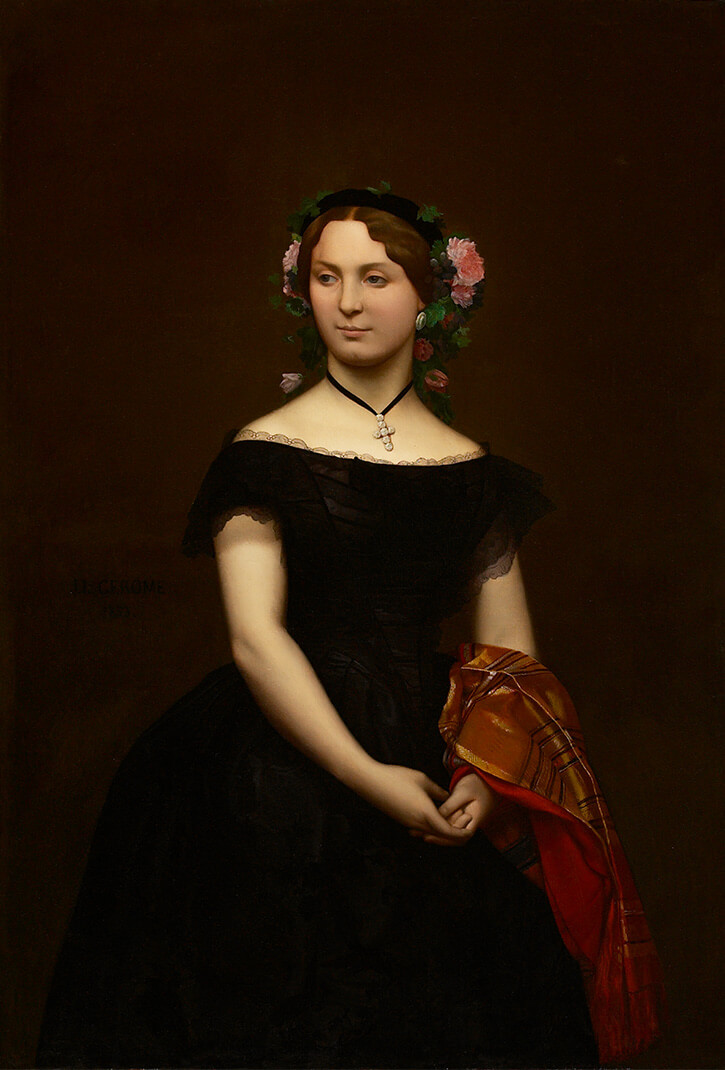
Portrait de Mlle Durand (Portrait of a Lady) 1853
Jean Léon Gerome (French 1824-1904)
oil on canvas, The Joey and Toby Tanenbaum Collection, 2002