A must-see exhibition at the Art Gallery of Hamilton is truly epic in scope.
Metamorphoses: Visions of Antiquity in the Modern Era invites visitors to journey through time as ancient, modern, and contemporary art come together in conversation. The exhibition—which is on view at the AGH until January 4, 2026—explores how artists have reimagined classical traditions over centuries.
For this article, we conducted a Q&A with Dr. Amy Wallace, guest curator of Metamorphoses, about how the exhibition came together and became such an overwhelming success.

Q. Could you please tell us about the inspiration behind Metamorphoses: Visions of Antiquity in the Modern Era? What led you to create this exhibition, and how long was the entire process?
A. The inspiration for this exhibition reaches back more than 2,000 years to Ovid’s Metamorphoses. The key takeaway of the Metamorphoses—that change is the essence of creation—offers a timeless lens through which to understand artistic practice. Taking up the poet’s vision, the exhibition brings together ancient, modern, and contemporary art to explore transformation as an enduring artistic impulse.
I began research for the exhibition in 2020 with assistance from Neve Sugars-Keen, an exceptional undergraduate student at Carleton University. That early research grew into a special-topics course that I designed and taught on Roman art and its legacies. The breadth of topics that students explored in their research was impressive and brought my thinking in new directions. While the majority of the curatorial work occurred over the past two years, the research and ideas were developing and transforming over the course of five years.
Q. For anyone who isn’t familiar with Ovid’s Metamorphoses, could you please tell us a little about what makes this epic work so special and inspiring?
A. The Metamorphoses is a collection of over 250 transformation stories from Greco-Roman mythology and history which Ovid ingeniously weaves into a single, continuous narrative. The result is nothing less than a mythological history of the world from the beginning of creation to the death of Julius Caesar in 44 BCE—one year before Ovid was born.
The Metamorphoses is widely considered to be Ovid’s greatest and most influential work. It has served for centuries as the primary sourcebook of Greco-Roman mythology for artists working within the classical tradition. Although it was written over 2,000 years ago, the poem’s wide-ranging exploration of transformation remains highly resonant today.
Q. Why do you think stories of classical myth are so timeless and continue to inspire artists to this day?
A. Classical myths grapple with enduring questions that continue to shape contemporary society. While the Metamorphoses is above all a meditation on the ubiquity of change, it also explores the complexities of power, injustice, identity, desire, and art. Engaging with these ancient stories provides a conduit, not only to the past, but also to self-discovery in the present.
At the same time, Greco-Roman myths often reflect antiquated views that conflict with contemporary values. Metamorphoses: Visions of Antiquity in the Modern Era considers how modern and contemporary artists have reacted against classical narratives and revivalism in Western art history. In doing so, the exhibition positions the classical tradition as both a source of inspiration and an ideal that artists have challenged across time.
Q. The exhibition includes a number of classical artworks, as well as many contemporary pieces. How did you go about choosing which works would be included?
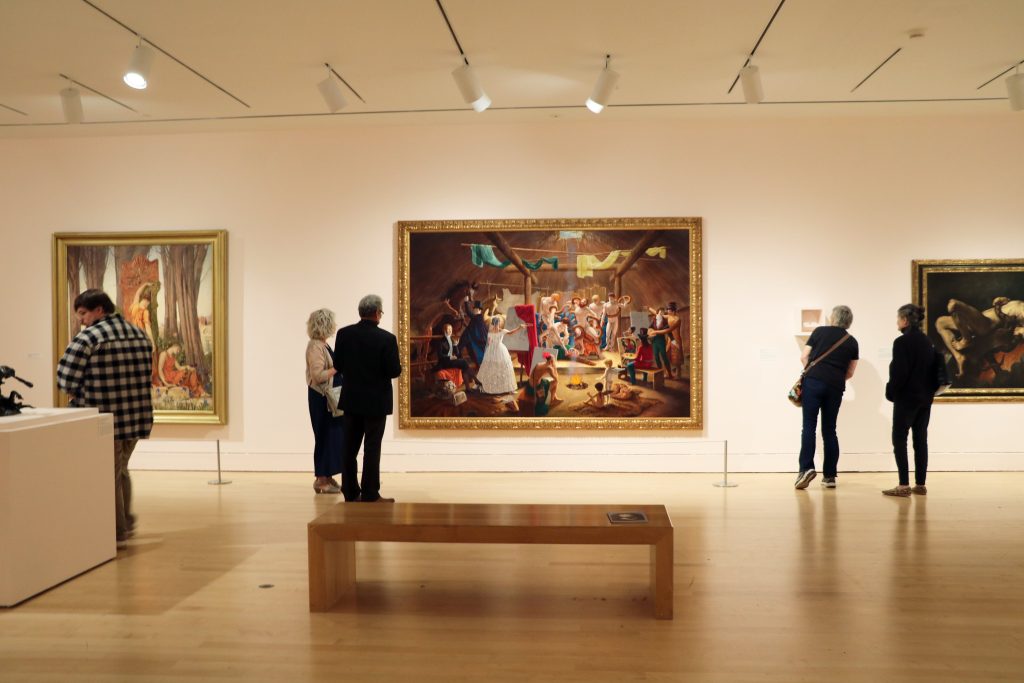
A. The majority of the works in the exhibition are drawn from the Art Gallery of Hamilton’s remarkable Tanenbaum Collection, which contains over 200 works of nineteenth-century European art. Among the Tanenbaum Collection’s many strengths are works from the classical tradition that reveal the enduring influence of ancient Greek and Roman aesthetic ideals on Western art.
From this starting point, we developed an exhibition that unites different points of view in order to reveal both the continuities and ruptures within the classical tradition. We identified loans in public and private collections that would spark conversations around broader themes like identity, gender, and power as they relate to the classical tradition. Throughout the exhibition planning process, striking the right balance between ancient, modern, and contemporary art in each space was a key curatorial consideration.
Q. What are some of your favourite artworks featured in the exhibition?
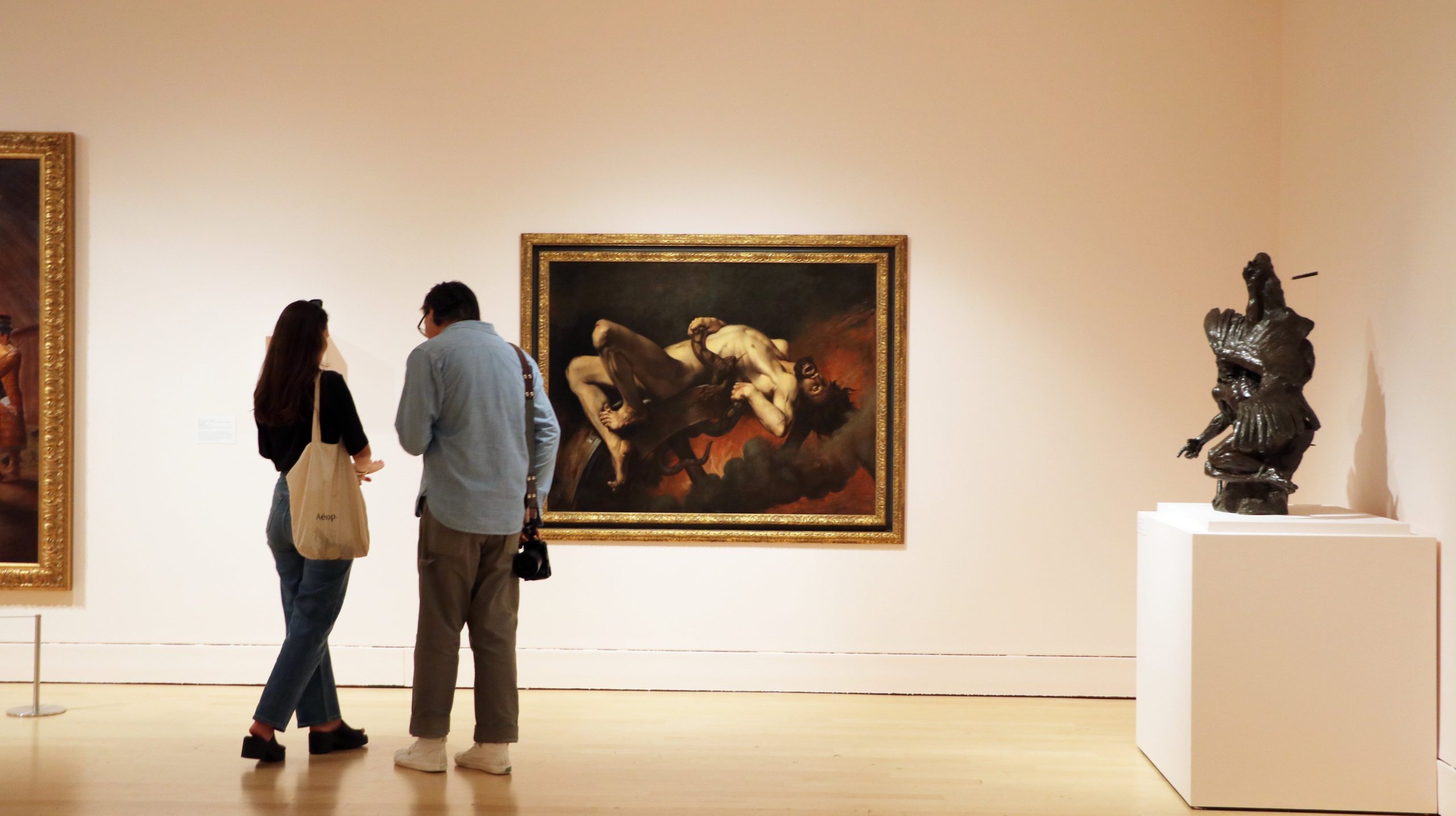
A. One of my favourite objects in the exhibition is an ancient wall plaque depictingMedusa (c. 100–1 BCE) on loan from the Royal Ontario Museum. This particular depiction shows Medusa smiling—a strong contrast to more grotesque portrayals of Medusa that predominate in later periods.
Ovid’s Metamorphoses describes the goddess Minerva’s transformation of Medusa into a snake-haired monster as divine punishment; her severed head is later used as a weapon by Perseus to turn his enemies to stone. Medusa’s story is violent and tragic, yet through her transformation, she becomes powerful. I like to think of Medusa as the quintessential artist-figure: she possesses the power to transform the world through her vision—the very essence of artistic creation.
An example of that transformative vision is on display in Esmaa Mohamoud’s Gluttony, Gluttony, Gluttony (2023), another one of my favourite artworks in the exhibition. The sculptural installation depicts three Black girls who initially appear to be carved from marble, a material associated with Neoclassicsm. However, the busts are actually composed of ethically sourced shea butter. Fifteen thousand handmade shea nuts surround the bases of the plinths, calling attention to the Western demand for shea butter and the exploitative labour practices that support the industry. The installation is a commentary on the environmental and human costs of North American consumption.
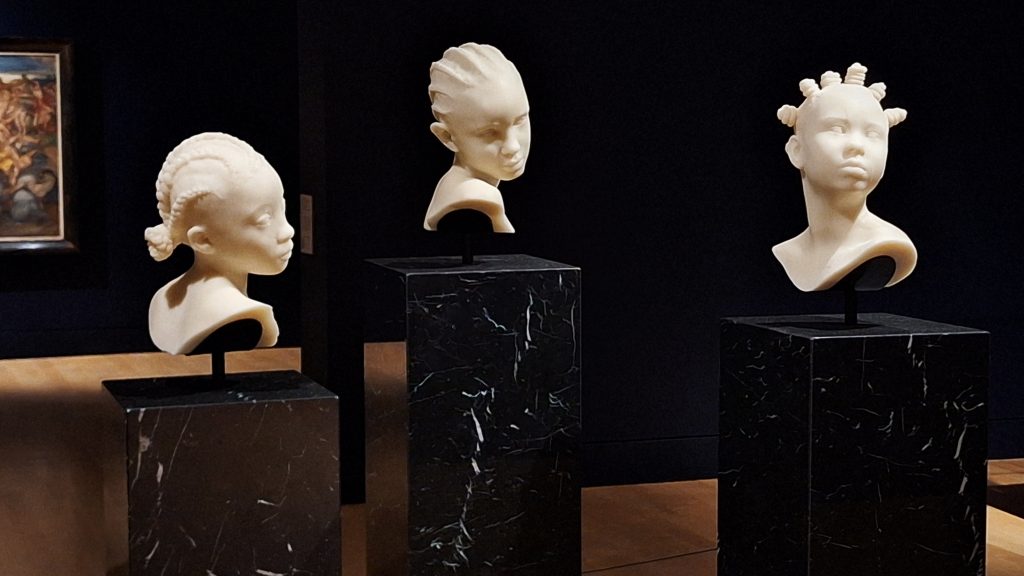
Gluttony, Gluttony, Gluttony exists in dialogue with other ground-breaking works from art history. The figural trio echoes French Realist Jean-François Millet’s The Gleaners (1857), a painting that casts a light on class inequality in France by depicting three female peasants gathering stray shafts of wheat. In contrast, Mohamoud’s workexposes the related systems of economic and racial inequality on a global scale. We are fortunate to have this important work on loan from a private collection.
Q. What has been the most fulfilling part of curating this exhibition?
A. It has been incredibly fulfilling to witness how the classical and post-classical works interact in the gallery spaces. While the majority of the aesthetic and conceptual linkages were planned, others emerged by chance once the objects came together.
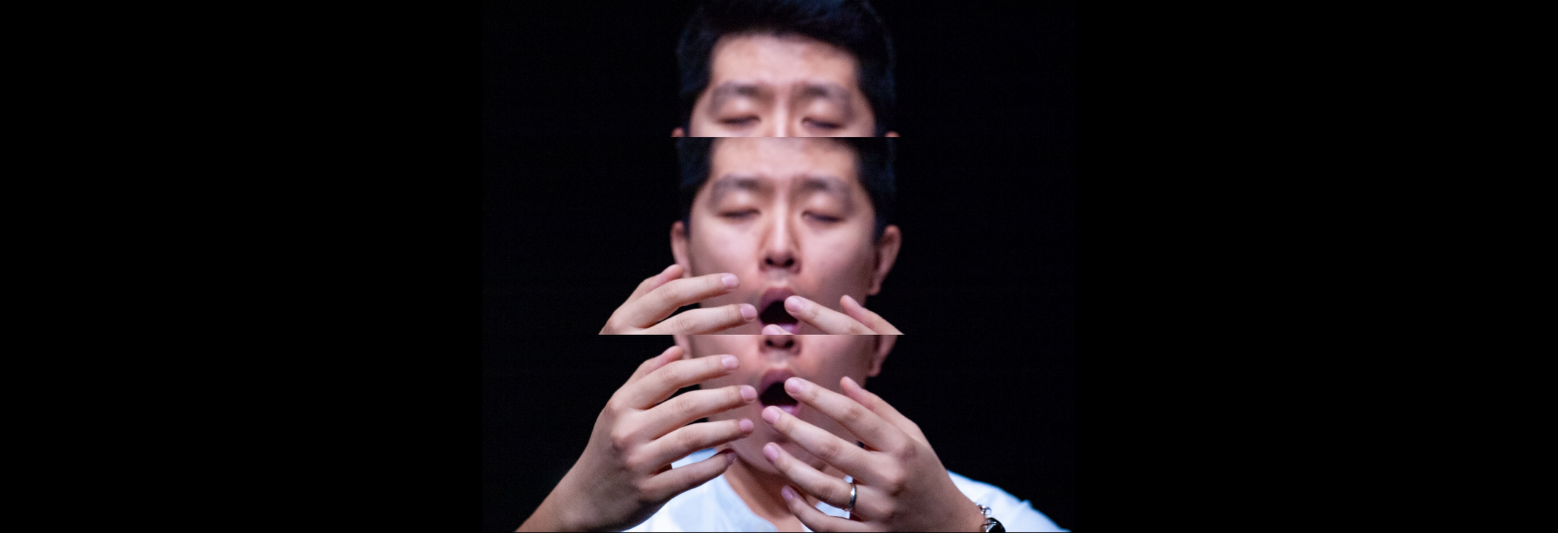
A powerful work in the exhibition is Cassils’ video installation entitled Tiresias (2013). In the Metamorphoses, Ovid recounts the story of Tiresias, who is transformed into a woman for seven years before being transformed back into a man. Cassils reinterprets this ancient story by using their body heat to melt an ice sculpture of an idealized male torso. The work evokes Tiresias’s bodily fluidity through melting ice and dripping water.
The video installation is shown in dialogue with ancient and modern works that feature figures from classical history and mythology, such as the god Apollo, the poet Sappho, and the legendary Amazons, whose stories of non-conformity to fixed notions of gender and sexuality embody queer and trans potential in the ancient world. Tiresias opened a space to interrogate the classical body and its association to gender, generating some of the richest connections between objects across time in the exhibition.
Q. What would you like visitors to come away with after experiencing Metamorphoses: Visions of Antiquity in the Modern Era?
A. One of the key ideas I hope visitors take away is an understanding of art as an ongoing process of transformation—of materials, experiences, and traditions. This definition is articulated by Ovid in the Metamorphoses, and it echoes throughout the exhibition.
Visitors may also leave with a deeper understanding of the classical tradition: not as a monolithic inheritance, but rather as a construct that has itself been transformed and reinterpreted by artists across time.
Ultimately, my hope is that visitors will find affinities between their own lives and the themes of transformation and renewal explored in the exhibition, creating an opportunity for self-discovery and mutual connection.
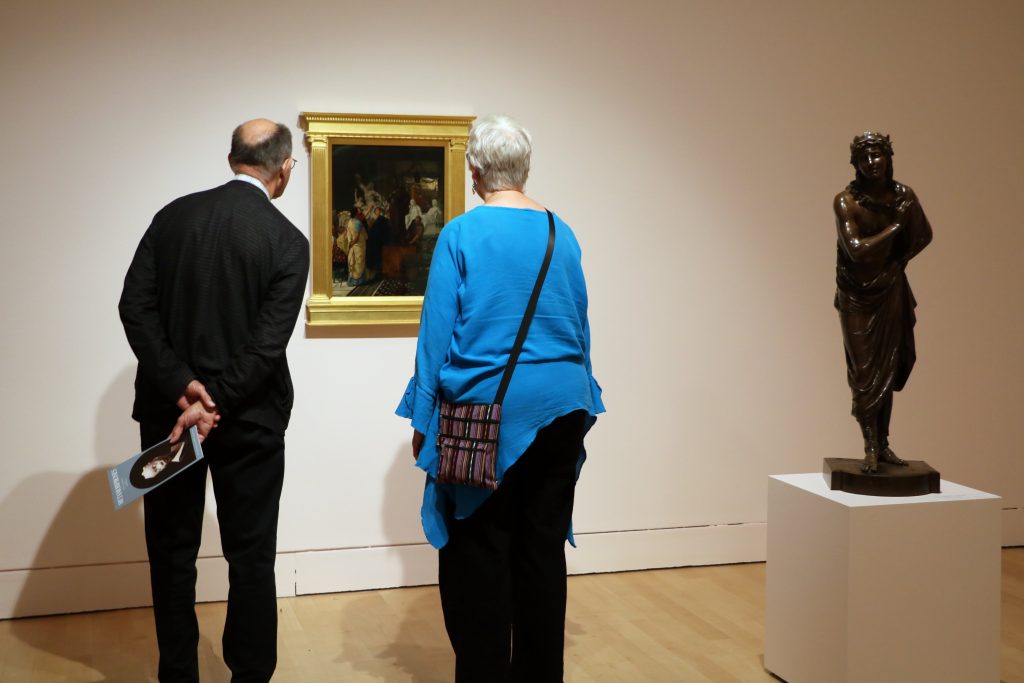
We invite everyone to visit the AGH and experience this special exhibition during its final days before it closes on January 4, 2026.
For more information about Metamorphoses: Visions of Antiquity in the Modern Era, please visit artgalleryofhamilton.com/metamorphoses.